
Maison Pfister in Colmar: What to See and How Long to Allow

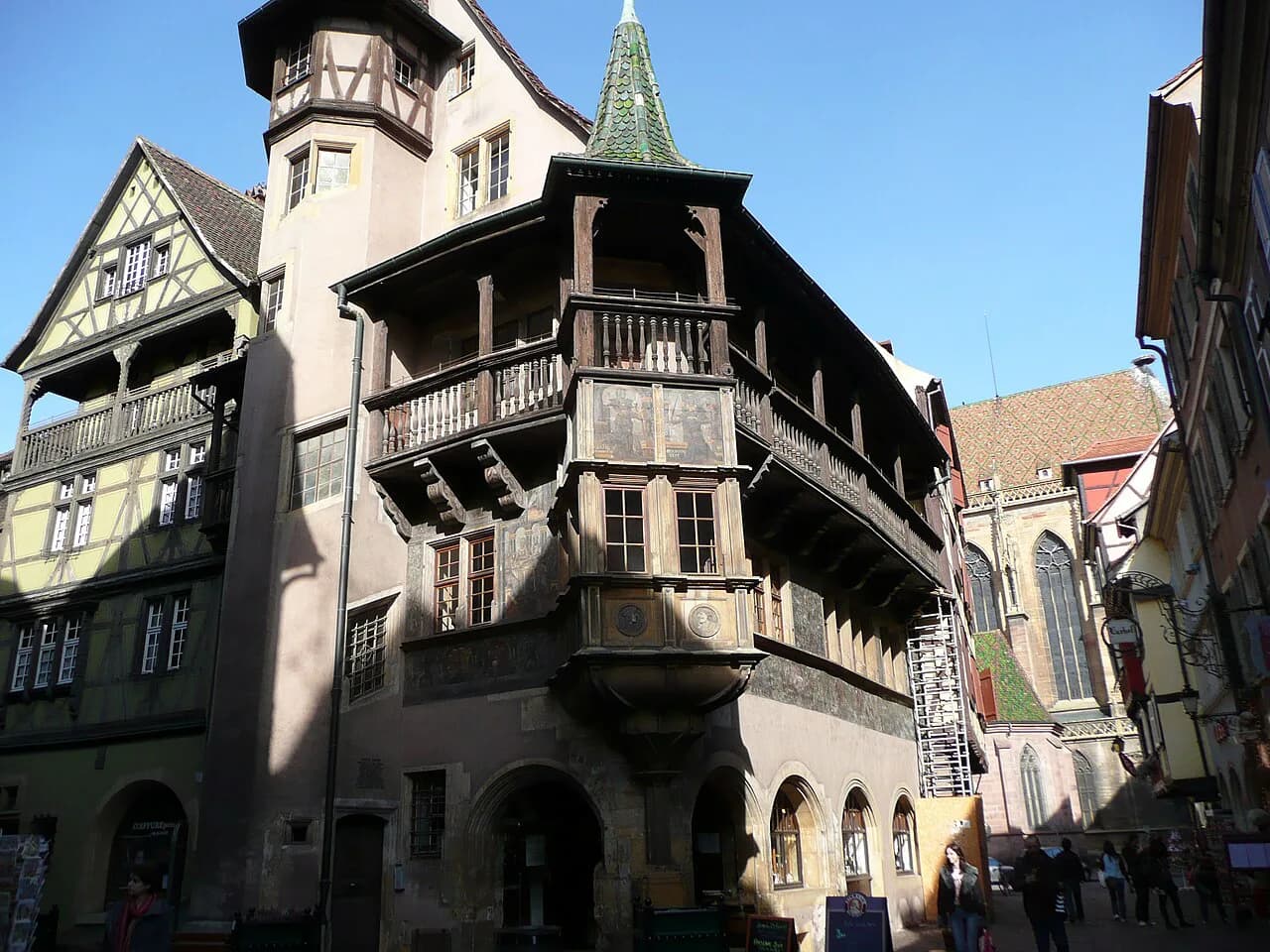
Maison Pfister is a short stop, not a museum: you look at the outside of a 16th-century merchants' house on rue des Marchands and move on. The reward is the façade, with its angled oriel, painted murals and long wooden gallery, which the Colmar tourist office singles out among the town's remarkable merchants' homes. Give it 10 to 15 minutes and build it into a walk through the pedestrian centre; for the wider set of sights, start with the Colmar Attractions guide.
What Maison Pfister is
The house sits in Colmar's historic centre, a compact area the tourist office describes as classed as a protected sector and restored over more than 20 years. It belongs to the same group of wealthy merchants' homes as the House of Heads and the Adolf house, which the tourist office calls the oldest in Colmar. Treat it as one piece of that ensemble rather than a standalone attraction.
Colmar itself is a town of roughly 70,000 people in the Upper Rhine, between the Vosges and the Rhine and within easy reach of Strasbourg and Mulhouse. That scale is why the centre is walkable and why a single house is worth a pause rather than a dedicated trip. If you are still deciding how to shape a break here, the broader Colmar Attractions: 6 Visitor Guides collection sets out the main sights.
Where Maison Pfister stands
The house is on rue des Marchands, in the pedestrianised old town and a short walk from the Collégiale St Martin. Coming from the station side, aim for the cathedral quarter first and use the church tower as your landmark; once in the pedestrian zone, signposts and the flow of visitors do most of the work.
The tourist office publishes a map of Colmar with a discovery tour, downloadable as a PDF, which is the simplest way to fix the house's position before you set out. Its own address is Place Unterlinden, the same square as the former convent that now holds the Unterlinden Museum, Colmar, so it works as a first stop if you want paper in hand.
What to look for on the façade
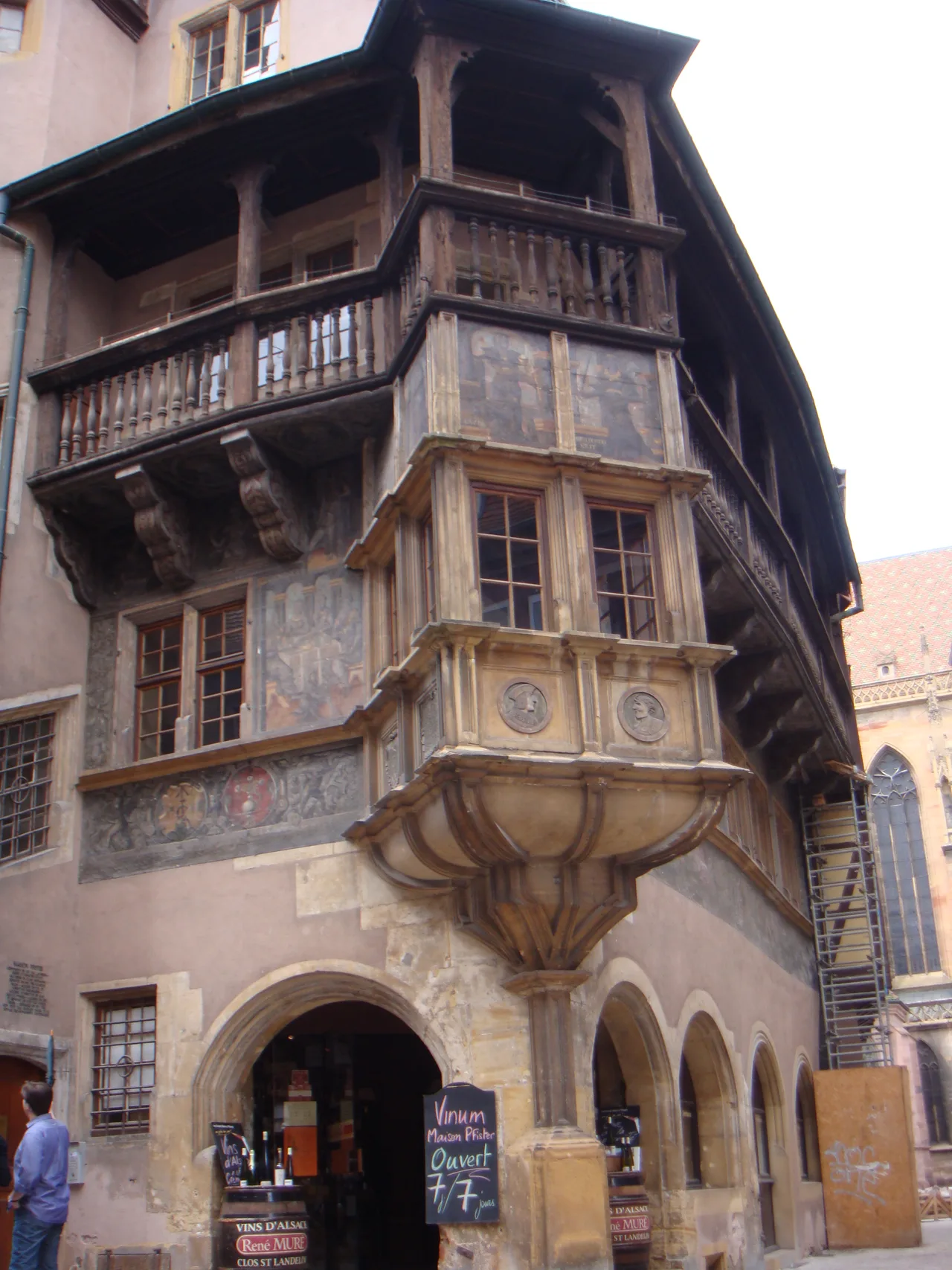
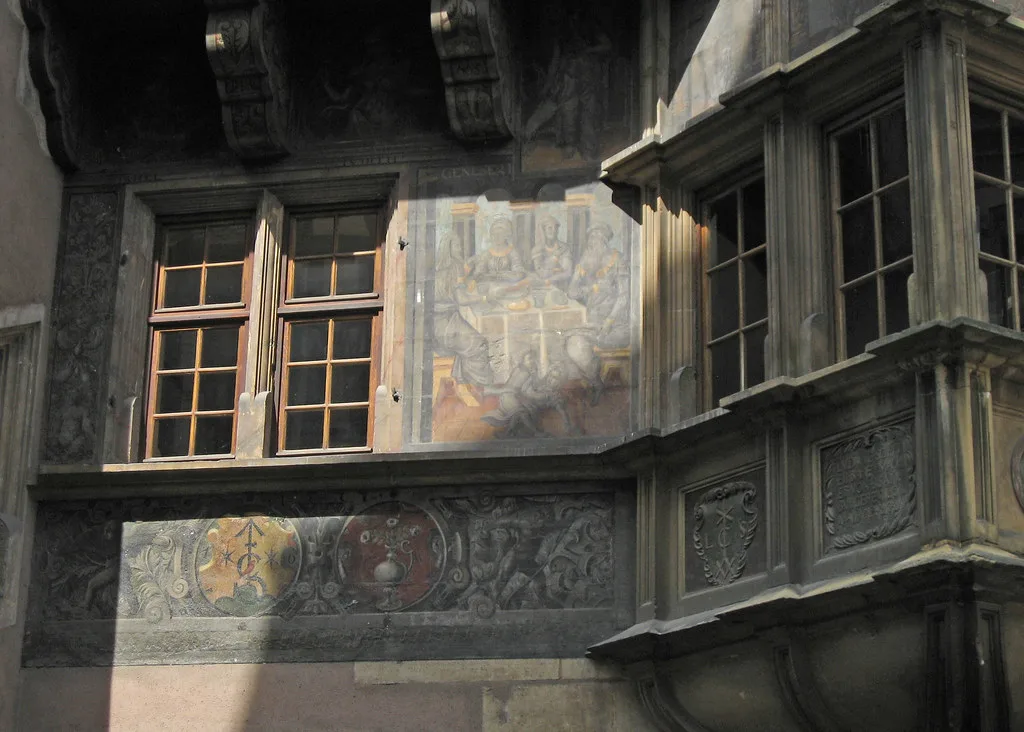
Start with the corner oriel, the projecting bay carried on carved supports, and the painted murals that run across the upper walls. Then step back for the long wooden gallery, which gives the house its distinctive horizontal band and is best appreciated from the far side of the street. The tourist office rates it among Colmar's finest merchant homes, alongside the 16th-century House of Heads and its 111 masks.
The building is usually described as Colmar's finest Renaissance house, built in 1537 with Burgundian and Italianate detailing. Take that date as reported history; the useful takeaway is that the decoration mixes German Renaissance forms with influences from further south.
Seeing it from the street
Plan on viewing the exterior only. Maison Pfister is a private building on a public street, and nothing published by the tourist office advertises interior visits, tours or admission, so do not build a morning around going in. Photography from the pavement is the point: morning light on the painted walls is easier to work with than the flat light of midday.
The street is narrow enough that a wide-angle lens helps, but the better view of the gallery is often a few steps back along the pavement rather than directly beneath it. Keep the stop short and let the pleasure come from looking properly rather than from ticking off a list.
Built in 1537: what the date tells you
The 1537 date places the house in the period when Colmar's merchant families were rebuilding in stone and timber and decorating their frontages as statements of standing. The Burgundian and Italianate touches reported in the detailing fit that pattern of local wealth borrowing from wider European fashion.
Colmar's centre preserves a run of buildings from the Middle Ages to the 18th century, which is why a single house rewards a second look: you can read the town's commercial history in its frontages. The tourist office covers the Adolf house, the House of Heads and the church on the same heritage pages.
How long to allow and where it fits
Budget 10 to 15 minutes at the house, plus the time it takes to walk there through the pedestrian centre. It works best as one stop on a circuit of the old town rather than a destination in its own right, and it sits naturally between the cathedral quarter and the canals. If you are weighing up which old-town stops deserve your time, the guide to things to do in Colmar covers the rest of the centre.
A sensible half-day runs from Place Unterlinden through the shopping streets to rue des Marchands, then on to Little Venice (La Petite Venise) and the Quartier des Tanneurs, whose white-fronted houses the tourist office flags as a photogenic stretch. Add the covered market only if you are passing in the morning. If you want to plan that canal-side half of the walk in more detail, the guide to things to do in Colmar fills in the rest of the old town.
Nearby sights to pair with it
The Maison des Têtes, with its three-storey oriel and 111 carved masks, is close enough to combine in the same walk, and the Collégiale St Martin is a few minutes further on. Both are exterior-first stops unless you are attending a service or an exhibition, so the pace stays brisk.
The covered market at 13 rue des Ecoles is a permanent terroir hall in a brick and metal building designed in 1865, with around 20 merchants selling fruit and vegetables, cheese, meat, fish, bread and pastry. It suits a lunchtime pause rather than a sight in itself.
For the canal-side views that define most Colmar photographs, walk south-east to little venice colmar, where the water and timbered houses draw the crowds. Go early or late in the day if you want the quays without company.
Finding it with the tourist office map
Download the tourist office's brochures before you travel: it publishes maps, a magazine and a discovery-tour route as PDFs, and it has cut back on printed runs in favour of downloads. Having the map on your phone saves hunting for a paper copy on arrival.
The tourist office sits on Place Unterlinden, and from 1 April to the end of November it opens Monday to Saturday from 9am to 6pm and Sunday from 9am to 1pm, with shorter public-holiday hours. Use it for the map and for current information on the town, then walk the route at your own pace.
Practical notes for your visit
There is no admission to arrange and no booking to make for the exterior, so the house slots into any free hour. Check with the tourist office for any change to access on the street itself, particularly during town events that close routes or fill the squares.
Colmar's centre is compact and flat, so a morning covering the church, the merchants' houses and the canals is realistic on foot. Wear shoes that cope with cobbles and keep the map handy for the tangle of one-way streets in the pedestrian zone.
Plan Your Visit
Maison Pfister earns a deliberate pause, not a half-day: look at the oriel, the murals and the gallery, then carry on to the Maison des Têtes and the canals. The Colmar attractions guide covers the rest of the old town so you can sequence the stops without doubling back.
Get the discovery-tour map from Place Unterlinden before you start, note the tourist office's seasonal hours, and leave the house as one short, well-lit stop on a longer walk. That is how a single Renaissance façade fits best into a weekend in Colmar.
Explore more Colmar guides
Frequently Asked Questions
What is the Maison Pfister in Colmar?
It is a 16th-century merchants' house on rue des Marchands in the pedestrian old town, built in 1537 and usually described as Colmar's finest Renaissance house. Visitors come for the exterior: an angled corner oriel, painted murals and a long wooden gallery that runs across the upper façade.
When was the Pfister House built?
The house is dated to 1537, and its detailing is reported as mixing Burgundian and Italianate influences with German Renaissance forms. Read the date as architectural history rather than something verified on a plaque at the door.
Can you go inside the Maison Pfister?
Plan on viewing it from the street. It is a private building, and the Colmar tourist office publishes nothing about interior visits, guided tours or admission for the house, so do not schedule a morning around going in. Ask at the tourist office on Place Unterlinden if you want to confirm the position on the day.
Where is the Pfister House in Colmar?
It stands on rue des Marchands in the pedestrianised centre, a short walk from the Collégiale St Martin. The simplest way to locate it is the tourist office's downloadable map of Colmar with its discovery tour, which you can carry on your phone.
What else is near the Pfister House?
The Maison des Têtes, with its three-storey oriel and 111 carved masks, and the Collégiale St Martin are both within the same walk, and the canals of Little Venice and the Quartier des Tanneurs lie a little further on. The covered market at 13 rue des Ecoles makes a good lunchtime stop with around 20 merchants.
How long do you need at the Pfister House?
Allow 10 to 15 minutes for the façade, plus walking time through the pedestrian streets. It works as one stop on a half-day circuit rather than a destination of its own, so slot it between the cathedral quarter and the canals.
Sources
- Colmar Alsace France Tourist Office - Discover Colmar Landing
- Colmar Alsace France Tourist Office - Demande de documentation EN
- Colmar Alsace France Tourist Office - Permanent terroir market - Market hall - Colmar
- Colmar Alsace France Tourist Office - Welcome
- Pfister House, built 1537, Colmar, France