
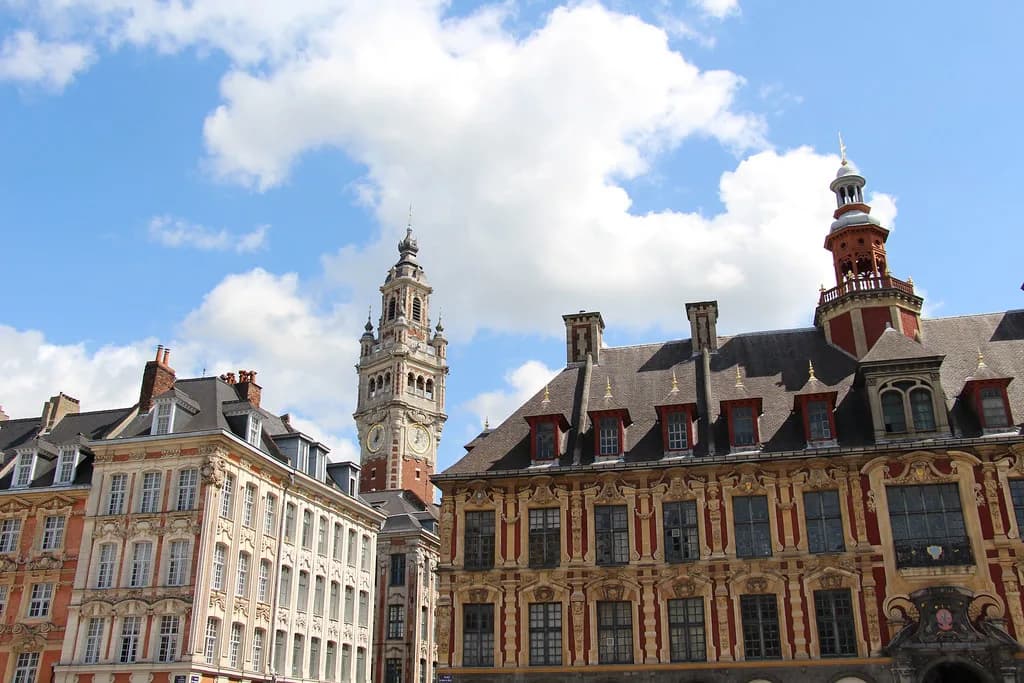
Grand'Place Lille (Place du Général de Gaulle): What to See
The Grand'Place is Lille's central square, and it carries two names: locals know it as the Grand'Place, while the official name is the place du Général de Gaulle, adopted in 1944 in honour of the politician born in the city. Both labels point to the same open space in the middle of the walkable centre, so there is no separate sight to hunt down.
Treat it as the anchor of a city break rather than a destination in itself. The square is the natural first stop when you arrive, because the buildings around it explain how Lille grew as a trading town and where the old town begins. Allow the square itself under an hour, then extend the visit into Vieux-Lille or towards one of the city's museums.
Where the Grand'Place is and how to reach it
The square sits in the heart of Lille, with the Vieille Bourse on its northern side and the shopping streets running off towards the station. If you arrive at Lille-Flandres, the walk into the centre brings you to the square in a few minutes, and the route passes the Place du Théâtre before the Grand'Place opens out. Coming by Eurostar from London or by TGV from Paris puts you at the same starting point, and the last stretch is on foot.
Arriving from Vieux-Lille, the rue de la Monnaie brings you into the old town's shopping lanes before you reach the square, so the two areas join naturally on one loop. Recent improvement works have favoured pedestrian routes across the square, which makes the crossing on foot straightforward, though the surrounding streets still carry city traffic. Plan the square as a walking stop rather than a place you need transport to reach.
Reading the square: Flemish gables and French classicism
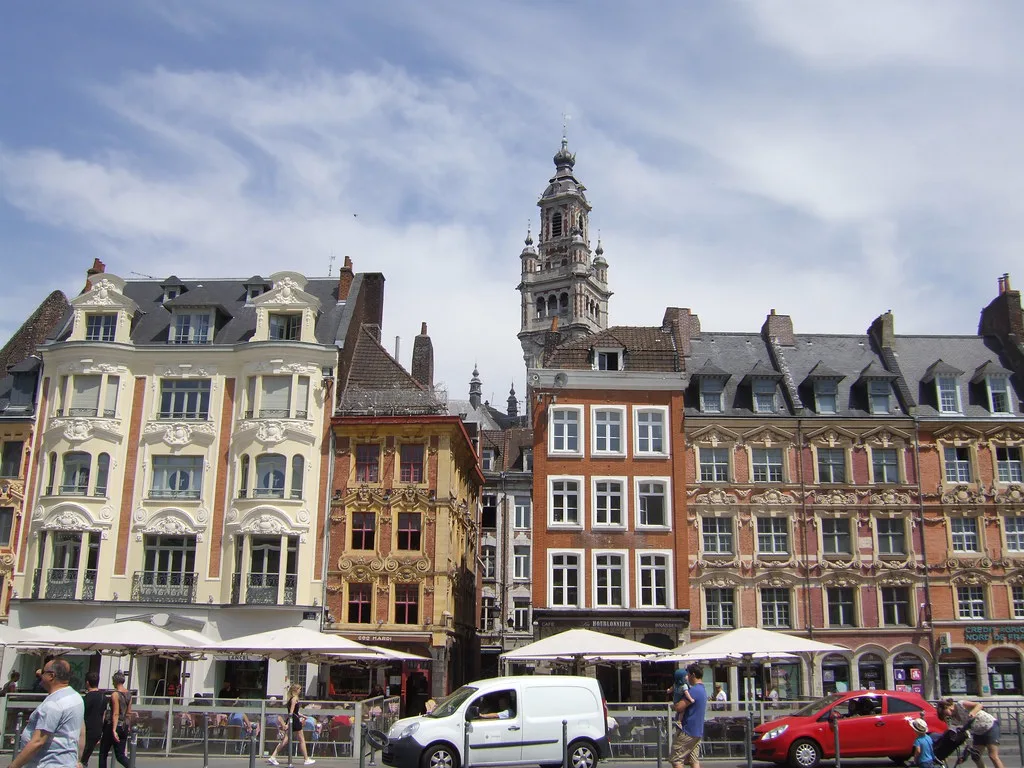
The Grand'Place holds two architectural languages side by side. The gabled houses around the square carry the ornament of Flemish trading wealth, while the buildings added after Lille was attached to France in 1667 take a more restrained, classical French tone. That contrast is the reason to look up rather than simply cross the square: the two styles sit within a few paces of each other.
The square began as a market space and took its present shape over centuries, with the exchange building eventually separating the Grand'Place from the smaller Petite Place, now the place du Théâtre. Streets were later driven through to connect the square with Vieux-Lille and the station, which is why the layout feels open and easy to navigate today. Walk the perimeter once before choosing where to stop.
The Vieille Bourse: the former exchange and its courtyard
The Vieille Bourse is the square's best-known building, a former commercial exchange designed by Julien Destrez and built after the city's merchants won permission to erect it in 1651. Its façade mixes local decorative motifs with classical forms, and it sits on the north side of the square, which makes it the obvious first stop. Look at the carving before you go through the entrance.
Stepping into the courtyard takes you away from the noise of the square into a contained, quieter space where booksellers set out their stock. It is a short pause rather than a sight that needs scheduling, and it works well as a breather between the terrace and the old town lanes. The square's travel coverage describes the courtyard as a bookish, beautifully contained place, and that is the right way to approach it.
The Théâtre du Nord in the former Grand-Garde
On the square, the Théâtre du Nord occupies the building known as the Grand-Garde, redesigned by Thomas-Joseph Gombert with a deliberately austere French decorative scheme after the city became French in 1667. It is the clearest single example of the classical layer on the square, and it rewards a close look at the façade rather than a glance from the middle of the paving. Read it against the Flemish houses opposite to see the change in taste.
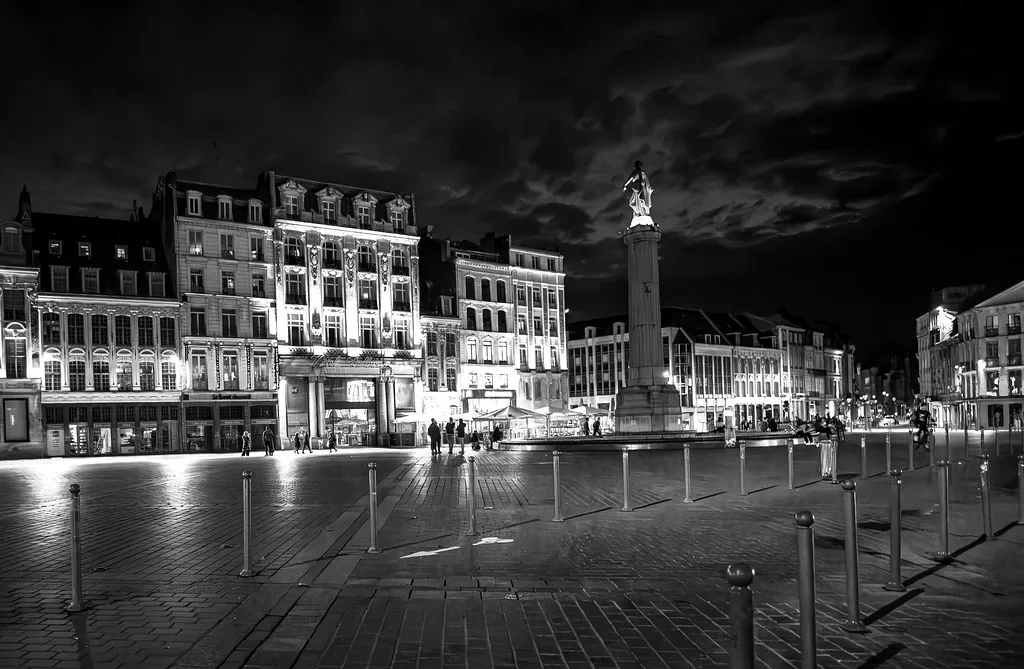
The Déesse statue and the square's market origins
The statue of the Déesse was added to the square in 1845, part of the nineteenth-century embellishment that also brought new streets and a shopping gallery connecting the Grand'Place to the rest of the centre. It is a small feature by comparison with the Bourse, but it marks the point where the square turned from a working market into a civic space. The square had hosted a grain market from the fourteenth century, after marshy ground was drained.
How long to allow and the best order to walk it
Give the square itself under an hour: a circuit of the façades, a few minutes inside the Vieille Bourse courtyard, and a proper look at the Théâtre du Nord. Add a coffee on a terrace and the stop stretches comfortably to an hour and a half. The square works best at the start of a morning, before you commit the rest of the day elsewhere.
A sensible order starts at the square, moves through the courtyard and then heads into Vieux-Lille along the rue de la Monnaie, which puts the shopping lanes and side streets at the end of the walk. If you want a museum on the same day, put it either side of this loop rather than in the middle, since the old town invites slow wandering. From the central cluster you can reach the Palais des Beaux-Arts de Lille or the Lille Belfry on foot or with a short tram or metro ride.
Coffee, lunch and regional food around the square
Terrace tables line the Grand'Place, which makes it an easy place for a drink while you watch the light move across the façades. For a proper meal, the old town around the square is where you look for estaminets serving Flemish dishes, along with waffles and the merveilleux meringue pastries sold at Aux Merveilleux de Fred. Pick a table off the square itself if you want quieter surroundings.
Menus on the square serve its position as much as the food, so read a terrace board before sitting down and see whether it suits the meal you have in mind. The square is a good coffee stop, and the old town lanes just behind it give you more choice at lunch.
Nearby in five minutes: Place du Théâtre, rue de la Monnaie and Vieux-Lille
The place du Théâtre sits immediately beside the Grand'Place, separated from it by the Bourse, and it opens the way towards the shopping streets around the rue Nationale and rue Faidherbe. Continue west and you reach the rue de la Monnaie, the classic entry into Vieux-Lille's cobbled lanes, brick façades and small boutiques. This is the natural extension of a Grand'Place visit, and it needs no planning beyond comfortable shoes.
Two other sights sit within reasonable walking distance of the square. The Cathédrale Notre-Dame-de-la-Treille is in Vieux-Lille, and the Citadelle de Lille, Vauban's seventeenth-century fortress with its surrounding parkland and canals, is further west, best treated as a separate afternoon rather than a detour from the square.
Practical points: crowds, the layout and the Braderie weekend
The square is pedestrian-friendly rather than fully closed to traffic, and it becomes busy at weekends and during major events. The Braderie de Lille, the annual flea market held over a weekend in early autumn, transforms the city centre with stalls and crowds, so treat any visit that coincides with it as a different kind of day out. Outside those dates, the square is a calm place to start a morning.
Late spring to early autumn gives the best odds of mild weather for terraces and walking, though the square and its neighbours stay open to visitors year-round. Wear shoes you can stand and walk in, because the appeal of the area is in the wandering rather than in a single viewpoint. Keep your bearings by using the Bourse as the fixed point on the square.
Where to check current details before you go
Opening arrangements for the Vieille Bourse, the Théâtre du Nord's programme and any events on the square change through the year, so confirm them with the venue or the city's tourist office before you set out. The same applies to market activity and shop hours in the surrounding streets, which vary by day. Build the square into your route first and fix the timings afterwards.
Making the Grand'Place Work in a Lille Weekend
The Grand'Place earns its place as the start of a Lille weekend because it does several jobs at once: it explains the city's Flemish and French layers, it holds the Vieille Bourse courtyard, and it puts you at the edge of Vieux-Lille. Give it an hour, take the courtyard slowly, then follow the rue de la Monnaie into the old town.
Pair it with one museum rather than three, and keep the rest of the day for walking and eating. The Palais des Beaux-Arts de Lille and the cathedral make sensible companions, and the wider set of Lille Attractions: 6 Visitor Guides helps you choose between them.
Explore more Lille guides
Frequently Asked Questions
Is the Grand'Place the same as Place du Général de Gaulle?
Yes. The square in the centre of Lille is known locally as the Grand'Place and officially as the place du Général de Gaulle, a name it took in 1944 in honour of the general born in the city. Guides and maps use both names, so search either and you will arrive at the same place.
What is there to see on the Grand'Place in Lille?
Three features justify the stop: the Vieille Bourse, a former exchange from the mid-seventeenth century with a courtyard used by booksellers; the Théâtre du Nord in the former Grand-Garde, with its austere classical façade; and the Déesse statue added in 1845. Around them, the gabled houses show the Flemish style that predates the French classical additions.
Can you go inside the Vieille Bourse?
The courtyard is the part visitors step into, and it holds booksellers' stalls in a quiet space away from the square. Access arrangements vary, so check current details with the venue or the tourist office.
How long do you need at the Grand'Place?
Under an hour covers the façades, the courtyard and the Théâtre du Nord. With a terrace coffee, allow an hour and a half. Most visitors then continue into Vieux-Lille, which adds another hour or more depending on how much they linger.
What is nearby the Grand'Place?
The place du Théâtre sits directly beside the square, and the rue de la Monnaie leads from the centre into Vieux-Lille. The Cathédrale Notre-Dame-de-la-Treille is in the old town, while the Citadelle de Lille, Vauban's fortress with its park and canals, is further west and better treated as a separate outing.
Is the Grand'Place pedestrianised?
Recent works have favoured pedestrian routes across the square, so walking it is straightforward. It is not a fully closed space, and surrounding streets carry city traffic, so watch for vehicles at the edges.