
Basilica of Notre-Dame du Port: Clermont-Ferrand's Romanesque Church
The Basilica of Notre-Dame du Port is Clermont-Ferrand's Romanesque counterweight to its black Gothic cathedral: a blonde arkose church in the old Port quarter, free to enter and open every day. If you have a spare hour in the city, this is the single interior most worth folding into a short break.
What the Basilica of Notre-Dame du Port is
Notre-Dame du Port is a former collegiate church built in the first third of the twelfth century in blonde arkose, the region's characteristic stone. It is counted a masterpiece of Auvergne Romanesque, and it forms part of the UNESCO World Heritage listing of the Routes of Santiago de Compostela in France. Come expecting a working church rather than a museum set piece: the architecture, carvings and furnishings are the whole show.
The listing matters for how you read the building. As a stop on the Compostela routes, it was designed to move pilgrims through wide aisles and an ambulatory around the choir, so the plan is more generous and circulation-minded than a simple parish church. Knowing that, the radiating chapels and the walk-around behind the altar make sense rather than feeling like decoration.
Where it is in Clermont-Ferrand
The basilica stands on Rue du Port in the Port district, east of the old town centre and away from the cathedral's lava-stone silhouette on the hill. The name comes from the Latin portus, a market or trading place, which tells you the quarter grew up around commerce rather than as a ceremonial set piece. For a short break, that puts it on a natural eastward loop rather than on the main central axis.
Practically, treat the Port quarter as its own half-day rather than something you tack onto a cathedral visit. If you are mapping a wider weekend, the Clermont-Ferrand Attractions: 6 Visitor Guides give you the other sights to slot around it, including the Cathédrale Notre-Dame-de-l'Assomption. Walking between the two takes a manageable chunk of a morning if you keep the pace easy.
Opening hours and entry
The basilica is open every day of the year from 9.00 to 18.00, and entry is free. That removes the main planning friction: no ticket, no timed slot, no booking decision. It also means the visit can flex around weather, a late lunch or a museum that has overrun.
Because there is nothing to book, the only thing worth checking before you travel is whether the church is closed for a service or a one-off event on your dates. The parish publishes its own notices separately from the tourism board, so a quick look at the parish site the week you go is the sensible move. Otherwise, turn up and walk in.
How long to allow, and when to go
Give the basilica 45 minutes to an hour if you want to read the carvings and find the furnishings, or 20 minutes for a straight architectural look. It is a single nave-and-ambulatory building, so there is no long route to walk; the time goes on looking, not covering ground. Pair it with a coffee in the quarter rather than trying to stretch it into a half-day on its own.
The exterior to look at first
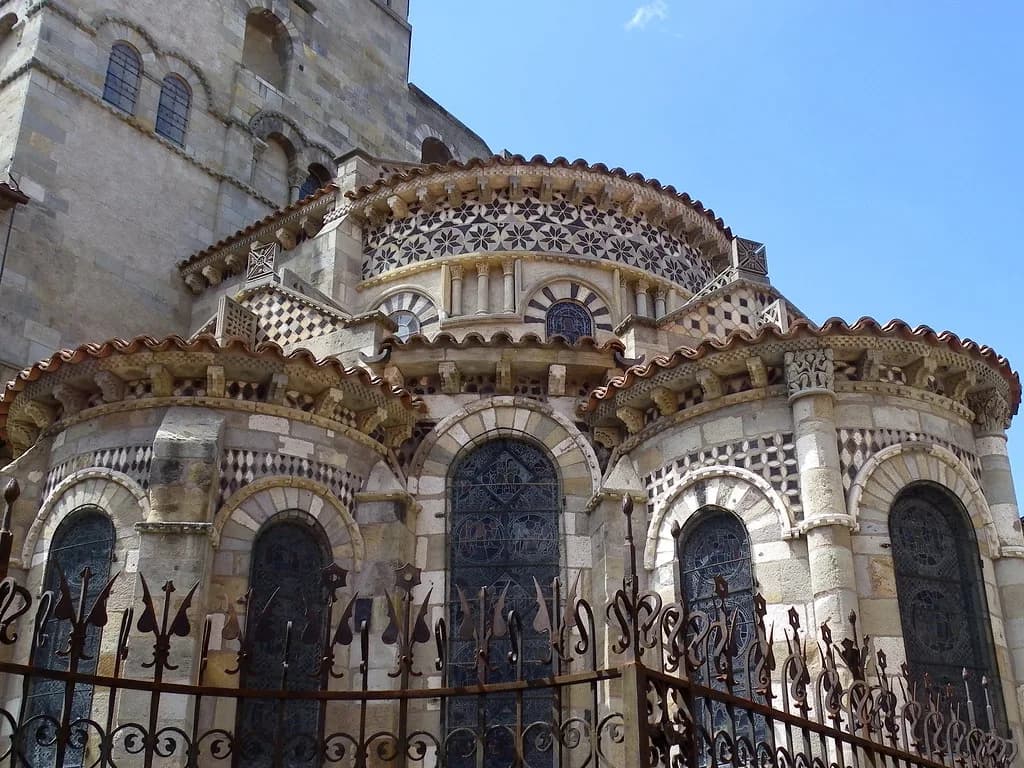
Start outside. The octagonal bell tower is the silhouette you will recognise from across the quarter, and the raised chevet at the east end is where the building shows off: half-round arches, fine carving and the pyramidal roofline over the apse. The south portal carries a carved programme worth a few minutes before you go in.
Auvergne Romanesque detail to hunt for
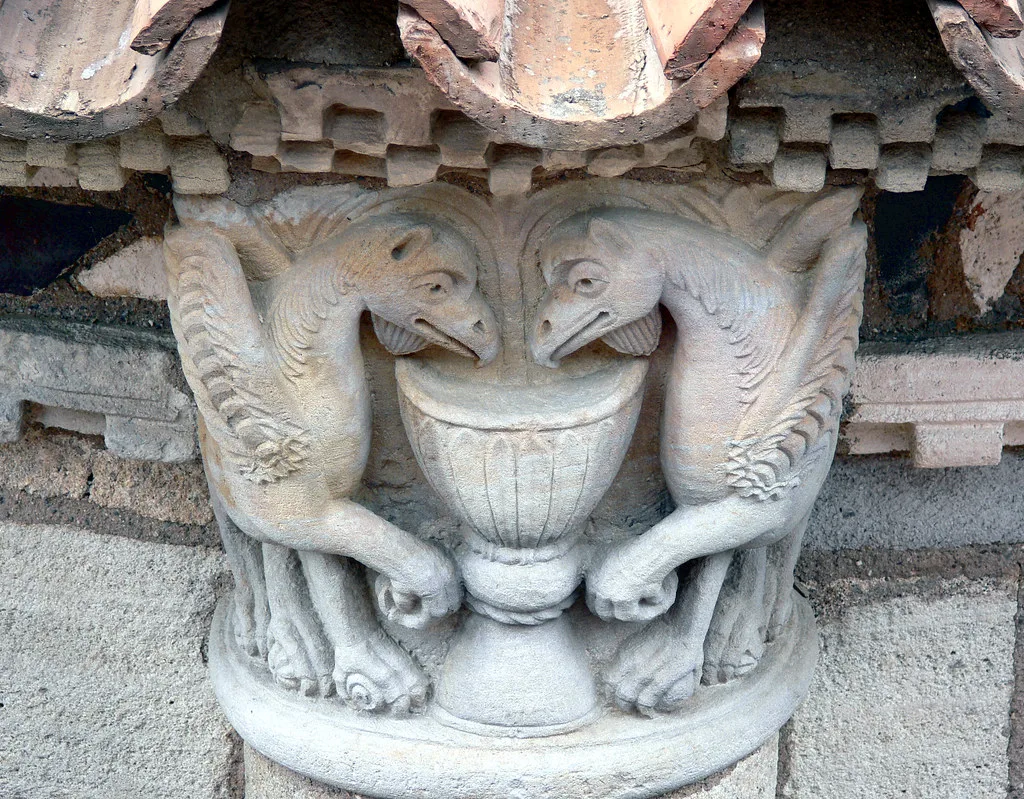
The apse is decorated with mosaics of lava stone, a dark inlay against the pale arkose that gives the east end its pattern. In the choir, look for the four historiated capitals, carved with figures rather than left as plain blocks. These are the details that separate a quick look from a proper visit, and they are easy to miss if you keep your eyes at head height.
Inside: nave, aisles and ambulatory
The interior is a barrel-vaulted nave flanked by two side aisles with large arcades and tribunes above them, leading to a choir ringed by an ambulatory and radiating chapels. The 2008 restoration, completed in December of that year, whitewashed the volumes and brought back a sense of unity to the space, and the nineteenth-century stained glass now reads clearly against it. Do not expect gloom: this is a bright interior, and that changes how you photograph and how long you linger.
The Black Madonna in the crypt
The devotion that has kept this church at the centre of Clermont life is to the Black Madonna, kept in the crypt since 1614. The figure is the reason the building has always mattered to the city, not just to architectural historians. Find the crypt before you leave, and treat it as the quietest part of the visit rather than a tick-box.
Furnishings worth seeking out
Centuries of donations have left the church with a rich set of furnishings, including paintings by masters and sculpture. Two pieces are singled out: a delicate Vierge allaitant from the fourteenth or fifteenth century, and an Annunciation attributed to Philippe de Champaigne. Look for them as you move through the chapels, and let them slow you down rather than racing the nave.
Accessibility and practical points
The tourism board lists the basilica as accessible to wheelchair users without assistance, with door widths over 77 cm and a slope above 5% that is nonetheless manageable. Documentation is available in braille, and simple French documentation is provided, along with seating. If you need a specific arrangement, such as an audio description, the listing notes that supporting tools are available on site.
Nearby in the Port quarter
The Maison du Tourisme on Place de la Victoire is the practical stop for the Parcours du Port heritage route, which walks you through the quarter around the basilica. That makes a good pairing: see the church, then pick up the route and let it take you through the surrounding streets. It is a natural way to spend the rest of a morning without adding another museum.
If you want more of the city in the same day, Place de Jaude, Clermont-Ferrand is the obvious central anchor for lunch and orientation, and the Musée d'Art Roger-Quilliot, Clermont-Ferrand suits a slower afternoon if the weather turns. Both work as separate stops rather than extensions of the basilica itself.
Honest verdict: should you prioritise it?
Yes, if you have any interest in Romanesque architecture or in how a pilgrimage church actually works. The cathedral gives you the dramatic black-lava silhouette and the Gothic verticality; Notre-Dame du Port gives you the warm stone, the carved capitals and the pilgrim plan. On a short break, see both, and do this one first if you want the contrast to land. If you are weighing up another city for a similar short break, our Lyon city guide covers the same decision at a very different scale.
If you are in Clermont-Ferrand with only a few hours and no particular interest in churches, the free entry and central-ish location make it an easy yes anyway, since it costs you nothing but an hour. For a full picture of what else fills a weekend, use the clermont ferrand guide and build the rest of the day around the Port quarter rather than the cathedral hill.
Plan Your Visit
The basilica asks almost nothing of you: no ticket, no booking, open daily from 9.00 to 18.00. That makes it one of the easiest high-value stops in Clermont-Ferrand, and an obvious anchor for a morning in the Port quarter. Check the parish notices for any service closures before you set out, then give it an hour and let the details do the work.
Explore more Clermont-Ferrand guides
Frequently Asked Questions
Is the Basilica of Notre-Dame du Port free to visit?
Yes. Entry is free, and there is no ticket to buy or timed slot to book, so you can walk in during opening hours.
What are the opening hours of Notre-Dame du Port in Clermont-Ferrand?
The basilica is open every day from 9.00 to 18.00 throughout the year. Check the parish's own notices before travelling in case a service or event closes it on your dates.
How long does it take to visit Notre-Dame du Port?
Allow 45 minutes to an hour to read the carvings, find the Black Madonna in the crypt and look at the furnishings. A quick architectural look takes about 20 minutes.
What is there to see inside the Basilica of Notre-Dame du Port?
Look for the barrel-vaulted nave and tribunes, the ambulatory with radiating chapels, the four historiated capitals in the choir, the fourteenth- or fifteenth-century Vierge allaitant and the Annunciation attributed to Philippe de Champaigne.
Where is the Black Madonna kept?
The Black Madonna is kept in the crypt and has been venerated there since 1614. It is the quietest part of the visit and easy to miss if you stay in the nave.
Is Notre-Dame du Port a UNESCO World Heritage Site?
Yes. It forms part of the UNESCO listing of the Routes of Santiago de Compostela in France, which is why its aisles and ambulatory are designed for moving pilgrims through the church.
Is the basilica accessible for wheelchair users?
The tourism board lists it as accessible without assistance, with door widths over 77 cm and a manageable slope above 5%. Braille documentation and simple French documentation are available on site.