
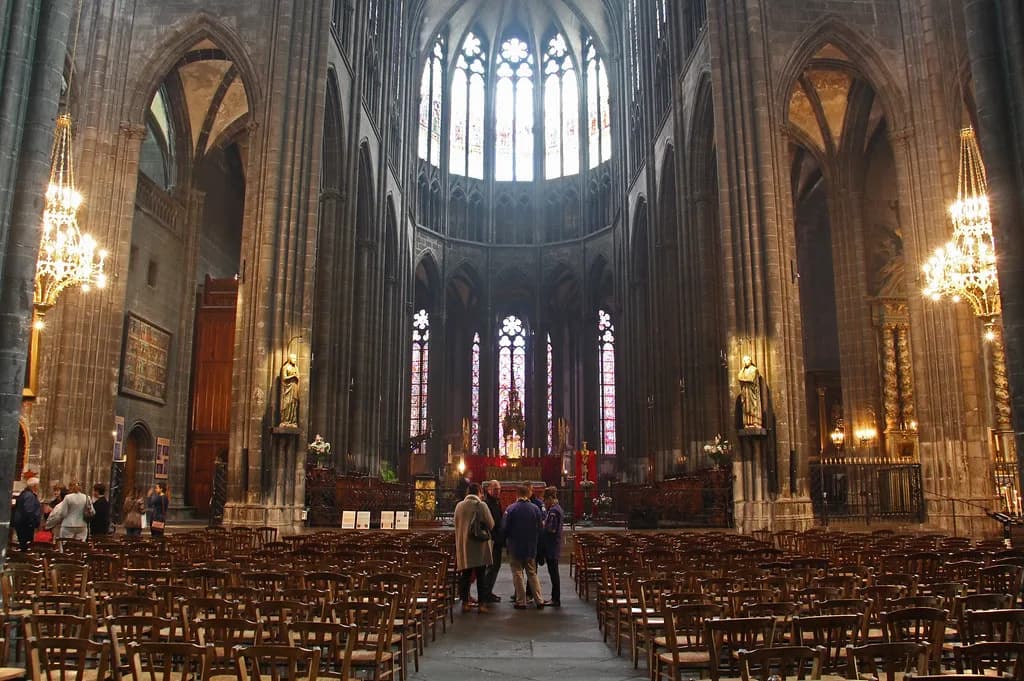
Clermont-Ferrand Cathedral: What to See Inside the Black Cathedral
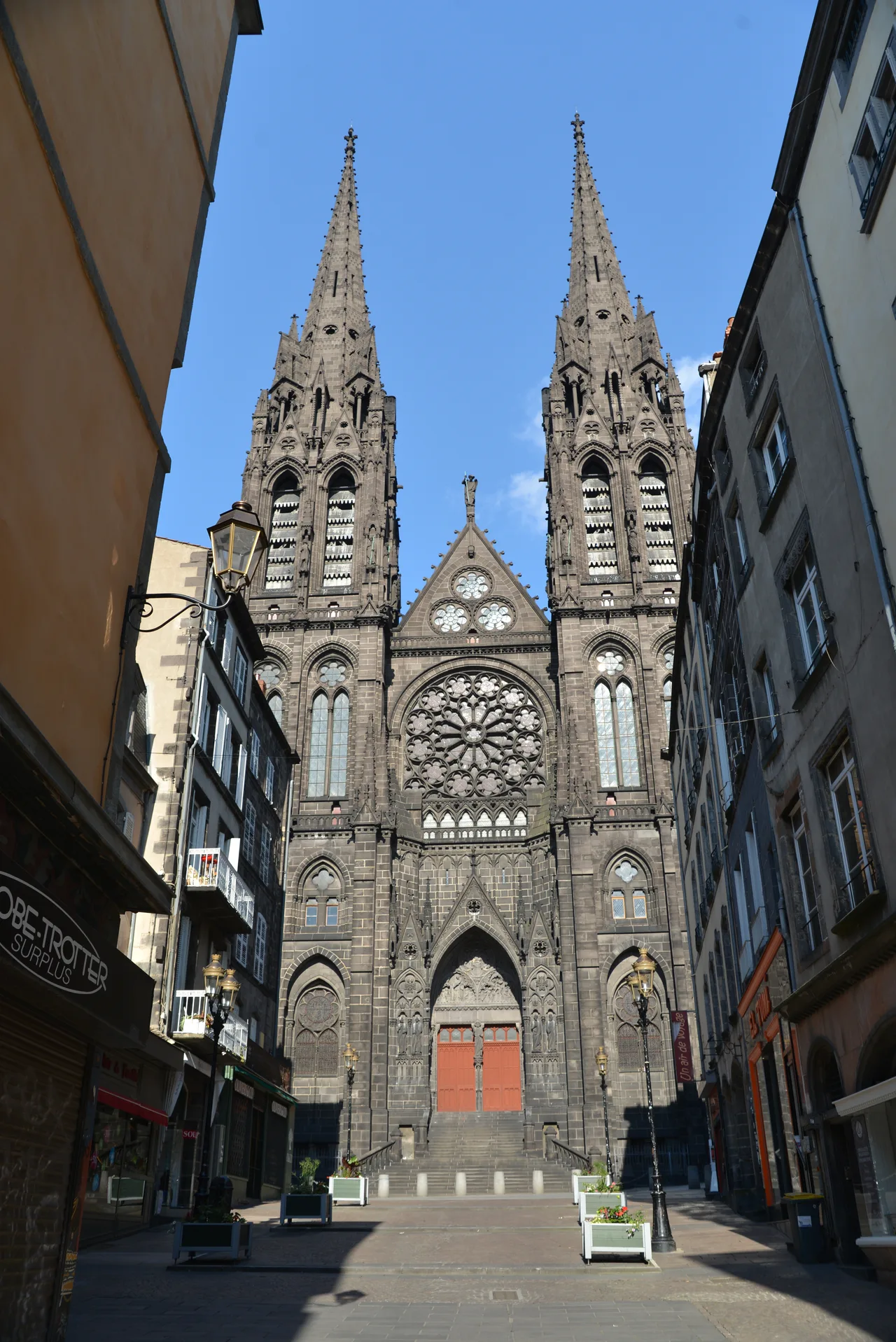
Clermont-Ferrand Cathedral, the Cathédrale Notre-Dame-de-l'Assomption, is the black cathedral at the centre of the old town, built from dark volcanic rock that gives the surrounding streets their nickname, the ville noire. It holds three rose windows, a set of story windows with about 400 medallions, and a west front with twin spires that was completed in 1902, not in the Middle Ages.
This page sticks to the one building: where it sits, how to reach it, what deserves your time inside, and how long to allow. It works as a focused stop of roughly an hour, or considerably longer if you plan to read the glass properly.
Clermont-Ferrand Cathedral in brief: Notre-Dame-de-l'Assomption, the black cathedral of the ville noire
The cathedral stands in Clermont, the historic episcopal half of what became Clermont-Ferrand, and is dedicated to Our Lady of the Assumption. Construction began in 1248 and the building was consecrated in 1359, though the west facade was left unfinished at that point.
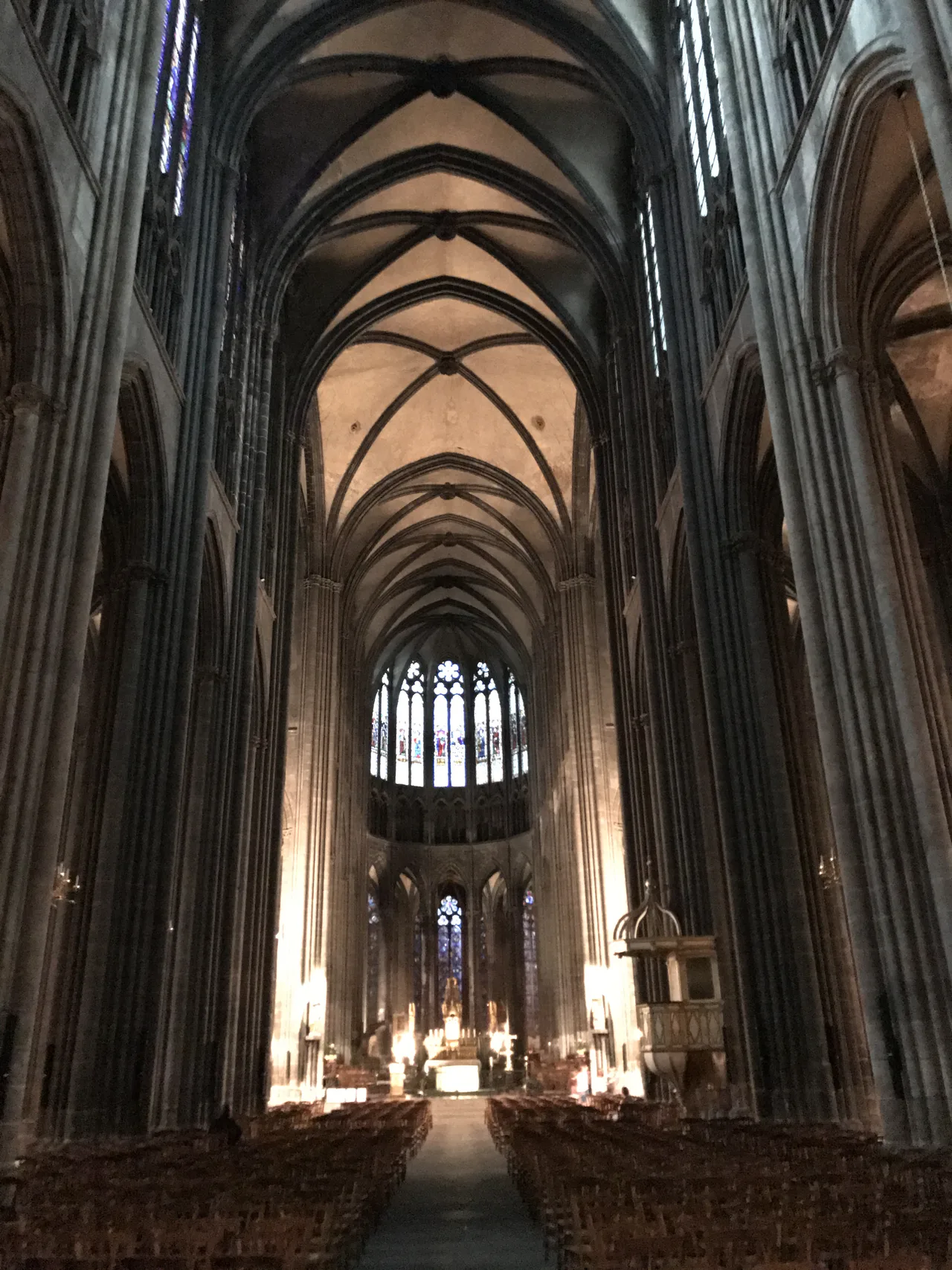
Its dimensions give a sense of scale before you arrive: 92 metres long, with the western spires reaching 96.2 metres and the Tour de la Bayette bell tower standing at 50.7 metres. The nave rises to 28.7 metres at the transept crossing, which is why the upper windows are hard to read from floor level.
Clermont and Montferrand were separate towns until royal decrees joined them, which is why the old centre still feels like two settlements stitched together. The cathedral belongs firmly to the Clermont half, on the rise of the old town.
Where it is: the historic centre of Clermont, the steep climb to the west door
The cathedral sits in the heart of the old town, with a square on its south side containing a statue of Pope Urban II. The approach to the west door is quite steep, so anyone with mobility concerns should plan the climb rather than arrive at the foot of it unprepared.
Pope Urban II preached the First Crusade at the Council of Clermont in November 1095, on the site of an earlier religious building, roughly 150 years before work on the present cathedral began. The statue is a reminder that the square has been a stage for big moments for a very long time.
The narrow streets around the cathedral are the ville noire itself, so the dark stone of the church reads as part of the district rather than an oddity dropped into it. Allow a few minutes to walk the lanes on the south and west sides before or after your visit.
How to get there and how long to allow
The cathedral is a walk from the centre of Clermont-Ferrand, and the city's trams and buses serve the central stops around Place de Jaude. From there it is a short but uphill walk to the west front, so build in ten to fifteen minutes if you are coming from the shopping streets.
For most visitors forty-five minutes to an hour covers the nave, the three rose windows and a look at the chapels. If you intend to study the medallions in the story windows, plan a longer stop and treat the cathedral as an art gallery you return to rather than a single sweep.
Check the cathedral's own website or the tourist office for current opening times before you travel, since access can vary by season and by service. The building is an active place of worship, so visits may pause during Mass.
Why it looks black: volcanic stone from the surrounding region
The cathedral is built from very dark volcanic stone, which is why it is known as the black cathedral and why the old town around it is called the ville noire. The material comes from the volcanic terrain of the Puy-de-Dôme, the landscape that defines this part of the Auvergne.
The effect is strongest on overcast days and in the narrow streets, where the walls read as near-black rather than grey. Step inside and the contrast with the luminous glass is the thing most visitors remember. If you enjoy reading a cathedral's glass this closely, the Ajaccio Cathedral guide shows how another French cathedral's interior repays the same attention.
The west front: Viollet-le-Duc's towers and spires, finished in 1902
Revolutionary damage in 1794 stripped three towers and broke altars and statues before the demolition was halted, leaving the west end incomplete for decades. Napoleon III later funded both the repair and the completion of the west facade, including the two spires, and put Eugène Viollet-le-Duc in charge.
Viollet-le-Duc added two bays to the north and one to the south, plus the narthex and the whole west front, blending a 13th-century-style facade onto a 14th-century nave. The works finished in 1902, and the steps up to the west door were left heavy because the town council would not release enough land for a grander entrance.
Knowing this changes how you read the building: the west front is a 19th-century reconstruction in medieval dress, while the nave behind it is genuinely 14th-century. Look for the join where the new work meets the old.
The three rose windows and what to look for in each
There are three great rose windows, and their colour follows their orientation. The north rose leans blue and reads darker because north light is intense and cool, while the south rose is lighter and warmer, tending to red.
The west rose is partly hidden by the organ, so position yourself well back in the nave to get a view of it. The south rose is worth a look from outside as well, where the exterior stonework frames the glass differently.
Time your visit for midday if you can, when the south rose is at its brightest and the north rose keeps its deep blue. On a dull day the north window will be the harder of the three to read.
The 13th-century glass and 400-odd medallions in the story windows
Clermont-Ferrand holds some of the best 13th-century glass in France, and alongside the medieval panels sit imaginative windows completed in 1981. The building also has highly regarded restoration work carried out by Gauldin Clermont in 1930.
Beyond the rose windows there are many story windows made up of roughly 400 medallions, with narrative scenes rather than single figures. Pick a handful of panels and read them properly instead of trying to take in all 400, or the detail blurs into colour.
Two medallions in Saint Anne's chapel are especially early, from the late 12th century, which makes them older than most of the glass around them. The distance from Paris helped preserve the windows through the Revolution and the World Wars.
The chapels worth lingering in: Saint Anne's and the north apse chapels
Head for the north apse chapels of Saint Austremoine and Saint George, where the glass repays close attention. On the south side of the apse, the middle lancets of Saint Anne's Chapel hold panels mostly from the 12th century, including the bottom eight medallions of the two lancets.
The clerestory above holds thirty-four 15th-century lancets, often showing prophets, kings, bishops and saints. Because they sit high up, they are easier to identify with optical help than with the naked eye.
Bring binoculars: reading the clerestory lancets
Binoculars turn the upper windows from coloured haze into readable scenes, particularly the thirty-four clerestory lancets and the upper parts of the rose windows. If you care about the glass, pack a compact pair; if not, concentrate on the lower windows and the chapels.
The cathedral rewards repeat visits precisely because there is too much to absorb at once. A second short stop later in the day, with different light, shows the north and south roses in quite different moods.
The square and the statue of Pope Urban II
The square on the south side of the cathedral holds a statue of Pope Urban II, who called the First Crusade at Clermont in 1095. Five different versions of his speech survive, all written after the event, so what he actually said is genuinely uncertain.
In summer the square sometimes hosts an outdoor screen showing films, fitting for a city with a strong connection to cinema and an annual short film festival. The square is also the best place to step back and see the south flank and rose in context.
Nearby: the old town around the cathedral
The lanes of the old town below the cathedral are worth an hour of wandering after your visit, with the dark volcanic stone running through the street fronts as well as the church. Place de Jaude, the city's main square, is a short downhill walk away and a natural next stop.
The Basilica of Notre-Dame du Port is the other major Romanesque church in the city, and makes a good contrast to the Gothic cathedral and its 19th-century west front. The Musée d'Art Roger-Quilliot and L'Aventure Michelin fill out a fuller day if you want more than churches, and the Clermont-Ferrand Attractions: 6 Visitor Guides cover both in detail.
Practical points before you go
Opening hours and any entry charge are not fixed facts you can rely on from a distance, so confirm times on the cathedral's own site or at the tourist office before setting out. Allow for services, which take priority over sightseeing.
Wear shoes that cope with the steep climb to the west door and the cobbled lanes around it. The dark stone makes the interior feel cool, so a layer helps even on a warm day.
What to see next in Clermont-Ferrand
After the cathedral, the obvious pairings are the Basilica of Notre-Dame du Port for Romanesque sculpture and Place de Jaude for the city's civic centre. Both are within walking distance of the old town and fit neatly into a half day.
Plan Your Visit
Clermont-Ferrand Cathedral is a one-hour stop that can stretch to half a day if the glass grips you, and it anchors the old ville noire better than any other building in the city. Go for the 13th-century windows, the three roses and the oddity of a 19th-century west front bolted onto a medieval nave.
Build the climb into your plan, check current opening times before you travel, and bring binoculars if you want to read the upper lancets. Pair the cathedral with the Basilica of Notre-Dame du Port and Place de Jaude for a complete half day.
Explore more Clermont-Ferrand guides
Frequently Asked Questions
Why is Clermont-Ferrand Cathedral black?
The cathedral is built from very dark volcanic stone from the surrounding Puy-de-Dôme terrain, which is why it is known as the black cathedral and why the old town around it carries the nickname the ville noire. The effect is strongest in the narrow streets and on overcast days; inside, the dark walls set off the stained glass.
How long does it take to visit Clermont-Ferrand Cathedral?
Allow forty-five minutes to an hour for the nave, the three rose windows and a look at the chapels. If you want to study the roughly 400 medallions in the story windows or read the clerestory lancets with binoculars, plan a longer stop and expect to return a second time.
What is there to see inside Clermont-Ferrand Cathedral?
The highlights are three rose windows whose colours follow their orientation, story windows built from some 400 medallions, and the north apse chapels of Saint Austremoine and Saint George. Saint Anne's Chapel holds panels mostly from the 12th century, including the bottom eight medallions of its two lancets.
Who finished the west front of Clermont-Ferrand Cathedral?
After Revolutionary damage in 1794 left the west end incomplete, Napoleon III funded the repair and completion of the facade and put Eugène Viollet-le-Duc in charge. He added the narthex, two bays to the north and one to the south, and the two spires, with the works finished in 1902.
Where is the black cathedral in France?
It stands in the old centre of Clermont-Ferrand in the Auvergne, on the rise of the historic Clermont half of the city rather than the former Montferrand. The west door is reached by a notably steep climb, so plan the approach if walking uphill is difficult.