
Musée Casa Pairal in Perpignan: What to See Inside the Castillet
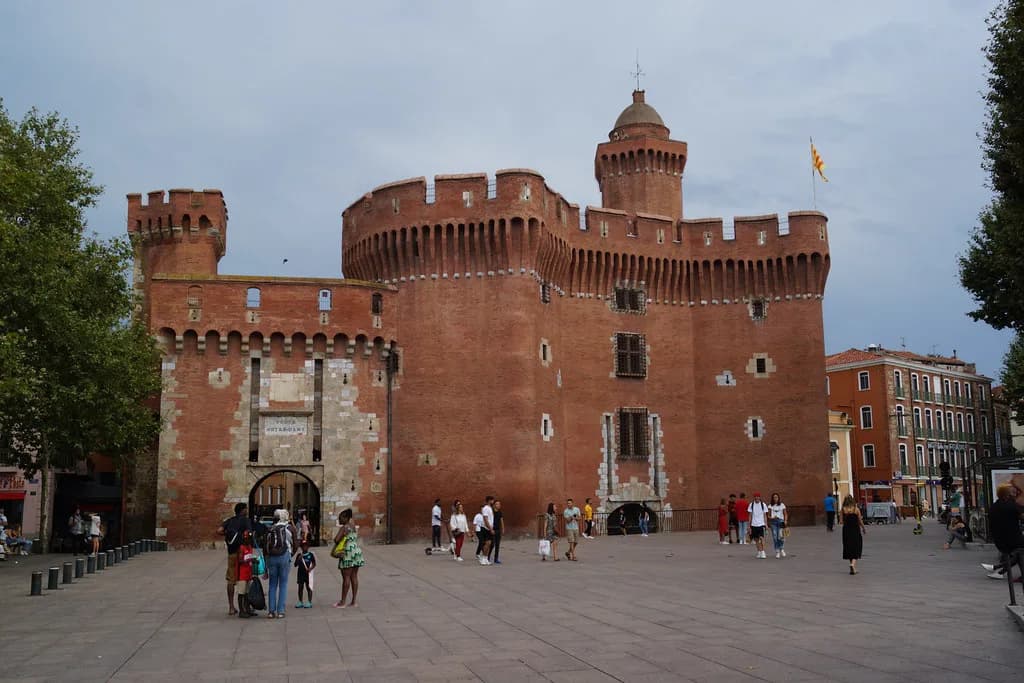
The Musée Casa Pairal is the museum of Catalan arts and popular traditions inside the Castillet, the brick gatehouse that served as the main entrance to Perpignan's fortified walls. Full admission is 2 €, the reduced rate is 1 €, and entry is free for under-26s and several other groups on proof of status. The visit pairs a folk-life collection with a 142-step climb to the roof terrace over the city and the Roussillon valley.
Allow roughly an hour if you read the displays, rather than treating the tower as a quick photo stop. The building sits at Place de Verdun on the edge of the old town, so it works as a first orientation point before you walk into the tangle of lanes behind it.
The Castillet and the museum in one building
The Castillet is the surviving principal gate of Perpignan's medieval enceinte, built in brick with Baixas marble patinated by centuries over the frame. Construction began in 1368 under Aragonese rule, and Louis XI later added the terrace and the brick turret crowned with a cupola that you now see on the skyline. It is listed as a monument historique.
Between the 17th and 18th centuries the building was turned into a state penitentiary, a phase that explains how a city gate ended up with interior rooms rather than a simple passage. Today the museum occupies those rooms and the tower doubles as one of the town's symbols, used for cultural and festive events.
For practical planning, the gate and the museum are the same stop, so you do not need to schedule them as separate visits. Combine the two and you get the architecture on the way up and the collection on the way through.
Where it is and how to reach it
The address is Le Castillet, place de Verdun, 66000 Perpignan, at the northern edge of the old town where the modern centre meets the historic lanes. Coming from the station side, this is the natural gateway into the pedestrian streets, and the walk from the centre takes only a few minutes.
The museum lists Parking Wilson, Parking Arago and Parking République as the nearest car parks, which makes Place de Verdun an easy drop-off if you arrive by car. There is no dedicated museum car park, so plan on one of those three and walk.
Walkers and cyclists arrive through the same square, and the hall of the Castillet once served as the town's syndicat d'initiative, which is why the gate has long been a first port of call for visitors. That history is useful context: the building was designed to be found easily.
If you are building a short break around the city, the rest of the central sights sit within walking distance of this point.
Inside: what the collection shows
The museum is an ethnography collection, not a fine-art gallery. It covers traditional costume, agricultural tools, transport, domestic life and religious life, with objects that mostly date from the 19th century through to the 1950s and some pieces from earlier centuries. Materials range from leather and textiles to metal, wood, ceramics and stonework.
Several holdings come from local workshops and firms, including the Bella doll company, and there are horse-drawn vehicle collections and maritime material such as Catalan boats and fishing gear used at sea and in the lagoons. The boats themselves are on deposit with the departmental boat restoration centre at Paulilles, so expect documentation and models rather than hulls in the tower.
Look out for the reconstructed kitchen of the Mas del Gleix, kept after the 2014 redisplay to preserve a memory of the original museum. It is the single most atmospheric room for most visitors and the best place to pause with children.
From private collection to public museum
The collection grew out of fieldwork. Charles Daliès gathered objects for a planned Catalan museum from the end of the First World War until 1937, and after his death the pieces were stored in the Castillet hall. Joseph Deloncle, a pharmacist and enthusiast for local ethnology, resumed collecting in the 1950s to fill the gaps, and the museum opened on 7 July 1963 under the patronage of Georges-Henri Rivière of the national folk arts museum.
That history is why the display feels personal rather than encyclopaedic: it is a regional collection assembled by amateurs who knew the Pyrénées-Orientales well. The 2014 redisplay modernised the presentation without discarding the older character of the rooms.
The climb to the terrace
Reaching the top means climbing 142 steps to the terrace Louis XI added, and the reward is a wide view over Perpignan and the whole Roussillon valley. The staircase is narrow and historic, so it is not a lift-served rooftop: anyone with limited mobility should decide before paying whether to stay with the collection on the lower levels.
Go up before the museum rooms if you want the clearest light and the fewest people on the stairs, then work back down through the galleries. On a warm afternoon the brick holds heat, so a morning slot is the more comfortable choice.
Opening hours by season
Published hours split by season: from 1 June to 30 September the museum is open every day from 10:30 to 18:30, while from 1 October to 31 May it opens Tuesday to Sunday from 11:00 to 17:30. Outside summer, Monday is the closed day, so a Monday city break should place this visit elsewhere in the schedule.
The phone number published for the museum is +33 (0)4 68 35 42 05, and the email is casapairal@mairie-perpignan.com. Check before a public holiday, when the published pattern may not match the day's actual opening.
Tickets and free entry
Admission is 2 € at full rate and 1 € reduced, which makes the museum one of the cheapest indoor stops in the city. Free entry applies to under-26s, ICOM members, specialist students and RSA beneficiaries, each on presentation of supporting proof.
Because the museum sits inside the old gate, that modest ticket covers both the collection and the terrace view. Bring ID if you expect to qualify for a concession.
How long to allow, and what to pair it with
Budget about an hour for the collection and the climb at an unhurried pace, longer if you read French comfortably and want to work through the labels. The rooms are small, so the visit never drags, but it also does not fill an afternoon on its own.
Pair it with the Cathédrale Saint-Jean-Baptiste, a short walk into the old town, and with a wander through the lanes rather than another museum on the same morning. Two indoor sights in one day is the sensible limit in a city this compact.
To plan those hours properly, work through the Perpignan Attractions guides and pick the ones that match your interests before you arrive.
Nearby in central Perpignan
Place de Verdun itself is the hinge between the modern city and the old town, so you can step from the museum straight into the historic streets. The Campo Santo, the medieval burial ground with its arcades, is one of the more unusual nearby stops and suits a quiet twenty minutes.
If you want more art after the folk collection, the Musée Hyacinthe Rigaud covers a completely different register and makes a natural second stop on a wet day.
For the wider layout of the centre, including the quarter around the museum, the Perpignan Neighborhoods: 4 Area Guides set out how the districts connect on foot.
Plan Your Visit
The Musée Casa Pairal is the right first stop in Perpignan because it explains the Catalan identity of the city and gives you the view that makes the street plan legible. Go on a Tuesday-to-Sunday visit outside summer, climb the 142 steps first, and spend the rest of the hour on the costume, tools and the Mas del Gleix kitchen.
Check the museum's published hours and rates on the day you go, since public holidays and seasonal changes are not covered by the standard pattern. Contact the museum directly on +33 (0)4 68 35 42 05 with any specific access question.
Explore more Perpignan guides
Frequently Asked Questions
What can you see at the Musée Casa Pairal in Perpignan?
The collection covers Catalan popular culture: traditional costume, agricultural tools, transport, domestic life and religious life, mostly drawn from the 19th century to the 1950s, plus earlier pieces and a mix of leather, textile, wood, metal and ceramic objects. A reconstructed kitchen from the Mas del Gleix was kept after the 2014 redisplay and is the room most visitors remember.
How many steps are there to the top of the Castillet?
There are 142 steps up to the terrace that Louis XI added to the tower. The climb is rewarded with a panorama over Perpignan and the Roussillon valley, but the historic staircase is narrow and there is no lift, so decide before buying a ticket if stairs are difficult.
When is the Musée Casa Pairal open?
From 1 June to 30 September it opens every day from 10:30 to 18:30. From 1 October to 31 May it opens Tuesday to Sunday from 11:00 to 17:30, which means Monday is the closed day for most of the year. Confirm the day's opening with the museum before travelling on a public holiday.
How much does the Musée Casa Pairal cost?
The museum publishes its current admission rates and concession rules on its official listing, and the ticket covers both the folk-life collection and the terrace at the top of the Castillet. Check that listing before you travel rather than relying on an older guide, and bring proof of status if you expect a concession.
Is the Castillet the same as the Musée Casa Pairal?
Yes, in practice they are one visit. The Castillet is the 14th-century brick gate that was once the main entrance to Perpignan's walls, and the museum of Catalan arts and traditions has occupied its interior since 1963. You pass through the displays on the way to the staircase and the roof terrace.