
Le Castillet: Perpignan's Medieval Gate and Casa Pairal Museum
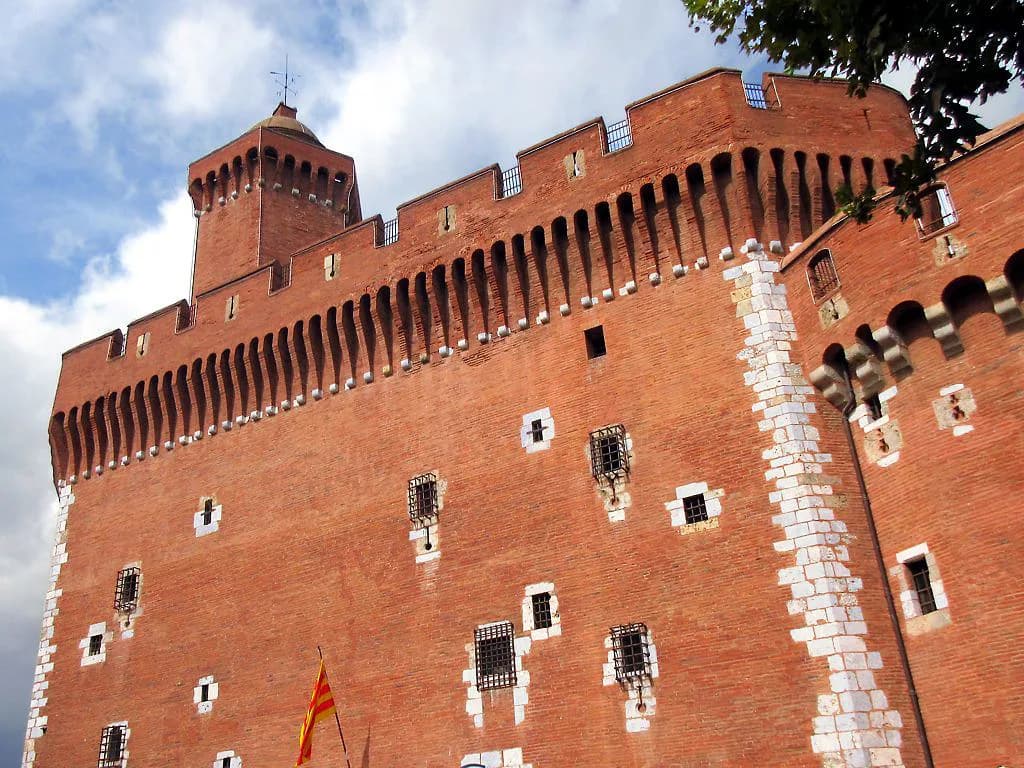
Le Castillet is Perpignan's surviving medieval gate, a red-brick tower on the edge of the old town that now houses the Casa Pairal museum. It is a compact, satisfying stop rather than a half-day sight: most visitors are done in around 45 minutes, with the rooftop view as the payoff.
The tower earns its keep because it explains the city in miniature. Its walls, prison years and Catalan collection set you up for the rest of the centre, and the cathedral, the Campo Santo and the Palais des Rois de Majorque are all within a short walk.
What Le Castillet Actually Is
Le Castillet was built in 1368 as a gate through the town walls, and it is the only one of those gates still standing. Its later career as a prison in the 17th and 18th centuries explains the heavy, closed-in look of parts of the structure.
Today the tower holds the Casa Pairal museum, which covers Catalan life and traditions in the Roussillon. That pairing is what makes the visit worthwhile: you get the architecture and the local history in one stop, rather than two separate tickets.
Le Castillet is also the emblem of the city, the building you will see on postcards and tourist material before you arrive. Treat it as your orientation landmark rather than a detour.
Where It Sits in Perpignan
The tower stands at the edge of the old centre, where the modern shopping streets meet the medieval quarter. Walking from Perpignan station into the centre takes about 15 minutes, and the route brings you past the Dalí statue on Place de Catalogne, a seated figure raised on a tall red chair facing back towards the station.
That walk is a useful arrival ritual: you pass the statue, cross into the busier streets and reach the tower without needing a bus or taxi. If you arrive with luggage, the station area is the sensible place to leave it before walking in.
What to See Outside
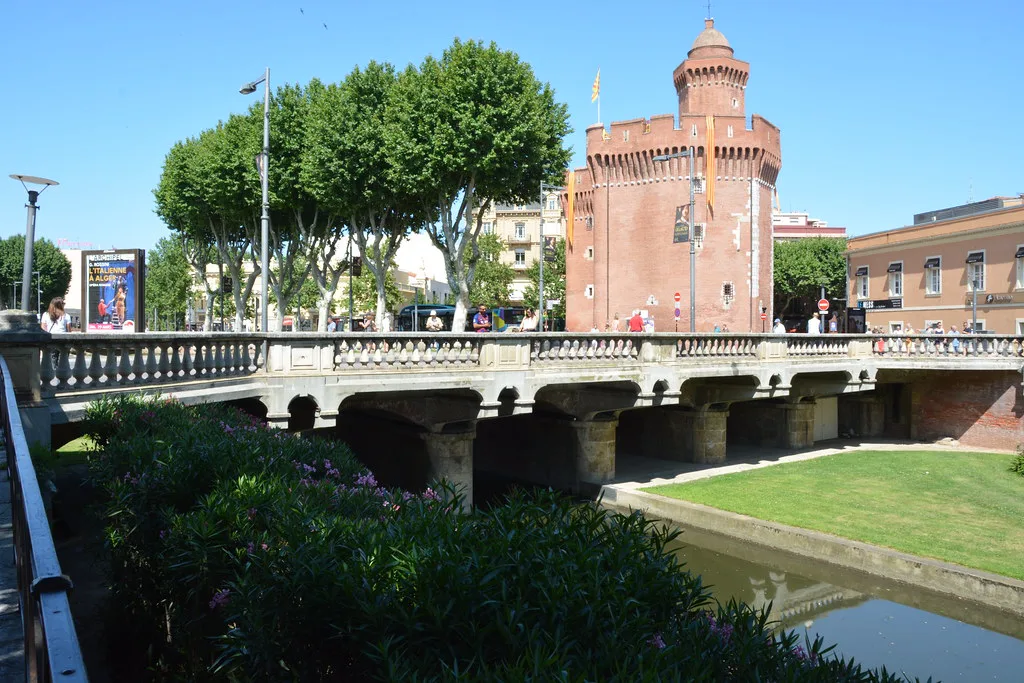
The exterior is the photograph everyone takes: banded red brick, a rounded tower and a crenellated top that reads as a castle gate more than a town gate. Walk round it once before going in, because the best angle is usually from the adjoining square rather than the main street.
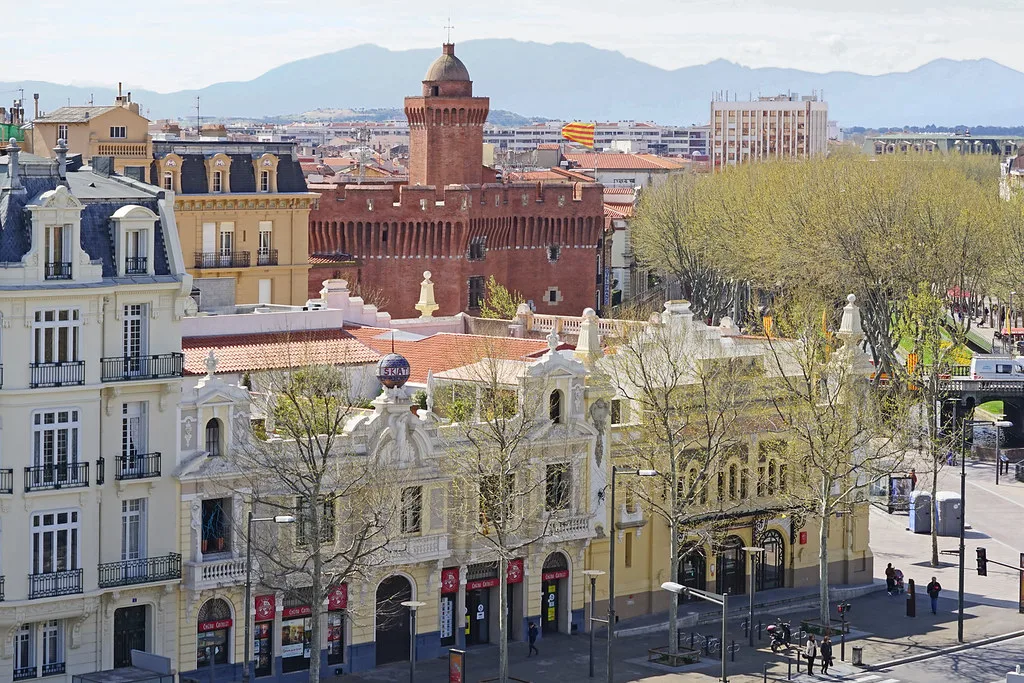
Round the corner stands the Cinéma Castillet, completed in 1911 and one of the oldest and most beautiful Art Nouveau cinemas in France. It is a working cinema, so treat the facade as the sight and check its own site for what is showing.
Inside: The Casa Pairal Museum
The Casa Pairal collection is housed in the tower itself, which means the building and the exhibits come as a package. Expect displays on Catalan daily life and traditions rather than a conventional fine-art hang, and read the room labels as you go: the context is the point.
The museum is small enough to take at a gentle pace even on a short break. Anyone planning a fuller art stop should look at the Musée Hyacinthe Rigaud, a few minutes away in the old town, which holds a much larger collection across two townhouses.
Climbing to the Top
The climb to the roof runs to 142 stone steps, and it is a stair climb rather than a lift ride. The reward is the view over the old town from the top of the monument, which is the single best reason to go up rather than simply photograph the outside.
Wear shoes you can climb in and leave the buggy at ground level if you can. The steps are the main physical constraint of the visit, so build in a few minutes at the top rather than treating the climb as a quick dash.
Tickets and Free Entry
Entry to Le Castillet and the Casa Pairal museum is free on the first Sunday of every month. It is also permanently free for people under 26 on presentation of proof of identity, which makes it one of the cheapest cultural stops in the city for younger travellers.
Standard ticket prices and daily opening hours are published by the tourist office rather than fixed in advance here, so check the current listing before you set out. Outside the free windows, budget for a small admission charge and have a card or cash ready.
How Long to Allow
Forty-five minutes is a realistic slot for the tower, the museum rooms and the roof, with a little extra if you like reading the displays. That makes it easy to pair with a morning in the old town rather than giving it a day of its own.
If you are short on time, do the roof first and the museum second: the view is the memory, and the exhibits can be skimmed. If you have longer, linger in the museum rooms before climbing, so you arrive at the top unhurried.
Nearby: The Old Town Cluster
The Cathédrale Saint-Jean-Baptiste is a short walk away, with foundations laid in 1324 and cathedral status granted in 1601. Its Gothic nave and stained glass make it the natural next stop after the tower, and entry is a simple case of walking in when services allow.
Beside the cathedral sits the cloistered cemetery of the Campo Santo, a quiet, walled space that most short-break visitors miss. It is a five-minute addition to the cathedral stop and a good place to slow down between sights.
Further out, the Palais des Rois de Majorque occupies the high ground above the city, a 13th-century residence begun as a fortress in 1274. The zigzagging steps up to its gardens are worth the effort for the views towards the Canigou massif.
Practical Trade-Offs
The stairs are the honest caveat: 142 steps up and down is fine for most people but not for everyone, and there is no shortcut to the roof. Anyone travelling with someone who cannot manage the climb should split up, with one person staying with the bags in the square.
Season matters more for comfort than for the sight itself. Perpignan is often described as one of the sunniest cities in France, with around 250 days of sunshine and its own microclimate, so a summer midday climb can be hot work.
Build the tower into a two-day break rather than making it the day's centrepiece. Pair it with the cathedral and Campo Santo in the morning, then use the afternoon for the palace or the Rigaud museum, which keeps walking distances short and the pace humane.
Fitting Le Castillet Into Your Perpignan Weekend
Le Castillet is a 45-minute stop that pays off twice: once for the red-brick gate itself, once for the view from the top. Go early in the day, climb before your legs tire, and use the tower as the anchor for a walk through the old centre.
If your dates are flexible, the first Sunday of the month is the obvious choice for free entry, and under-26s with ID pay nothing at any time. Check the tourist office listing for current hours and admission before you go.
Frequently Asked Questions
Is Le Castillet free to visit?
Entry to Le Castillet and the Casa Pairal museum is free on the first Sunday of every month, and it is permanently free for people under 26 who show proof of identity. At other times there is an admission charge, so check the tourist office listing for the current price before you go.
How many steps are there at Le Castillet?
There are 142 stone steps to the top of the monument. The climb is the main physical effort of the visit, and the roof view over the old town is the reward.
What is inside Le Castillet?
The tower houses the Casa Pairal museum, which covers Catalan life and traditions in the Roussillon. The building itself, with its history as a medieval gate and later a prison, is part of what you are seeing.
How long does Le Castillet take?
Allow around 45 minutes for the exterior, the museum rooms and the climb to the roof. That makes it an easy addition to a morning in the old town rather than a half-day outing.
Is Le Castillet worth visiting in Perpignan?
Yes, if you want the city's story in one compact stop: a 1368 gate, a Catalan collection and a rooftop view. Skip it only if stairs are a problem or your time in Perpignan is limited to a few hours.
How far is Le Castillet from Perpignan station?
It is roughly 15 minutes on foot from the station into the centre, passing the Dalí statue on Place de Catalogne on the way. That makes it a sensible first stop if you arrive by train.
What else is near Le Castillet?
The Cathédrale Saint-Jean-Baptiste, the Campo Santo cemetery and the Palais des Rois de Majorque are all within walking distance, as is the Musée Hyacinthe Rigaud. Grouping two or three of them makes a coherent half-day in the old centre.
When is the best time to climb Le Castillet?
Mornings are easier, especially in summer, because the climb is on stone stairs and the city is one of the sunniest in France. If free entry is the priority, plan around the first Sunday of the month instead.