
Basilica of Notre-Dame de Fourvière: A Visitor's Guide
The Basilica of Notre-Dame de Fourvière is a minor basilica on Fourvière hill, standing directly above Vieux-Lyon and looking down over the whole city. It was built between 1872 and 1884 as a thank-offering to the Virgin Mary after the Franco-Prussian war, and it has become one of Lyon's defining landmarks largely because of that dominant hilltop position.
Treat it as two churches in one building. The main church sits on top, and the Crypt of St Joseph runs underneath as a church in its own right, with its own altar. Budget time for both, and expect the upper church to take longer because the mosaics reward slow looking.
What the Basilica of Notre-Dame de Fourvière is
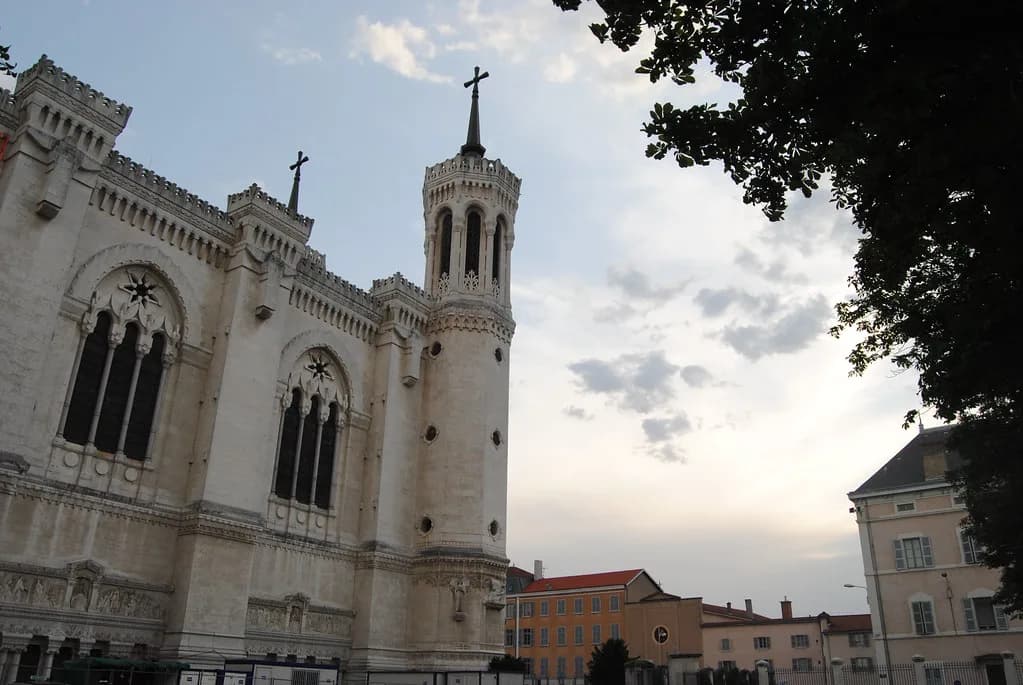
Fourvière is a minor basilica, not a cathedral, and it was designed by the Lyonnais architect Pierre Bossan. The facade blends Romanesque and Byzantine elements, and the building drew criticism while it went up, with some detractors calling it an upside-down elephant. That mixed style is exactly what makes the exterior worth a slow circuit before you go in.
Construction dates are given differently: the basilica's own account places the build between 1872 and 1884, while Wikipedia gives 1872 to 1896. Either way, the basilica was funded privately and built to thank the Virgin Mary for sparing the city during the Franco-Prussian war.
Where it is
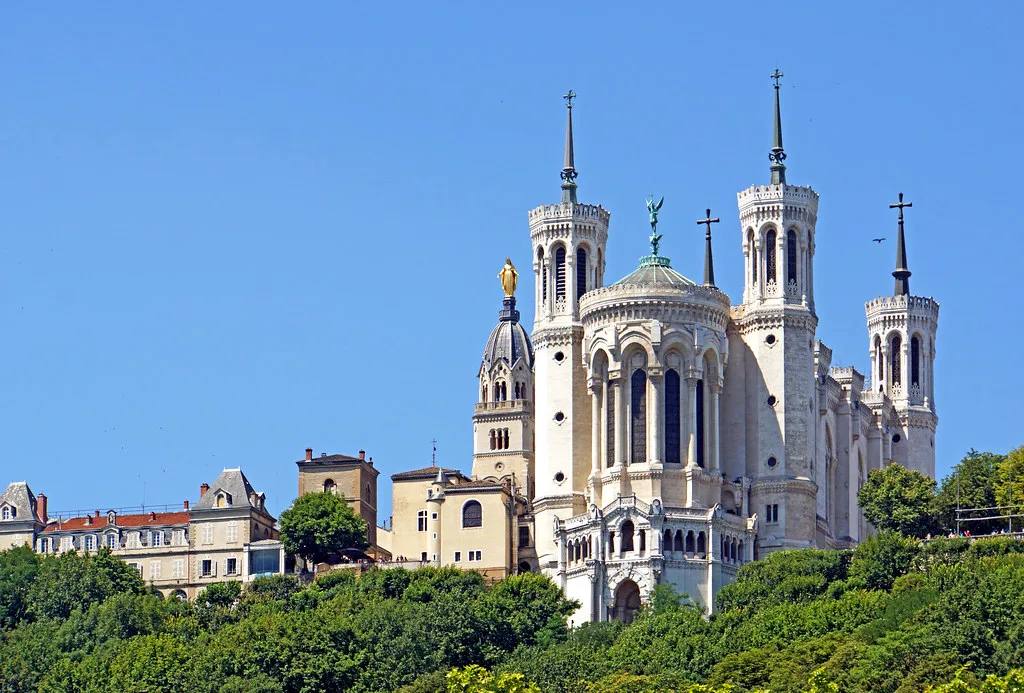
The basilica occupies the top of Fourvière hill on the west bank of the Saône, above the Renaissance streets of Vieux-Lyon. Its hilltop siting was part of the point: the church was meant to be seen from across the city, and the esplanade in front of it gives you the return view down over the rooftops and the river.
For scale, the building is 86 metres long and 35 metres wide. That is long enough that the facade and the side elevations read quite differently, so walk round at least one flank before heading inside.
The basilica pairs naturally with the rest of the hill, and with the old town at its foot. If you are building a Lyon itinerary around the hill, the wider set of Lyon Attractions gives you the surrounding sights to slot in before or after. For the streets and courtyards below, our guide to things to do in Lyon is the natural next read.
How to get there
The classic approach is from Vieux-Lyon below: the old quarter sits directly under the hill, and the climb up to the basilica is the natural continuation of a walk through its traboules and courtyards. A funicular also runs up Fourvière hill, which saves the gradient if you would rather spend your energy on the visit itself. For the streets you pass through at the start of the climb, see Vieux Lyon.
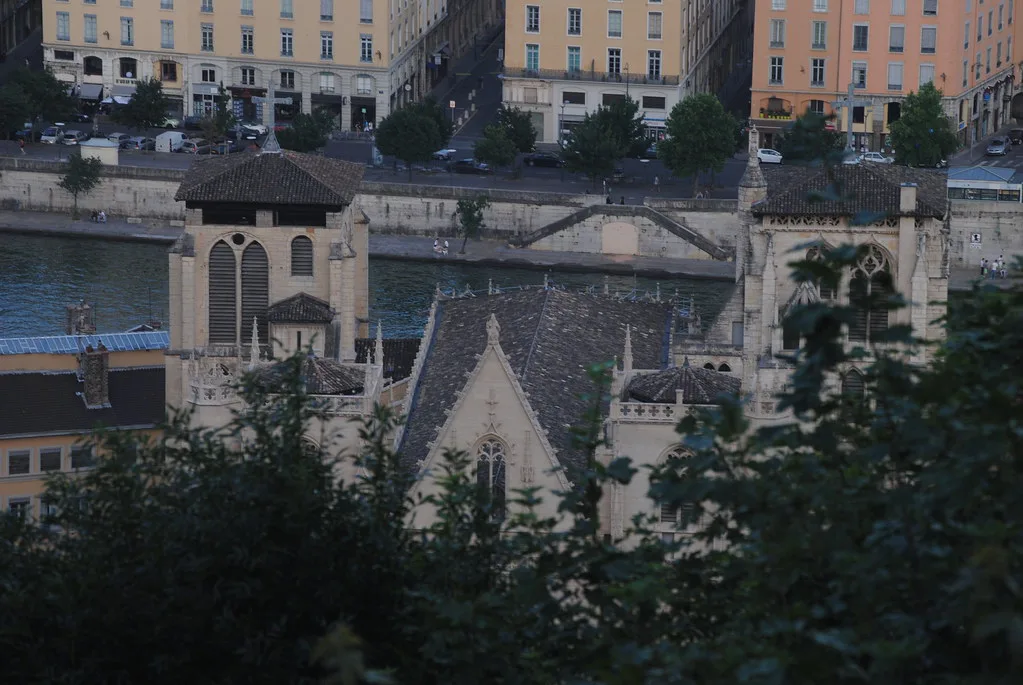
Check the funicular's current operating times and fares with TCL, the Lyon transport network, before you set out, since these change with season and service patterns. Vieux-Lyon is also where you find the Cathédrale Saint-Jean-Baptiste, a useful marker for the start of the climb and a worthwhile stop in its own right.
Whichever way you come up, the last stretch is on foot and the hilltop is exposed, so the walk is easier in flat shoes and with a layer against the wind. Allow a relaxed half-hour for the climb from the old town if you are walking.
The exterior: four towers and a gallery of angels
The four octagonal towers are the first thing to look for. They represent the four cardinal virtues — fortitude, justice, prudence and temperance — and each is decorated with stylised floral engraving. Count them from the esplanade before you go closer, because the octagonal shape reads best from a distance.
Higher up, an upper gallery uses caryatids sculpted as angels holding swords, which gives the facade its fortress-like, defensive feel. Below them, a winged lion guards the entrance to the crypt and doubles as an emblem of the city of Lyon. Look for the lion on your way down to the lower church rather than rushing past it.
Inside the upper church
The upper church is the one people remember, and mosaics are the reason. They cover the nave and choir from floor to ceiling, and Bossan took his cue from the churches he saw in Sicily. Give the nave a few minutes from the back before you move forward, because the floor patterns become more elaborate as you approach the choir.
Three cupolas sit above the nave, and each carries Marian symbolism: Mary as daughter of the Father, spouse of the Holy Spirit and mother of Christ. The focal point of the altar is a statue of the Virgin in Carrara marble, veiled as a sign of purity.
The choir is the most decorated part of the church, with a vault of jewels, roses and foliage, cherubs, and a keystone six metres wide with the dove of the Holy Spirit at its centre. Stand under the dome and look straight up rather than at eye level.
The Crypt of St Joseph
The crypt is not just a foundation but a full church below ground, with its own altar and a choir covered in mosaics and angel statues celebrating the virtues of St Joseph. Bossan intended pilgrims to reach Mary through Joseph, moving from the darkness of the crypt into the light of the church above, and walking it in that order makes the design legible.
The crypt's chapels are each dedicated to a version of the Virgin from a different pilgrimage site, including Portugal, Poland, Hungary, India, the Philippines, Lebanon, Guadeloupe and China. The walls are lined with marble plaques known as ex-votos, left by people giving thanks for answered prayers. These are the most human part of the building, so leave time to read a few.
Mosaics to seek out
Two floor-to-ceiling mosaics in the upper church are worth hunting down. One depicts the 1571 Battle of Lepanto, where Pope Pius V called on the Virgin Mary to bring victory to Christian sailors against the Turkish fleet of Selim II. The other shows Joan of Arc's triumphant arrival in Orléans, surrounded by five key moments of her life: the voices, the victory at Patay, the coronation in Reims, the capture and the burning at the stake.
Another mosaic shows Louis XIII and Anne of Austria offering a crown to the Virgin in hope of an heir, who would become Louis XIV. Together with the Lepanto panel, it makes the church's decoration a running political and religious narrative rather than pure ornament.
How long to allow
Allow around an hour to 90 minutes for the basilica itself, split between the upper church, the crypt and a circuit of the exterior. The mosaics and ex-votos reward slow looking, so a rushed twenty minutes misses the point of the building.
Add the time you spend on the esplanade outside, which is where the hilltop position pays off, and the walk or funicular up. If you are combining the basilica with the old town below, the fuller list of things to do in Lyon helps you sequence the day without doubling back up the hill.
Nearby on Fourvière hill and below
Back down in the old town, the Cathédrale Saint-Jean-Baptiste in Vieux-Lyon is the obvious companion sight and sits at the foot of the hill. Farther out, Place Bellecour, Lyon makes a natural next stop on the Presqu'île between the two rivers, and the Parc de la Tête d'Or offers a complete change of scale if you want green space after a morning of mosaics.
Across the city, the Musée des Confluences sits at the meeting of the Rhône and the Saône and gives you a very different kind of building to compare with Bossan's basilica. None of these are on the hill itself, so plan them as a second half of the day rather than an add-on to the basilica visit.
Plan Your Visit
Fourvière works best as a half-day anchored on the hill: facade first, then the upper church, then down into the crypt, and finally the view back over Lyon from the esplanade. Coming up from Vieux-Lyon on foot or by funicular keeps the old town in the same morning.
Check the basilica's own site for current opening hours before you travel, since the upper church and crypt can keep different times. Pair the visit with the Cathédrale Saint-Jean-Baptiste below the hill and the wider Lyon Attractions list to fill the rest of your day.
Explore more Lyon guides
Frequently Asked Questions
Is the Basilica of Notre-Dame de Fourvière free to visit?
Entry to the basilica has historically been free, with donations welcome, though access to the crypt and any guided options can differ from the main church. Check the basilica's official site for the latest arrangements.
What is the history of the Basilica of Notre-Dame de Fourvière?
It was built as a thank-offering to the Virgin Mary after the Franco-Prussian war, with construction given as 1872 to 1884 in the basilica's own account. The Lyonnais architect Pierre Bossan designed it in a mix of Romanesque and Byzantine styles, and the hilltop position made it a symbol of the city.
How do I get to the Basilica of Notre-Dame de Fourvière?
Walk up from Vieux-Lyon, the old quarter directly below the hill, or take the funicular up Fourvière. Funicular times and fares are set by TCL, the Lyon transport network.
How long does a visit to Fourvière basilica take?
Allow about an hour to 90 minutes to see the upper church, the Crypt of St Joseph and the exterior, plus time for the view from the esplanade. The mosaics and ex-votos reward slower looking, so a longer stop is easy to justify.
What should I look for inside the basilica?
The mosaic-covered nave and choir, the three Marian cupolas, the Battle of Lepanto mosaic and the Joan of Arc panel showing her arrival in Orléans. Down in the crypt, look for the chapels dedicated to the Virgin from different pilgrimage sites and the marble ex-votos on the walls.
Is there anything else to see nearby?
Vieux-Lyon sits directly below the hill, with the Cathédrale Saint-Jean-Baptiste as the natural companion sight. Further afield, Place Bellecour, the Parc de la Tête d'Or and the Musée des Confluences each make a good second stop.