
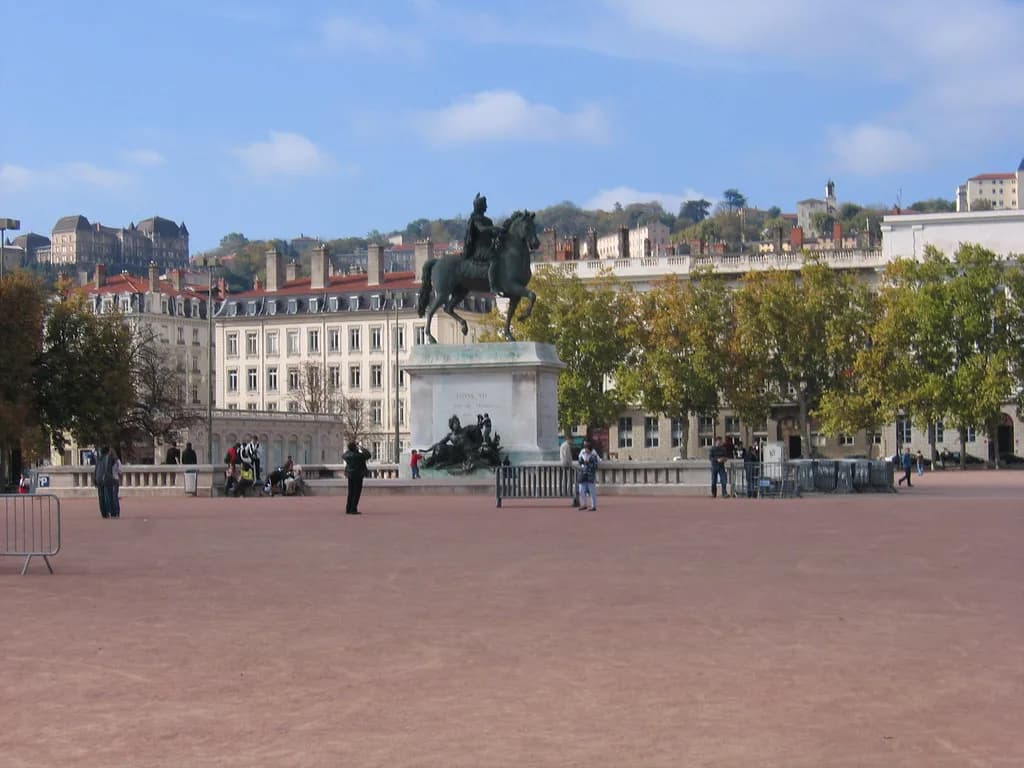
Place Bellecour: Lyon's Grand Square on the Presqu'île
Place Bellecour is the huge open square at the heart of Lyon's Presqu'île, the peninsula between the Saône and the Rhône. It takes about half an hour to look round properly, which makes it the easiest anchor for a day in the city centre.
Think of it as a junction rather than a sight with a turnstile: three of the Presqu'île's main streets radiate from it, the metro stops underneath, and the two rivers are a short walk either side. Use it to get your bearings before heading into the streets around it.
Where Place Bellecour sits
The square lies in Lyon's 2nd arrondissement, on the Presqu'île between the Rhône and the Saône. It is the point from which road distances in the city are measured and sits at a reference altitude of 170 metres, so it is genuinely the centre of Lyon rather than a sight on the edge of it.
Because it straddles the peninsula, you will cross it naturally walking between Vieux Lyon and the shopping streets to the north. For a wider look at how the city's quarters fit together, the Lyon Neighborhoods: 4 Area Guides are worth a read before you set out.
Getting there by metro, bus or bike
Bellecour metro station serves lines A and D, putting the square one stop from Perrache and a short ride from the main rail stations. Several bus lines also stop on or beside the square, and the city's Vélo'v bike-share stations sit on the cycle routes that cross it.
Cars circulate around the outside of the square even though the centre is pedestrian, so arriving by metro or on foot avoids hunting for parking on the ring road. If you come by tram, Perrache is roughly a ten-minute walk away.
How big the square is
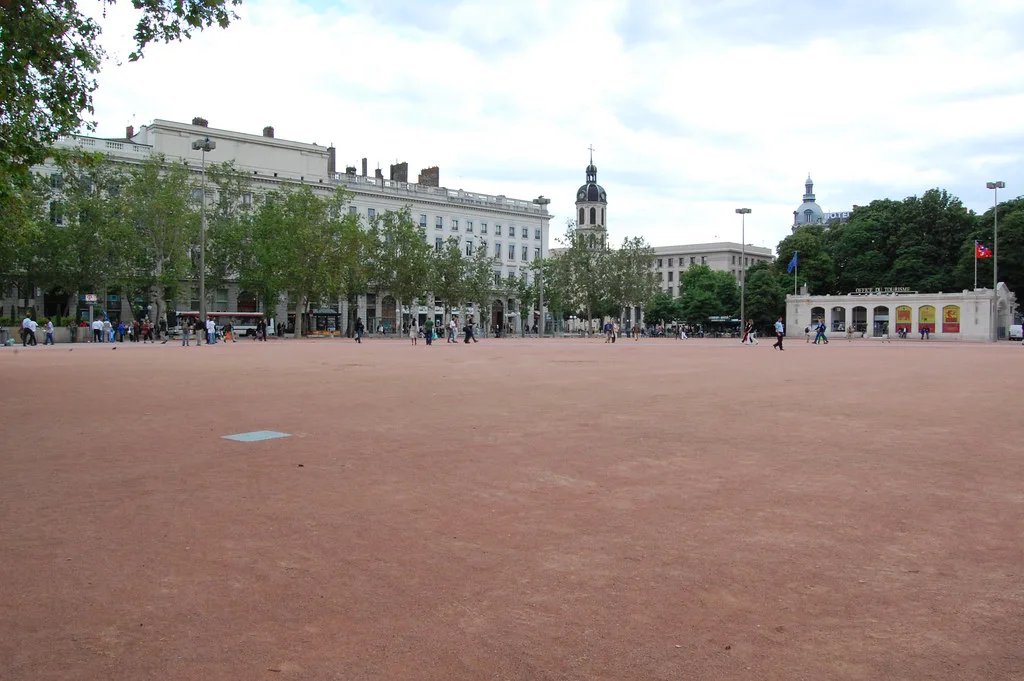
At about 62,000 square metres, roughly 310 by 200 metres, Place Bellecour is the fourth largest square in France and the largest pedestrian square in Europe. It is big enough to swallow a crowd: the famous Red Square in Moscow, at 23,100 square metres, would fit inside it several times over.
That scale changes how you visit. There is no gate, no queue and no enclosure, so you can cut across it in a few minutes or circle the whole perimeter in a quarter of an hour; the interesting detail is all in the statues and the buildings framing the edges.
The Louis XIV statue at the centre
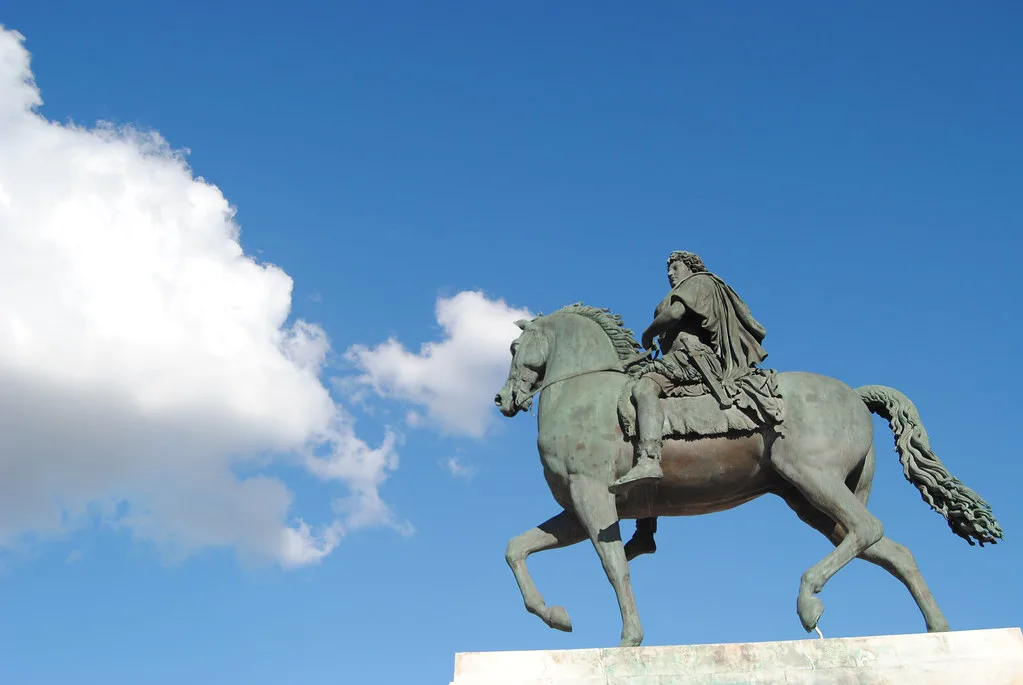
A bronze equestrian statue of Louis XIV stands at the middle of the square, 5.70 metres tall and weighing 15 tonnes. The sculptor François-Frédéric Lemot made it in Paris and it was hauled to Lyon on a carriage drawn by twenty-four horses, then installed in 1825.
This is not the first royal statue on the site. An earlier version by Martin Desjardins went up in 1713 and was pulled down in 1793 to be melted into cannon during the Revolution, which is why the figure you see today dates from the Restoration.
At the statue's feet sit two allegorical figures of the Rhône and the Saône, carved by the Coustou brothers in 1714 and hidden in the Hôtel de Ville during the Revolution before being put back in 1826. Look also for the small local tradition of meeting beneath the horse's tail, a rendezvous point Lyon couples have long used.
Saint-Exupéry and the Petit Prince
On the western side of the square stands a statue of Antoine de Saint-Exupéry seated in front of his most famous character, the Petit Prince. It was placed in 2000 to mark the centenary of the birth of the writer and aviator, who was born in Lyon.
It is a natural pause if you have children with you, and there is a small park on the square where they can run about before you move on.
The Veilleur de Pierre memorial
On the square's perimeter stands the Veilleur de Pierre, a memorial erected where a bomb planted by the Lyon resistance exploded on 26 July 1944. The architect Louis Thomas and the sculptor Salendre designed it, and it carries the inscription asking passers-by to tell the world that those commemorated died for liberty.
It is easy to miss while heading for the statue, so approach the edges of the square deliberately. The memorial gives a few minutes of weight to what would otherwise be a purely scenic stop.
The three streets leading off the square
Three major streets fan out from Place Bellecour, and knowing where each one goes saves a lot of backtracking. Rue de la République runs north to the Hôtel de Ville and the Opéra, with rue du Président Édouard Herriot continuing on towards place des Terreaux; both are largely pedestrian and lined with shops.
Rue Victor Hugo heads south towards Perrache and the lively quarter around it. Rue du Président Édouard Herriot is also where many of the luxury names cluster, so pick your street by whether you want shopping, civic buildings or the station.
How long to allow
Give the square itself 20 to 30 minutes: enough to walk the perimeter, see the Louis XIV statue, the Coustou allegories, the Saint-Exupéry group and the Veilleur de Pierre. Add time if you want a coffee at one of the two brasseries on the square or a sit-down in the park.
Its real value is as a starting point. From here you can walk north into the shopping streets, west over the Saône towards Vieux Lyon and the cathedral, or south to Perrache, so treat it as the first pin on a Presqu'île morning rather than a destination in itself.
What to see nearby
The square is ringed by shops, cafés and restaurants, and both rivers are within a few minutes' walk, with riverboat cruises running on the Saône. The Musée des Beaux-Arts de Lyon, in a former Benedictine abbey, is a short walk north via place des Terreaux.
Further out, the Musée des Confluences at the tip of the peninsula and the Basilica of Notre-Dame de Fourvière on the hill above Vieux Lyon make good halves of a day, and the Parc de la Tête d'Or is the city's big green escape to the north.
Plan Your Visit
Place Bellecour is central, so slot it into the start of a Presqu'île walk rather than treating it as a ticketed attraction. Take metro line A or D to Bellecour, look at the statues at the centre and the memorial at the edge, then pick one of the three radiating streets and carry on.
Nothing on the square is enclosed or timed, so there is no closing time to work around. Check transport disruptions on the city network's own site before you travel, and confirm any museum hours separately for the sights you add on either side.
Frequently Asked Questions
Is Place Bellecour free to visit?
Yes. Place Bellecour is an open public square with no gate, ticket desk or enclosure, so you can walk onto it and around the statues at no cost at any hour. The cafés and brasseries on the square charge for what you order, and nearby museums and other sights set their own admission separately.
How do I get to Place Bellecour by metro?
Bellecour metro station serves lines A and D, putting the square one stop from Perrache and a short ride from the main rail stations. Several bus lines stop on or beside the square, and Vélo'v bike-share stations sit on the cycle routes that cross it. Cars circulate around the outer ring, so arriving by metro or on foot is simpler than driving.
How much time should I allow at Place Bellecour?
Twenty to 30 minutes covers the perimeter, the Louis XIV statue with the Rhône and Saône allegories, the Saint-Exupéry and Petit Prince group and the Veilleur de Pierre memorial. Add time for a coffee at one of the two brasseries or a sit in the small park. Most visitors use the square as a starting point for a walk through the Presqu'île rather than a destination in itself.
Is Place Bellecour really the largest pedestrian square in Europe?
Place Bellecour measures about 62,000 square metres, roughly 310 by 200 metres, which makes it the fourth largest square in France and the largest pedestrian square in Europe. Traffic runs around the outside, but the whole central expanse is car-free. For comparison, Red Square in Moscow covers 23,100 square metres.