
Arc de Triomphe, Montpellier: What to See at the Porte du Peyrou
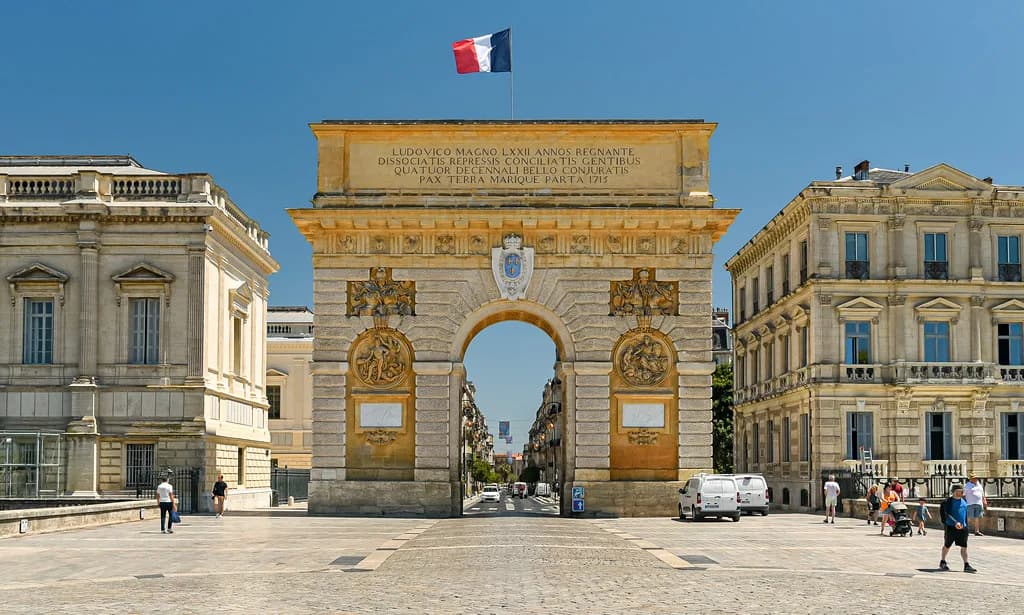
Montpellier's Arc de Triomphe is a triumphal arch of 1692 standing at the eastern end of the Jardin de Peyrou, where the park meets the old town. Locals know it as the Porte du Peyrou, and it is the gateway most visitors pass through on the climb from the city centre to the promenade. It is an outdoor monument with no ticket and no opening hours.
Allow ten to fifteen minutes at the arch itself, then stay on the promenade for the statue, water tower and aqueduct. The walk works best as one continuous loop from Place de la Comédie up through the Écusson, across the park, and back down past the Jardin des Plantes.
What the Montpellier Arc de Triomphe Actually Is
This is not the Paris monument. Montpellier's arch is a smaller royal gateway built at the end of the 17th century as a copy of the gates of Paris, erected in honour of Louis XIV, and it marks the ceremonial entrance to the city from the royal square beyond.
It is also called the Porte du Peyrou, and it sits at the eastern end of the Jardin de Peyrou, a park near the centre of town. The arch frames the passage between the park and the streets of the old city, so you walk through it rather than around it.
Where the Arch Stands
The arch stands where the Promenade du Peyrou meets the old town, at the western edge of the Écusson, the historic centre. On one side are the narrow lanes and hôtels particuliers of the old town; on the other, the raised, tree-lined sweep of the Promenade du Peyrou, one of the highest points in the city.
Because the promenade sits uphill, the arch reads as a doorway between two different cities: dense medieval streets below and a formal royal square above. Arriving on foot from the east, you notice the change in scale as soon as you step through.
How to Get There
The simplest route is on foot: start at Place de la Comédie, head northwest into the pedestrian streets of the Écusson, and keep climbing until you reach the arch. Most of the centre is pedestrian-friendly and the main sights sit within walking distance of one another, so the walk is the point rather than a chore.
If you would rather save your legs, Montpellier's tram network runs five lines across the city and connects the centre with surrounding neighbourhoods. A standard TaM ticket costs €1.90 and covers unlimited bus and tram travel for 90 minutes, so you can ride to the Peyrou side and walk in from there.
Montpellier Saint-Roch station is a short walk from Place de la Comédie, which makes the foot route practical even on a short break. Direct high-speed trains from Paris Gare de Lyon take as little as three hours and fifteen minutes.
Why It Was Built
At the end of the 17th century the king's intendant ordered a triumphal arch on the model of the gates of Paris, dedicated to Louis XIV. It formed part of a deliberate programme of royal display: the arch led into a newly laid-out square crowned by an equestrian statue of the king.
The arch still functions as the formal entrance to the city centre from the Peyrou park, which is why it is described as a mandatory access point rather than a decorative landmark. Reading it as infrastructure first and monument second makes the layout of this edge of the old town easier to follow.
What to Look at on the Arch
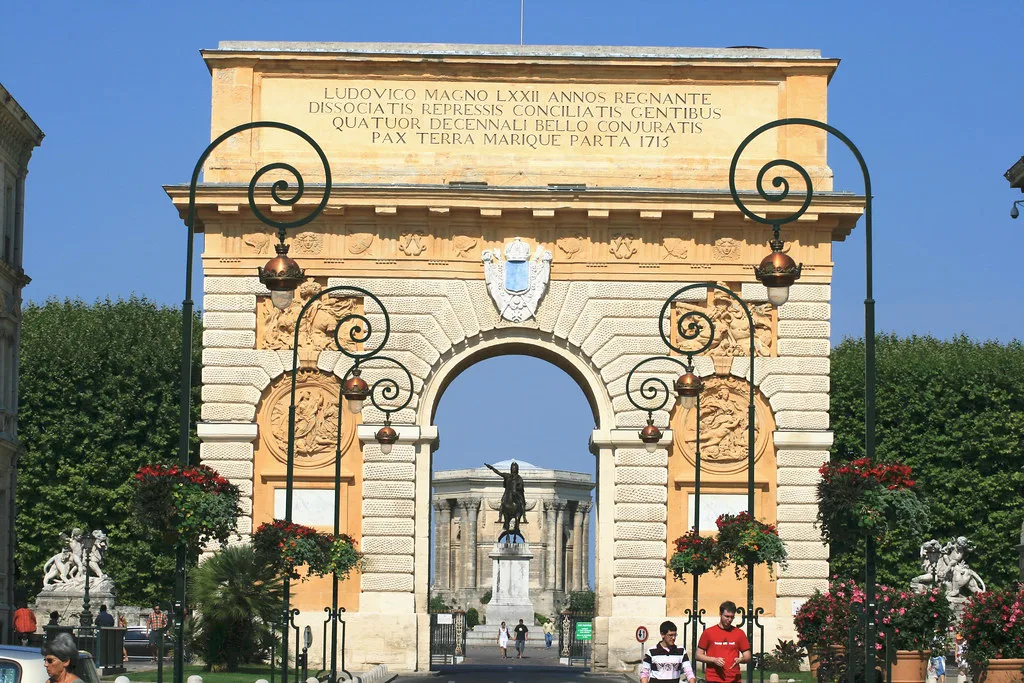
Look at the way the arch frames the view in both directions. Stand in front of it from the park side and the opening lines up with the street running downhill into the Écusson; stand beneath it and the promenade opens out behind you.
The structure is best seen in late-afternoon light, when the low sun catches the stone and the park behind it glows. There is nothing to queue for and no interior to visit, so the whole experience is about position and view rather than exhibits.
The View Through the Arch
On the park side, the Promenade du Peyrou includes the equestrian statue of Louis XIV, an ornate 18th-century water tower and the Saint-Clément Aqueduct, with the Arc de Triomphe itself at the eastern entrance. On a clear day the elevated position gives views across the city rooftops and out towards the surrounding countryside.
It is a peaceful place to walk, sit or picnic between sights, and it makes a natural break between the dense old town and the botanical garden below.
How Long to Allow
Budget ten to fifteen minutes for the arch and its immediate view, then at least another half hour on the promenade for the statue, the water tower and the aqueduct. If you add the downhill walk to the botanical garden, the whole circuit comfortably fills a morning or an afternoon.
The arch is an outdoor structure you can see at any hour, so it slots into a day around fixed museum timings. The Musée Fabre, for instance, is generally open Tuesday to Sunday from 11am to 6pm, with the permanent collection free on the first Sunday of each month.
What to See Nearby on the Same Walk
From the arch, walk the length of the promenade to the Château d'Eau and the Saint-Clément Aqueduct, then drop south towards the Jardin des Plantes, the city's botanical garden. The garden dates back to 1593 and holds more than 2,600 plant species across nearly five hectares, so it rewards more than a quick pass-through.
Continue east and you reach the cathedral quarter, where the Cathédrale Saint-Pierre sits at the heart of the old town. Admission to the cathedral is free, though it generally closes over lunchtime, so time the end of your walk accordingly.
The Sunday Market on the Promenade
Les Dimanches du Peyrou runs every Sunday on the promenade, with antique and flea stalls set out among the landmarks. It is worth timing a visit around it if you like browsing old objects, and the surrounding streets stay busy with the market crowd.
The market runs from roughly 7.30am to 2pm, which suits a morning start followed by lunch in the old town. Keep it as a Sunday fixture rather than a daily routine, since it is the weekend that brings the stalls out.
Practical Notes
The arch has no ticket office, no turnstile and no set hours, so there is nothing to book in advance and no closed day to work around. Treat it as part of the street layout rather than a museum, and plan your day around the sights that do have schedules.
Late afternoon gives the best light on the stone and the best views from the promenade, with sunset over the rooftops a common stopping point. Wear shoes you can walk in, since the approach from Place de la Comédie is uphill through cobbled lanes.
Plan Your Visit
Montpellier's Arc de Triomphe is a short, free stop folded into one of the city's best walks: uphill from Place de la Comédie, through the arch, across the Promenade du Peyrou, and down past the aqueduct and the Jardin des Plantes. Give it a morning on a Sunday for the market, or a late afternoon for the light.
Explore more Montpellier guides
Frequently Asked Questions
Is the Montpellier Arc de Triomphe the same as the one in Paris?
No. Montpellier's arch is a 1692 gateway commissioned in honour of Louis XIV and modelled on the gates of Paris. It is much smaller than the Paris monument, has no interior to visit and cannot be climbed.
Do you need tickets for the Arc de Triomphe in Montpellier?
No. It is an outdoor arch on a public street at the entrance to the Promenade du Peyrou, with no ticket office or set opening hours. You simply walk through or stand beneath it.
Where exactly is the Porte du Peyrou?
It stands at the eastern end of the Jardin de Peyrou on Rue la Blottière, at the western edge of the Écusson. The old town is below it on one side and the raised promenade on the other.
What else is there to see at the Promenade du Peyrou?
The promenade holds the equestrian statue of Louis XIV, the Château d'Eau and the Saint-Clément Aqueduct. On Sundays, the antique and flea market Les Dimanches du Peyrou sets up stalls along it.
How long does a visit take?
Allow ten to fifteen minutes for the arch and its view, plus at least half an hour on the promenade. Add the botanical garden and cathedral quarter and the walk fills a morning or afternoon.
When is the Sunday market on the promenade?
Les Dimanches du Peyrou takes place every Sunday, roughly from 7.30am to 2.30pm. It is a flea and antique market, so arrive in the morning and bring some cash for stalls that do not take cards.