
Promenade du Peyrou: Montpellier's Royal Esplanade
The Promenade du Peyrou is a free, open royal esplanade on the western edge of central Montpellier, laid out as a belvedere looking over the city. You come here for the axis of monuments and the view, not for a ticketed attraction, and it slots neatly into a half-day walk from the old town.
Allow 30 to 60 minutes on the esplanade itself, longer if you linger on the terrace edge or browse the Sunday flea market. The site is exposed and the paving is uneven in places, so it is a poor choice at midday in high summer and a very good one in late afternoon light.
What the Promenade du Peyrou is
The promenade du Peyrou, also called the place royale du Peyrou, is a 4.59-hectare esplanade west of the Écusson quarter of Montpellier. It was conceived as a royal square and viewing terrace, which is why the layout reads as a formal outdoor room rather than a park with paths and planting.
Treat it as public ground: you walk on, walk across and walk off, with no gate to queue at. That makes it the easiest major sight in the city to fit around museum timings or a lunch booking.
Where it is and how to reach it
The esplanade sits at the top of the old town, immediately west of the Écusson, and the natural approach on foot is along Rue Foch from the centre. Walk west from the shopping streets and the arch closes the view at the end of the street, which makes the route hard to lose.
From Place de la Comédie the walk to the foot of the promenade takes roughly 15 minutes at an unhurried pace, all of it level until the last short pull up. The old quarter is largely pedestrian, so this is a walking approach rather than a drive-and-park one, and it links up naturally with the other things to do in Montpellier around the old town.
If you are coming from further out, Montpellier's five tram lines connect the historic centre with the stations and outer neighbourhoods, and a single TaM ticket gives 90 minutes of bus and tram travel. Check the TaM app or the machines at the stop for the current fare before you travel.
The Arc de Triomphe and the western axis
The Arc de Triomphe at the eastern entrance was built in 1692 in honour of Louis XIV, and it works as the doorway to the whole composition. Passing under it and out onto the open expanse is the moment the site makes sense: arch, square, statue, water tower and aqueduct in one line.
Walk the axis in one direction rather than wandering in, so you end at the aqueduct and the western edge where the view opens out. This is the single most useful planning decision you can make here.
The statue of Louis XIV and the royal-square layout
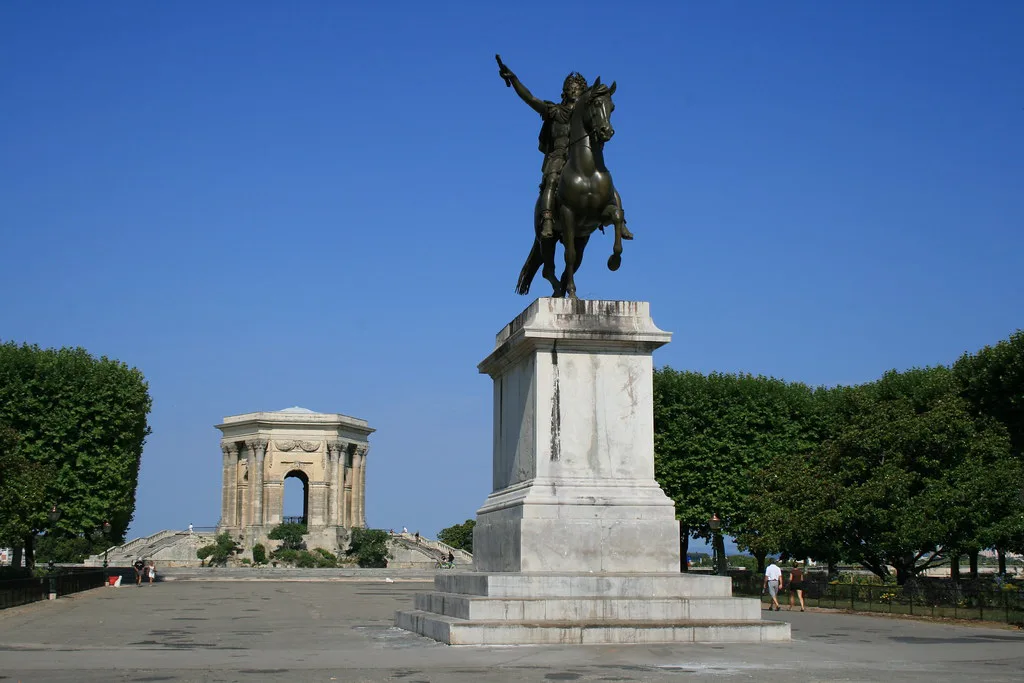
At the centre of the esplanade stands the equestrian statue of Louis XIV, the figure that fixes the square's royal identity and its sightlines. The monument is by Jean Giral, and it anchors the formal geometry of the space rather than sitting as a decorative afterthought.
Because the square was designed to be looked along and looked out from, the best photographs tend to be taken from the edges, facing in along the axis or out over the rooftops. Give the centre a few minutes, then move to the perimeter.
The Château d'Eau and the Saint-Clément Aqueduct
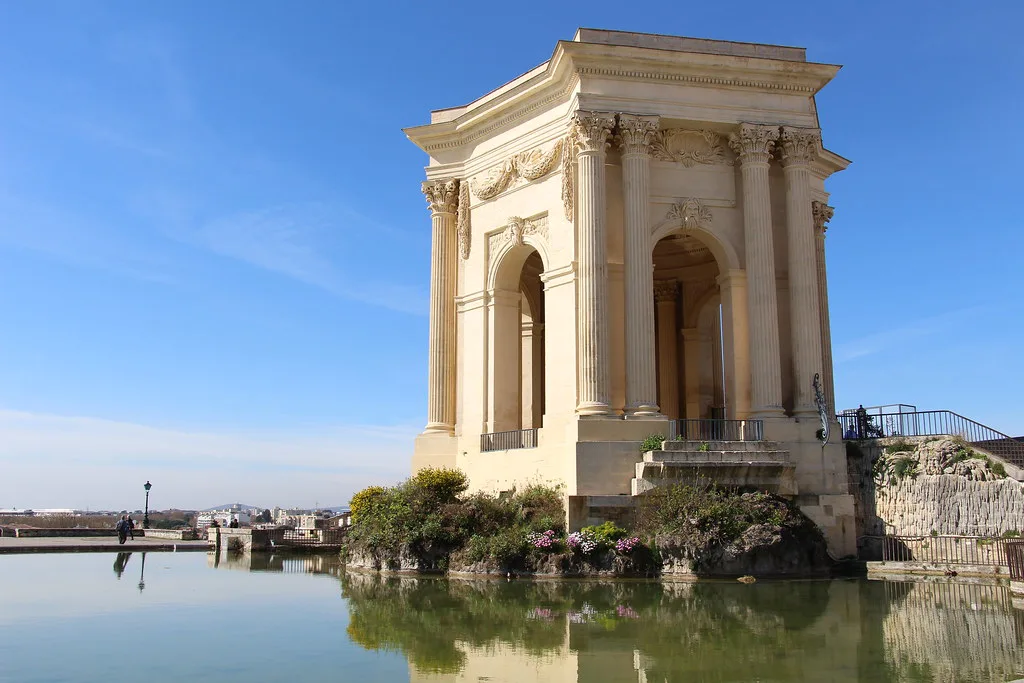
At the western end of the promenade you reach the Château d'Eau, the ornate 18th-century water tower, beyond which runs the Saint-Clément Aqueduct. Water is the organising idea of the whole site: the aqueduct brought it in, the tower received and distributed it, and the promenade was built as the monumental setting for that system.
The aqueduct continues as the Arceaux, the arcade that gives the neighbouring Les Arceaux district its name and its landmark. Standing at the tower and looking along the arches gives you the clearest reading of how the engineering and the ceremonial square fit together.
Views from the belvedere
The promenade occupies one of the highest points in the city, so from the open western edge you look out over rooftops and, on a clear day, towards the surrounding countryside. The payoff is the sweep rather than a single landmark view, so give yourself a few minutes at the rail rather than a quick glance.
Light matters more here than at almost any other sight in Montpellier: late afternoon and the hour before sunset bring warm light across the stone and the rooftops. Midday in July and August flattens the view and leaves you standing on hot, open paving with little shade.
How long to allow
Budget 30 to 60 minutes for the promenade on its own: enough to walk the axis, look at the statue and the tower, read the aqueduct and take in the view. If you are photographing or picnicking, add half an hour and come in the late afternoon rather than the middle of the day.
The site combines well with the Jardin des Plantes, the old botanical garden just below it, which is a short walk back towards the Écusson. Pairing the two gives you a natural half-day loop of open ground and shade.
For art, the Musée Fabre sits back in the old town within walking distance, and its galleries make a sensible rain-or-heat fallback after the exposed esplanade. Allow at least two hours there if you go in.
The Sunday flea market on the promenade
Les Dimanches du Peyrou is a Sunday flea and antique market held on the promenade, which fundamentally changes the character of a visit. Come on a Sunday and you are crossing a market rather than an empty esplanade; come on any other day and you get the architecture and the view uninterrupted.
Bring cash, because not every stall takes cards, and expect the stalls to occupy the central ground so the axis walk is slower. Check the city's own listing for the current schedule before you build a morning around it.
Practical points for the visit
There is no ticket to buy and no gate to pass, so the promenade works around whatever else you have booked. The trade-off is exposure: the esplanade is open, largely unshaded and uneven underfoot in places, which makes it hard work in heat and awkward with a pushchair or in thin soles.
Carry water and wear flat shoes, and time the visit for early morning or late afternoon in summer. There is no shelter on the open ground, so plan a café stop in the Écusson or Les Arceaux for afterwards rather than midway.
What is nearby
Place de la Canourgue, a tree-lined square in the oldest part of the Écusson, is a short walk back down and a good place to sit after the exposed promenade. The lanes of the old town, the cathedral and the university quarter are all within 20 minutes on foot.
Les Arceaux, below the aqueduct, is the obvious next stop on foot: the same water story, seen from street level, plus the district's own market life. From the promenade it is a descent of a few minutes rather than a separate trip.
Plan Your Visit
The Promenade du Peyrou is the one place in central Montpellier where you can read the city's royal planning, its water engineering and its geography in a single 40-minute walk. Go late in the day, walk the axis from the arch to the aqueduct, and treat the Sunday market as a different visit rather than a bonus.
Check the city's events listing before a Sunday visit and the TaM app for tram routes and fares, then build the rest of the day around the Jardin des Plantes and the Écusson lanes.
Explore more Montpellier guides
Frequently Asked Questions
Is the Promenade du Peyrou free to visit?
Yes. It is an open public esplanade rather than a ticketed attraction, with no gate or entrance fee, so you can walk on and off at any time of day.
How long should I allow for the Promenade du Peyrou?
Allow 30 to 60 minutes to walk the axis, see the statue of Louis XIV, the Château d'Eau and the aqueduct, and take in the view. Add time if you are visiting on a Sunday when the flea market is on.
How do you get to the Promenade du Peyrou from central Montpellier?
Walk west from Place de la Comédie through the Écusson and along Rue Foch to the Arc de Triomphe, which opens onto the esplanade; the walk takes around 15 minutes. Trams connect the wider city with the historic centre, and the TaM app lists current routes and fares.
Is there a market on the Promenade du Peyrou?
Yes, Les Dimanches du Peyrou is a Sunday flea and antique market held on the promenade. It changes the feel of a visit considerably, so check the city's current listing before planning a Sunday morning around it.
What else is near the Promenade du Peyrou?
The Jardin des Plantes is just below the promenade, Les Arceaux and its aqueduct arcade are a few minutes downhill, and the Musée Fabre, Place de la Canourgue and the cathedral are all within about 20 minutes on foot in the Écusson.
When is the best time to visit the Promenade du Peyrou?
Late afternoon and the hour before sunset give the best light across the stone and the rooftops. The esplanade is exposed with little shade, so avoid the middle of the day in summer.