
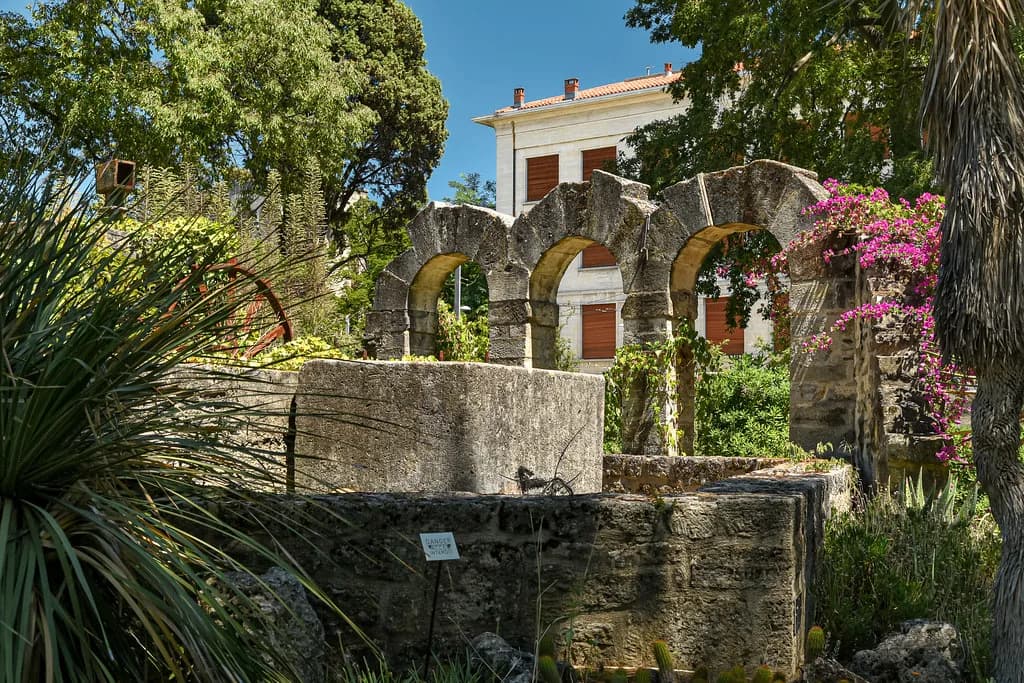
Jardin des Plantes, Montpellier: a Visitor's Guide to France's Oldest Botanical Garden
The Jardin des Plantes is Montpellier's botanical garden, founded in 1593 and described as the oldest in France, covering 4.5 hectares a short walk from the historic centre. You could cross it in fifteen minutes, but it rewards a slower hour spent on the terraces of the Montagne de Richer and among the glasshouses and memorial trees.
This guide treats the garden as one place: where it sits, what to look for by name, how long to give it and how it fits into a weekend in Montpellier. For the wider shortlist of sights around it, start with Montpellier Attractions: 6 Visitor Guides.
What the Jardin des Plantes is
This is a working botanical garden, not a landscaped city park: it began as a plot for medicinal plants, the simples of the medieval apothecary, before widening into the collections you walk past today. The original garden was far smaller than the present one and was laid out on the terraces that still form its historic core. It was ruined in 1622 during the siege of Montpellier, then rebuilt and enlarged over the following centuries.
That history explains the garden's character: a scientific collection that happens to be beautiful, with trees and buildings from different phases of French botany layered on top of each other. Allow enough time to read the labels and look up, because most of the interest is in individual specimens and structures rather than in a grand overall design.
Where it is and how to get there
The garden stands at 1 boulevard Henri IV on the eastern edge of the old town, tucked below the Tour des Pins and within easy walking reach of the historic centre. From the Place de la Comédie area, walk up through the Écusson's narrow streets towards the Faculté de Médecine; the garden gate appears as the streets open out. It is a realistic add-on to a walk between the cathedral and the covered markets rather than a separate excursion.
Montpellier's compact centre makes the garden an easy stop rather than a trip: the local tram network serves the old town, and the walk from the main squares takes well under half an hour. If you are still mapping the quarters, Montpellier Neighborhoods sets out how the Écusson fits together.
The layout: the Montagne de Richer and the English garden
The oldest part is the Montagne de Richer, five terraces where the first medicinal plants were grown; a statue of Richer de Belleval, the garden's founder, watches over them. Climbing those steps first puts the rest of the visit in order: you see the historic core before the later enlargements, rather than meeting them in reverse.
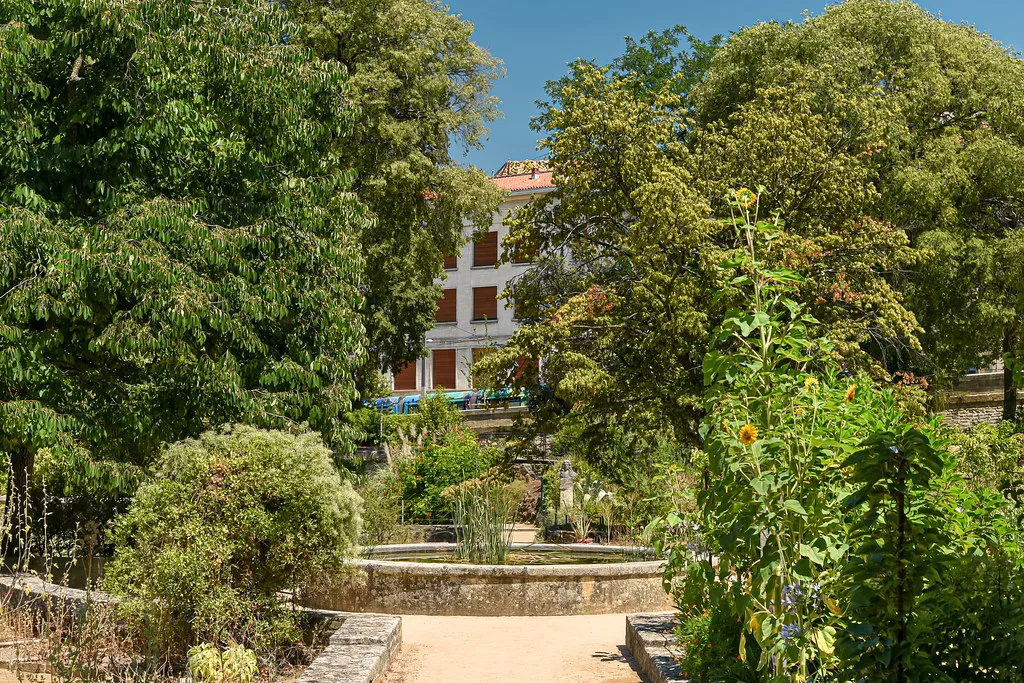
Between 1810 and 1860 the historic garden was enlarged twice to something close to its present size, with an eastern section given to the forestry school and a western one to vines, fruit trees and exotic plants. Charles Frédéric Martins, director from 1851 to 1880, added the English-style garden with its lake of Indian lotus, the Nélombos, and a small astronomical pavilion.
The Orangerie and its zodiac medallions
The Orangerie was designed by the Parisian architect Claude Mathieu de la Gardette and built between 1802 and 1804 at the urging of the botanists Antoine Gouan and Auguste Broussonnet. The building runs 49 metres, with 13 glazed arches topped by circular medallions of the zodiac signs as symbols of the months and seasons. It has always existed to shelter citrus and other tender plants from winter cold.
Inside is a bust of Augustin Pyrame de Candolle, the Swiss botanist who directed the garden from 1807 to 1816 and reorganised its systematic school and plant collections. The building and its surroundings were fully restored in 2017 with support from a foundation of 24 corporate patrons, so the arcades you see are a recent rehabilitation of an old structure.
The glasshouses: the Serre Martins
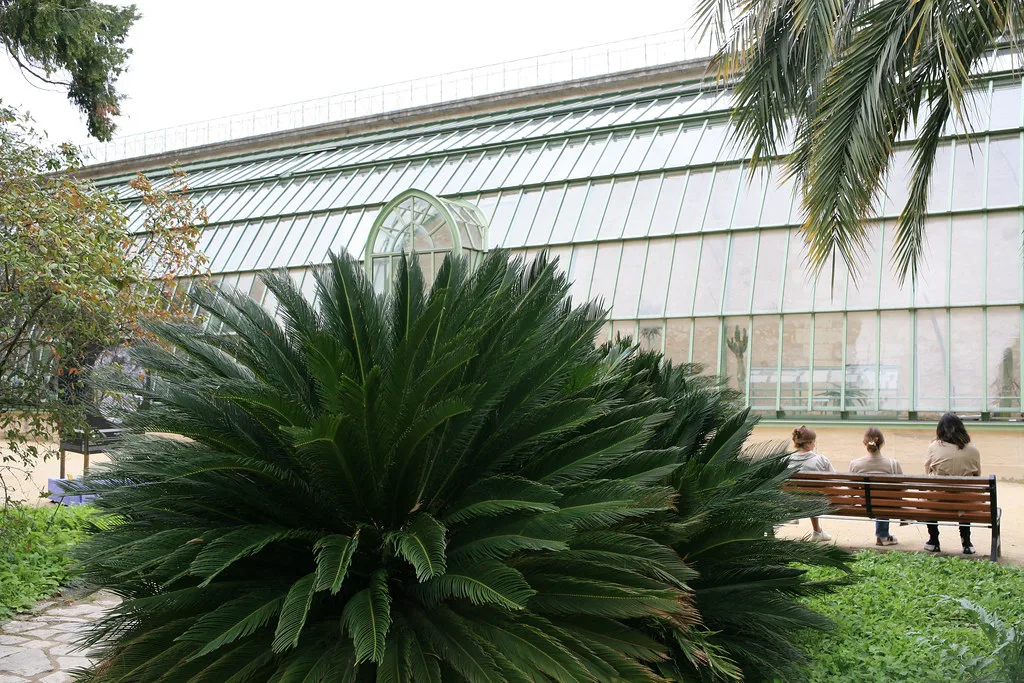
The Serre Martins is a 300-square-metre glasshouse named for Charles Frédéric Martins and filled mainly with cacti, agaves, aloes and other succulents from dry regions around the world. It is the part of the visit that most repays a closer look if you know Mediterranean planting, because the collection is arranged by habitat rather than by flower colour.
Martins was an explorer as well as a director, and his scientific missions across Europe and North Africa brought plants and improvements back to Montpellier. The glasshouse is not the largest you will see in France, but it gives the garden a useful contrast between the open terraces and a dense, dry-climate collection under glass.
The trees to look for
On the Montagne de Richer stands a broad-leaved filaire thought to be around 400 years old and the oldest tree in the garden. Its trunk has hollowed out over the centuries, and visitors push small slips of paper into the cavities with their wishes, hence its nickname, the wish tree or lovers' letterbox.
The ginkgo biloba was planted in 1795 and stands as a symbol of the medical faculty's revival; a male specimen, it was grafted with female branches around 1830 and became fertile. It is also known as the tree of the forty écus. Both trees are easy to miss if you walk only the central paths, so make a point of finding them early.
Monuments and stories: Narcissa and Rabelais
The garden holds a cénotaphe known as the tomb of Narcissa, a memorial to Elisabeth Lee Temple, an Englishwoman who died in Lyon and never set foot in Montpellier; the story that she was buried here at night is a legend. André Gide and Paul Valéry were among the writers drawn to the spot in the evening.
The Monument à Rabelais was erected in 1921 by Montpellier students who treated the writer as a model; Rabelais enrolled at the Faculty of Medicine in 1530. The figures on it include Gargantua and Pantagruel, with Frère Jean des Entommeures and Panurge on the hidden face. It is a five-minute stop that says a lot about how the city sees its student history.
The garden's fortunes are bound up with Pierre Magnol, the Montpelliérain botanist who classified plants by family and described nearly 2,000 species; the magnolia takes his name. The garden also drew nineteenth-century artists, and the Musée Fabre, Montpellier holds pencil and watercolour studies of the Tour des Pins seen from the garden, including one dated 1859.
Practical points: hours, tickets and time needed
Opening times differ between listings: one shows the garden open Tuesday to Thursday from 11:00 to 18:00, with a later Thursday closing, while another gives Tuesday to Sunday from 12:00 to 20:00. Check the garden's own site or the notice at the gate before you set out, especially for a Monday or an evening visit.
Give the garden 60 to 90 minutes: half an hour for the terraces and the two great trees, another twenty for the Orangerie and Serre Martins, and the rest for the memorials and the English garden. It works well as an early stop before the museums open, or as a shady break after a morning in the old town.
There is no need to pre-book anything for a normal visit, but the glasshouses and buildings may be closed at short notice for maintenance, so treat them as a bonus rather than the reason for coming. Entry arrangements are best confirmed on the garden's official University of Montpellier pages, which also list any guided visits.
Nearby: the Tour des Pins and the old town
The Tour des Pins rises beside the garden as one of the surviving fragments of the city walls, along with the Tour de la Babotte. Legend credits Nostradamus with prophesying that Montpellier would perish if the pines on the tower disappeared; the pines were removed in 1847, and two cypresses now grow in a purpose-made cavity instead.
From the garden gate you are a short walk from the cathedral and the lively student streets of the old town, and a little further from the Arc de Triomphe and the Place de la Comédie. Pair the garden with the Musée Fabre, Montpellier for its art collection, and finish on the Promenade du Peyrou for the view back over the city.
Plan Your Visit
The Jardin des Plantes suits travellers who like their sightseeing quiet, botanical and free of queues; it is not a headline monument and does not try to be. Come for the terraces, the filaire covered in paper wishes and the Orangerie's zodiac arches, and treat the glasshouses as a bonus.
Build it into a morning in the old town rather than a dedicated trip, and check the current hours before crossing the city for an evening visit. For the rest of your shortlist, from the cathedral to the arc de triomphe, see things to do in Montpellier.
Frequently Asked Questions
What is the origin of the Jardin des Plantes in Montpellier?
It began as a garden of medicinal plants laid out on the terraces of the Montagne de Richer and was ruined in 1622 during the siege of Montpellier, then rebuilt and enlarged. It is described as the oldest botanical garden in France, founded in 1593 and covering 4.5 hectares.
Is the Jardin des Plantes in Montpellier free to visit?
Check the garden's official University of Montpellier pages for current entry arrangements before you go. They are the reliable place for admission and any guided-visit details.
How long does it take to see the Jardin des Plantes?
Allow 60 to 90 minutes: half an hour for the terraces and the two great trees, twenty minutes for the Orangerie and the Serre Martins, and the remainder for the monuments and the English garden. A quick circuit of the central paths takes far less, but you would miss the named specimens.
What is the oldest tree in the Jardin des Plantes?
The broad-leaved filaire on the Montagne de Richer, thought to be around 400 years old. Its hollow trunk is used by visitors as a wish tree, with small slips of paper pushed into the cavities.
When is the Jardin des Plantes open?
Opening times vary between listings, so confirm on the garden's official site before you travel. One listing shows Tuesday to Thursday from 11:00 to 18:00 with a later Thursday closing; another gives Tuesday to Sunday from 12:00 to 20:00.
What should I look for near the garden?
The Tour des Pins, one of the surviving pieces of the city walls, stands beside the garden and carries the legend of Nostradamus and the pines. The cathedral and the old-town streets are a short walk away.