
The Gardens of Versailles: A Visitor's Guide to the Layout, Groves and Timing
The Gardens of Versailles are the designed landscape around the Château de Versailles: formal parterres, wooded groves, fountains and a cross-shaped Grand Canal, all laid out from 1661 by André Le Nôtre for Louis XIV. They are not a lawn you cross on the way in. The estate covers 830 hectares with more than eight miles of pathways, so the gardens need their own time budget even if you skip the palace interiors.
Treat the gardens as a standalone attraction rather than an add-on. A brisk circuit of the main axis takes about two hours; a relaxed one with a meal runs two to four hours, and adding the Trianon estate pushes the day to four or five. Deciding your time budget before you arrive is the single most useful planning step.
Where the gardens sit within the estate
The gardens open directly behind the palace, west of the Cour d'Honneur, and the château exit on the left-hand side leads straight into them. From there the Parterre and the Orangerie terrace sit closest to the building, with the Great Perspective running away toward the Grand Canal and the Trianon estate beyond.
Three stations serve Versailles, and the walk to the gardens differs by each. RER C to Versailles–Château–Rive Gauche puts you about 10 minutes on foot from the palace, Line L from Saint-Lazare arrives at Versailles–Rive Droite roughly 15 to 20 minutes away, and Line N from Montparnasse stops at Versailles–Chantiers about 15 minutes out. Rive Gauche is the obvious choice if the gardens are your priority.
Security screening at the Honor Gate is a routine bag check, with waits of five to ten minutes reported in summer. If you already hold a garden or Passeport ticket you still pass through the courtyard, so allow for it in your timing rather than expecting a direct walk-through.
The layout: Parterre, Orangerie and the Great Perspective
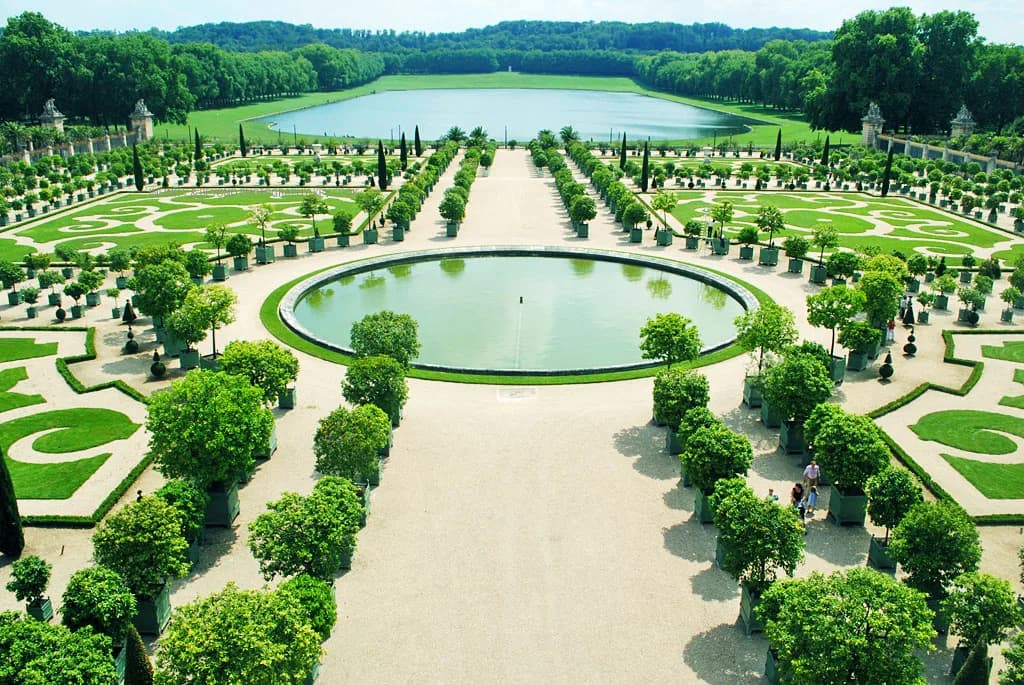
The garden reads as a series of stages on one axis. Turn left after leaving the château to reach the Parterre, a symmetrical terrace that opens the first big view, then continue to the Orangerie, where the kings of France kept their orange trees as a display of wealth. The balcony above the Orangerie gives the best elevated panorama in the garden.
From the garden access point it is roughly 200 metres to the start of the Great Perspective, and with a stop at the Orangerie you reach the first panorama in about three minutes. A broad staircase flanked by two fountains marks the entrance to the axis.
Le Nôtre used optical tricks to make distances look shorter and horizons closer, which is why the garden can feel smaller than it is. The result is a landscape built for walking rather than viewing from one spot, and the effect only works when you move through it.
The Green Carpet and the walk to the Fountain of Apollo
The central lawn, the Green Carpet, runs 330 metres along the axis, longer than the Eiffel Tower is tall. From the top of the Great Perspective to the Fountain of Apollo at the end of the formal gardens is 500 metres, about a 10-minute walk. That stretch is the spine of any garden visit and the part to do first while your legs are fresh.
Beyond the Fountain of Apollo the ground opens toward the Grand Canal, a cross-shaped waterway 24 hectares in extent where royal festivities and mock naval battles once took place. Louis XIV sailed it in a 20-metre galley powered by 42 rowers. Reaching the canal edge and turning back is a reasonable cut-off if you are short of time.
Le Nôtre's groves as outdoor rooms
The groves, or bosquets, are the wooded enclosures off the main axis, conceived as outdoor salons that mirror the rooms of the château. Most were created by André Le Nôtre over five decades, and the design principle is balance, symmetry and geometry. They are where the garden rewards wandering rather than marching.
Not all groves are open every day. Selected groves open to visitors on Tuesday, Saturday and Sunday from April to October, so build your visit around one of those days if the bosquets matter to you. On other days you see the main axis and the open gardens instead.
The estate holds 300 statues and around 50 working fountains across the grounds, so you will pass sculpture and water at almost every turn. Thirty lakes carry water jets, which is why the garden's character changes so much when the fountains are running.
Left-side picks: Ballroom, Mirror Basin and Colonnade
Start closest to the château and work down the left side first. The Ballroom Grove is a theatrical outdoor amphitheatre where fountains, stone staircases and greenery once staged Louis XIV's entertainments. It is the most stage-like of the groves and a good first stop.
Next comes the Mirror Basin, a water feature built around reflections and Le Nôtre's handling of light. Then the Colonnade Grove, a ring of 32 marble columns around a fountain designed by Mansart and modelled on a classical temple. Together the three make a compact circuit that takes well under an hour.
Right-side picks: Enceladus, Apollo's Bath and Neptune
The right side is best done from the far end back toward the château. The Enceladus Grove shows the giant crushed beneath Mount Olympus in a fountain composition about the downfall of rebellion, and Apollo's Bath Grove shows the sun god resting with the Muses, a nod to Louis XIV's chosen emblem.
The Three Fountains Grove is the hydraulic showpiece, with three terraces of fountains echoing each other in geometric harmony. Nearby, the Dragon Fountain is among the oldest water displays at Versailles, while the Basin of Neptune is the largest and most spectacular fountain complex on the estate.
The Triumphal Fountain closes the sequence with a baroque composition celebrating royal power and victory. If you only have an hour for groves, pick Neptune's Basin and the Colonnade and accept that the rest waits for another visit.
The Orangerie: the 155-metre parterre
The Orangerie is the south-facing garden beneath the Parterre du Midi, 155 metres long and planted with orange and lemon trees, rose bushes and centuries-old pomegranates. It extends over three hectares, flanked by two galleries that lead to the Hundred Steps.
The balcony above it is the viewpoint to prioritise: a sweeping, bird's-eye panorama that makes the scale of the garden legible in a way the ground-level paths do not. The Swiss Lake below was created to irrigate the king's vegetable garden.
Water: fountains and the Grand Canal
The garden was commissioned in 1661 and has been replanted roughly once a century to hold its design, most recently after storms in the late 20th century. That cycle is why the planting looks youthful rather than ancient, while the geometry is original.
The Grand Canal has been emptied three times: in 1792 to turn it into a vegetable garden, in 1808 when Napoléon restored its banks, and in 1940 over fears it made an easy target for bombers. Today it is the long horizon at the end of the Great Perspective and the natural turning point of a garden walk.
Fountain displays run to their own schedule, separate from garden opening. The estate stages the Grandes Eaux Musicales with water set to baroque music, and the fountain shows are the reason many visitors choose their date first. Confirm the current calendar and times on the official château site before booking travel.
The Trianon estate and Marie-Antoinette's English Garden
The Trianon estate is a separate world at the far end of the grounds, more intimate and quieter than the main garden. It holds three sites: the Grand Trianon, Louis XIV's pink-marble retreat; the Petit Trianon, the neoclassical house Marie-Antoinette made her own; and the Queen's Hamlet with its English Garden, a contrived rural village of dairy, mill and farmhouses.
The walk from the château to the Trianon covers 2.2 km, about 30 minutes at a leisurely pace, though a small land train and other estate transport cover the distance. The Trianon estate opens only in the afternoon, from 12pm, so it slots naturally after a morning in the gardens.
Budget three to four hours for all three Trianon sites without a proper lunch, or four to five with a meal. The Petit Trianon itself takes under 30 minutes; the time goes on the English Garden and the Hamlet, where winding paths and the Temple of Love on its artificial island reward a slow pass.
Tickets: Passeport, garden entry and Trianon-only access
Three ticket types matter for the gardens. The Passeport covers the château, gardens and Trianon and is priced by season, at 32 euros from April to October and 24 euros from November to March, with a timed palace slot. The Billet Château at 21 euros covers the palace and gardens in low season, and the Billet Domaine de Trianon at 12 euros covers the Grand Trianon, Petit Trianon, the Queen's Hamlet and the gardens in low season. These figures were published with a November 2025 update date, so treat them as a guide and confirm the current price when you book.
In-person numbers for the château-only and Trianon-only tickets are limited, and booking online is the safer route in season. Admission is free for under-18s worldwide, under-26 EU residents, disabled visitors plus one companion, and holders of certain professional cards. Carry proof of age or status, because the concession is checked at entry.
The palace interiors are a separate decision from the garden. The Hall of Mirrors and the State Apartments follow a marked one-way route and eat into garden time, so many visitors split the day between the two rather than trying both at pace; see the palace guide for the interior circuit.
How much time to allow
Two hours covers the Parterre, the Orangerie viewpoint, the Green Carpet and the Fountain of Apollo without a break. Add an hour for a serious pass at the groves on the left and right, and another for the canal end of the axis. That is a full half-day before the Trianon is counted.
If you want both the gardens and the Trianon, plan a full day and start at opening so the Trianon fits its midday slot. If you only have an afternoon, choose one: the main axis and Orangerie for the big views, or the Trianon for the quieter, more human-scale landscape.
Getting back and what to see on the walk out
Allow 15 to 20 minutes to walk back to your station, longer if you leave from the Trianon end of the grounds. Rive Gauche is the shortest return on foot, which makes it the easiest choice for a garden-led day.
The town of Versailles around the palace is home to around 85,000 residents and has its own markets and streets worth an hour if you have it. If you are staying over, the area guides cover where the town's quarters sit relative to the château; otherwise, one sentence of advice: a day trip from Paris is easy, but the gardens alone justify the trip.
Plan Your Visit
Decide first whether you are visiting the gardens alone or pairing them with the palace, then fix your day around grove opening and the Trianon's afternoon start. Book the Passeport online if you want both gardens and Trianon, and go for the garden-only or château ticket if your time is short.
Arrive via Rive Gauche if the gardens are the point, wear shoes for eight miles of paths, and start at the Orangerie balcony before walking the Green Carpet to the Fountain of Apollo. Everything else in the garden is a choice you make from there.
Explore more Versailles guides
Frequently Asked Questions
Are the Gardens of Versailles free to enter?
Not generally. Garden access is included in the Passeport, the Billet Château and the Billet Domaine de Trianon, and admission is free for under-18s worldwide, under-26 EU residents, disabled visitors with one companion and holders of certain professional cards. Check the official château site for the current position before you travel.
How long does it take to walk through the Gardens of Versailles?
Allow about two hours for the Parterre, the Orangerie viewpoint, the Green Carpet and the walk to the Fountain of Apollo. Add an hour for a proper look at the groves on each side and another for the canal end of the axis, which makes a half-day before the Trianon estate is counted.
Which day should I pick to see the groves?
Selected groves open on Tuesday, Saturday and Sunday from April to October, so plan a garden-led day around one of those. On other days the main axis, the Orangerie and the open gardens still give you the layout and the big views.
How far is the Trianon estate from the palace?
The walk from the château to the Trianon is 2.2 km, roughly 30 minutes at a leisurely pace, and estate transport covers the same route. The Trianon opens from midday, so it works best as an afternoon rather than a morning.
Do I need a separate ticket for the Trianon?
Either the Passeport or the Billet Domaine de Trianon gets you into the Grand Trianon, the Petit Trianon, the Queen's Hamlet and the gardens. The Billet Château does not cover the Trianon, so choose according to whether the estate is part of your plan.
When do the fountain displays run?
The fountain shows follow their own calendar, separate from garden opening, and the estate stages the Grandes Eaux Musicales with water set to baroque music. Check the official château site for the current dates and times before fixing your travel dates.