
Grand Trianon: A Visitor's Guide to Versailles' Pink Marble Palace
The Grand Trianon is a single-storey palace of pink marble and porphyry that Louis XIV had built as a refuge from court ceremony, and it remains the most refined building on the Versailles estate. It sits at the end of the northern branch of the Grand Canal, a 30-minute walk through the gardens from the main palace, so it is a deliberate detour rather than a stop on the way round.
Allow two hours for the Grand Trianon itself, more if you add the Petit Trianon and Queen's Hamlet on the same ticket. The trade-off is simple: the walk eats into your day, but the palace is quieter than the Château and the rooms are intimate rather than grand.
What the Grand Trianon is and why Louis XIV built it
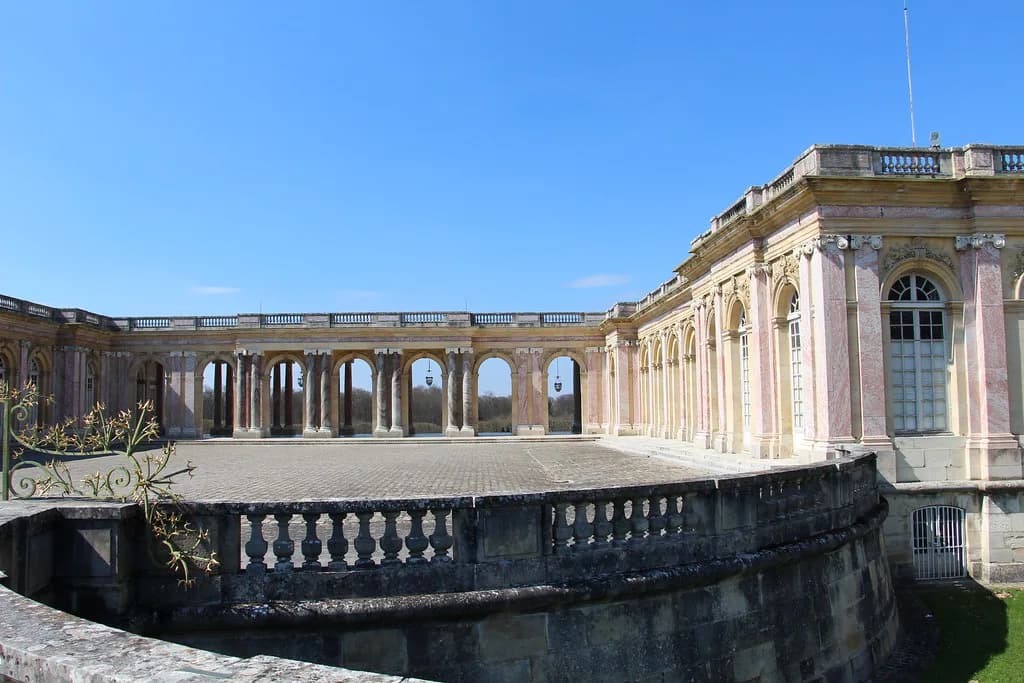
Jules Hardouin-Mansart erected the palace in 1687 on the site of an earlier Porcelain Trianon, following Louis XIV's instructions to the letter; the king even commissioned the Peristyle himself. It was originally called the Marble Trianon for the pink marble panels on its façades, and it was conceived as a private residence where the king could escape the arduous pomp of court life.
The building is set over a single storey, with a courtyard on one side and gardens on the other, and a balustrade running around the flat roof. That low, horizontal profile is what makes it feel like a garden pavilion rather than a palace.
Its later life matters as much as its origins: Napoleon restored and refurnished it, Marie Leszczynska used it in summer, and in 1963 General de Gaulle turned the North Wing into a presidential residence for visiting dignitaries. With a few exceptions the palace now shows First Empire interiors rather than Louis XIV's original furnishings, which were lost in the Revolution.
Where it sits on the estate
The Grand Trianon stands at the far end of the northern branch of the Grand Canal, on the estate of Trianon that adjoins the Petit Parc. The same estate holds the Petit Trianon, the Queen's Hamlet and a series of ornamental gardens, so the visit naturally clusters into one half-day.
Marie-Antoinette is associated with the Petit Trianon and the Hamlet rather than the Grand Trianon: Louis XVI gave her the Petit Trianon, and she built her cottage hamlet nearby. If her rooms are the reason you are coming this far, plan the Grand Trianon as the first stop and walk on from there.
Getting there from the palace
There are three ways to reach the Trianon palaces from the Palace of Versailles: on foot through the gardens, which takes about 30 minutes; by little train, getting off at the Grand Trianon or Petit Trianon stop; or by small electric vehicles. The walk is the most rewarding in good weather but the least forgiving if you are short of time.
You can also approach the Trianon palaces from the town of Versailles as well as from inside the estate, which suits anyone basing themselves in the town rather than arriving from Paris. Whichever route you take, note that the gardens carry an admission charge on days when the fountains are running unless you hold a Passport, Musical Gardens or Musical Fountains Show ticket.
Tickets and what they cover
The Estate of Trianon ticket costs 15 € at the standard rate and 12 € reduced. It includes the Grand Trianon, the Petit Trianon and their gardens, plus the Queen's Hamlet, which opens from noon, and temporary exhibitions held there.
Holders of a Paris Museum Pass still need to obtain a free ticket for the estate of Trianon, so the pass is not a walk-in at the gate. Only the Passport grants access to the whole estate, the Palace, the Trianon and the Gardens, and guarantees entry to the Palace.
Guided tours are priced separately and sit on top of admission; the Marie-Antoinette's Petit Trianon tour runs about 1½ hours from a meeting point at the Petit Trianon. If you want a guided visit rather than a self-guided walk, book it as an add-on rather than expecting it inside the standard ticket.
Opening hours and closures
The estate of Trianon opens from 12.00 pm to 6.30 pm and is closed on Mondays, 25 December, 1 January and 1 May. That afternoon start is later than most visitors expect, so build the morning around the Palace or the gardens and come out here after midday.
The gardens run from 7.00 am to 8.30 pm and the park from 7.00 am to 8.30 pm, so the grounds are open long before the palace interiors. If you arrive early, walk the gardens first and time your arrival at the Grand Trianon for noon.
The Peristyle, the palace's defining space
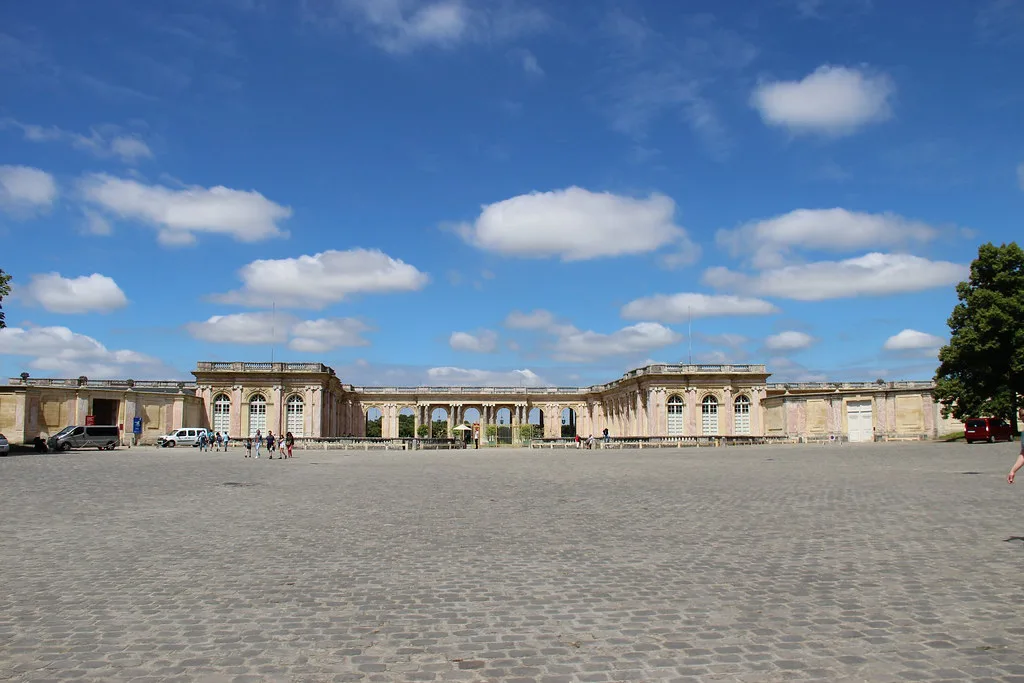
The Peristyle is the colonnade that connects the two wings, opening onto the courtyard on one side and the gardens on the other. Louis XIV personally commissioned it, and although the name is technically wrong, since a peristyle properly runs all the way round a building, the word stuck from the king's day.
This is the space that gives the palace its sense of light and transparency, and it works as a sheltered passage between the courtyard and the gardens. Napoleon had windows added on both sides in 1810 to make the crossing more comfortable; they were removed in 1910.
The Empress' Apartments and the Mirror Room
The left wing holds the Empress' Apartments, linked to the right wing by the Peristyle in a deliberate echo of how the Hall of Mirrors joins the King's and Queen's State Apartments at the Château. The Empress' Bedroom, once Louis XIV's own bedchamber, is split by a row of Corinthian columns and was divided in two under the First Empire for Marie-Louise.
The Mirror Room at the end of the South Wing has mirrored walls and a view over the Grand Canal, and served as Louis XIV's council chamber during his residence here from 1691 to 1703. It kept its original design but lost its furniture in the Revolution, and Napoleon later refurnished it; between 1810 and 1814 Marie-Louise used it for grand receptions.
State Apartments and the Emperor's Private Chambers
The right wing holds the State Apartments, and the sequence rewards a slow pass: the Round Room, one of the few spaces with Louis XIV's original Corinthian columns, marble floor slabs and wall paintings, then the Music Room, where shutters above the doors concealed the seats for musicians playing during the king's suppers.
The Malachite Room takes its name from the malachite sculptures Tsar Alexander I gave Napoleon, and the Cool Room, so called because it faces north, was Napoleon's council chamber and the place where Charles X took leave of his ministers on 31 July 1830. Its Louis XIV panelling and the paintings over the fireplace and between the windows survive.
The Emperor's Private Chambers are five rooms formed from Madame de Maintenon's rooms and a set furnished for Louis XV in 1750, with patio doors onto the former royal gardens. Napoleon moved in during December 1809, days after his divorce from Josephine, and the Emperor's Bedroom still holds the lemonwood fabric woven for Josephine in Lyon in 1807 and reused here in 1809.
The Cotelle Gallery and the Garden Room
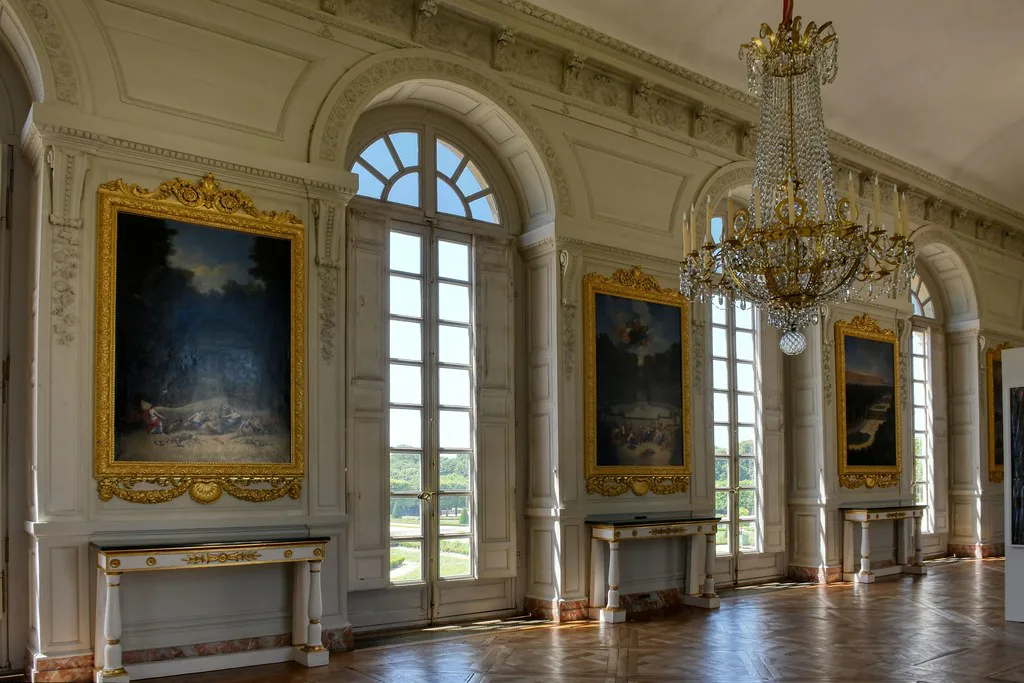
The Cotelle Gallery was positioned to shelter the flowerbeds from winter weather, with eleven full-length windows on the south wall and five on the north. It is lined with 24 paintings of the groves of Versailles and Trianon, 21 of them by Jean Cotelle, commissioned in 1687 and still a precise record of how the gardens looked when new.
At the far end, the Garden Room opens onto the Chestnut Grove and, past the raised flowerbeds, the side channel of the Grand Canal. In Louis XIV's day a games table stood in the middle of the room; a billiard table replaced it later.
What is closed in the North Wing
The North Wing of the Grand Trianon, the Trianon-sous-Bois wing that de Gaulle converted into a presidential residence, is closed until April as an exception. The Round Salon and the Belgian Queen's Apartment remain open to the public, so the closure trims the visit without gutting it.
Plan the interior route around the rooms that are open rather than around the wing, and ask at the entrance which spaces are accessible on the day you visit. The free estate leaflet, available at the entrance, carries a plan of the Trianon estate.
How long to allow
Two hours covers the Grand Trianon at an unhurried pace, and the 30-minute walk each way adds an hour to the round trip from the palace. The little train cuts the walking but ties you to its stopping points, so it suits anyone combining the Grand Trianon with the Petit Trianon and the Hamlet in a single afternoon.
If you are in Versailles for one day only, treat the Trianon as an alternative to a second pass through the Château rather than an addition. The estate opens at noon, so the morning belongs to the Palace and the gardens and the afternoon to the Trianon.
Gardens and the wider estate
The gardens of the Grand Trianon were laid out with immense flowerbeds and terraces planted with tens of thousands of aromatic flowers in pots buried in the beds, so the display could be changed daily. The effect was an ever-changing décor facing the garden side of the palace, and the geometric beds are still the reason to walk round the outside as well as through the rooms.
The Beautiful Waters of Trianon opens the gardens of the Grand Trianon and Petit Trianon and their fountains, including the Buffet d'Eau restored in 2023, on Tuesdays, Thursdays, Saturdays and Sundays from noon to 4 pm. Timed water displays are the one reason to fix your day before you travel.
Elsewhere on the estate, the Gallery of Coaches, the Sculpture and Mouldings Gallery on weekend afternoons, the Royal Tennis Court and the Park are free to visit. The interior of the Queen's House is accessible only on a guided tour.
Who should prioritise it, and who might skip it
Prioritise the Grand Trianon if you have a full day at Versailles, if you have seen the Château before, or if First Empire interiors and garden-facing architecture interest you more than crowds. The single-storey layout and the Peristyle make it the most civilised hour or two on the estate.
Skip it on a half-day trip, on a Monday when the estate is closed, or if you are travelling with people who will not manage the walk out and back. In those cases the Palace and gardens fill the time without the 30-minute trek each way.
Plan Your Visit
Build the day around the noon opening: Palace and gardens in the morning, then the walk or the little train out to the Trianon for the afternoon. Buy the Estate of Trianon ticket if the Grand Trianon and Petit Trianon are the point of the trip, and the Passport if you also want guaranteed entry to the Palace.
Check the official site for the day you plan to travel before fixing your dates, particularly for the North Wing closure and fountain-day garden charges.
Explore more Versailles guides
Frequently Asked Questions
What is the Grand Trianon at Versailles?
It is a single-storey palace of pink marble and porphyry built by Jules Hardouin-Mansart from 1687 for Louis XIV as a retreat from court ceremony. It stands at the end of the northern branch of the Grand Canal, with a courtyard on one side and gardens on the other, and most of its interiors now reflect the First Empire refurnishing by Napoleon rather than Louis XIV's lost original furniture.
Did Marie-Antoinette live in the Grand Trianon?
No. Marie-Antoinette is associated with the Petit Trianon, which Louis XVI gave her, and with the Queen's Hamlet she built nearby on the same estate. The Grand Trianon's royal residents included Louis XIV, Marie Leszczynska and later Napoleon and Marie-Louise.
Who lived in the Grand Trianon?
Louis XIV used it as a private retreat, Marie Leszczynska stayed in summer, and Napoleon restored and refurnished it and stayed here with Empress Marie-Louise. Louis-Philippe's family also spent time here, and from 1963 the North Wing served as a presidential residence for visiting foreign dignitaries.
How do you get to the Grand Trianon from the palace?
You can walk through the gardens, which takes about 30 minutes, take the little train and get off at the Grand Trianon or Petit Trianon stop, or use the small electric vehicles. The Trianon palaces can also be reached from the town of Versailles as well as from inside the estate.
How much does it cost to visit the Grand Trianon?
The Estate of Trianon ticket covers the Grand Trianon, the Petit Trianon and their gardens, plus the Queen's Hamlet and temporary exhibitions there; the current standard and reduced rates are listed on the official Château de Versailles ticket pages. Paris Museum Pass holders must still obtain a free ticket for the estate, and guided tours are priced separately.
Is the Grand Trianon open on Mondays?
No. The estate of Trianon opens from 12.00 pm to 6.30 pm and is closed on Mondays, as well as 25 December, 1 January and 1 May. The gardens and park open earlier, from 7.00 am, so an early start can be spent outdoors before the interiors open.
How long do you need at the Grand Trianon?
Allow about two hours for the palace itself and an extra hour for the return walk from the main palace, or use the little train to cut the walking. If you are adding the Petit Trianon and the Queen's Hamlet on the same ticket, set aside the whole afternoon.
Is the estate of Trianon worth visiting?
It is worth it on a full day at Versailles, especially if you have seen the Château before or want First Empire interiors and quieter garden-facing rooms. On a half-day trip the 30-minute walk each way and the noon opening make it hard to fit alongside the Palace.