
Petit Trianon: a Visitor's Guide to Marie-Antoinette's Pavilion at Versailles
The Petit Trianon is the small neoclassical palace that Louis XV commissioned from Ange-Jacques Gabriel and that was completed in 1768, set inside the gardens rather than beside the main Palace. It sits on the Trianon estate, which also holds the Grand Trianon, the Queen's Hamlet and several ornamental gardens. Marie-Antoinette received it as a gift from Louis XVI in 1774 and made it the centre of her private life at Versailles.
Visiting means a separate ticket, a separate part of the grounds and a walk or ride from the main building, so it is not something to squeeze in at the end of a Palace morning. The estate opens at noon and closes on Mondays, which shapes how you build the day. Allow a half-day if you want the Petit Trianon, the Grand Trianon and the outdoor walks without rushing.
What the Petit Trianon is
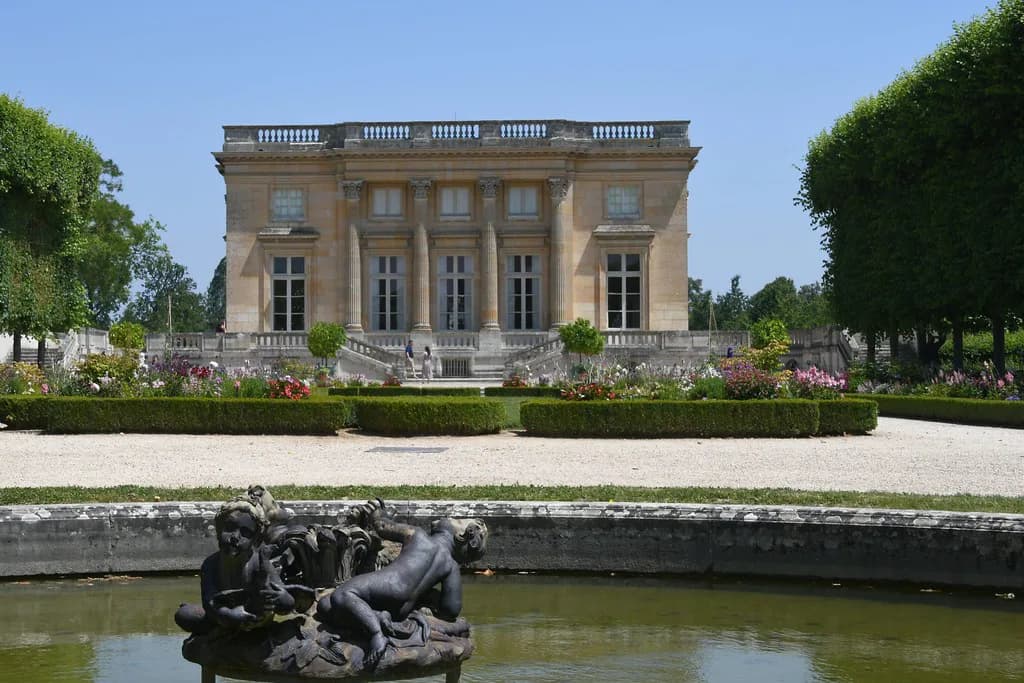
Louis XV wanted a pavilion in the middle of the gardens he had been developing for around a decade, and he asked Gabriel to design something large enough for himself and a small entourage. The result is a plain cube with a flat roof ringed by a balustrade, its four façades treated differently so the building never looks monotonous. The proportions are what make it famous: it is treated as a blueprint for neoclassicism, the restrained Greek style then spreading across Europe.
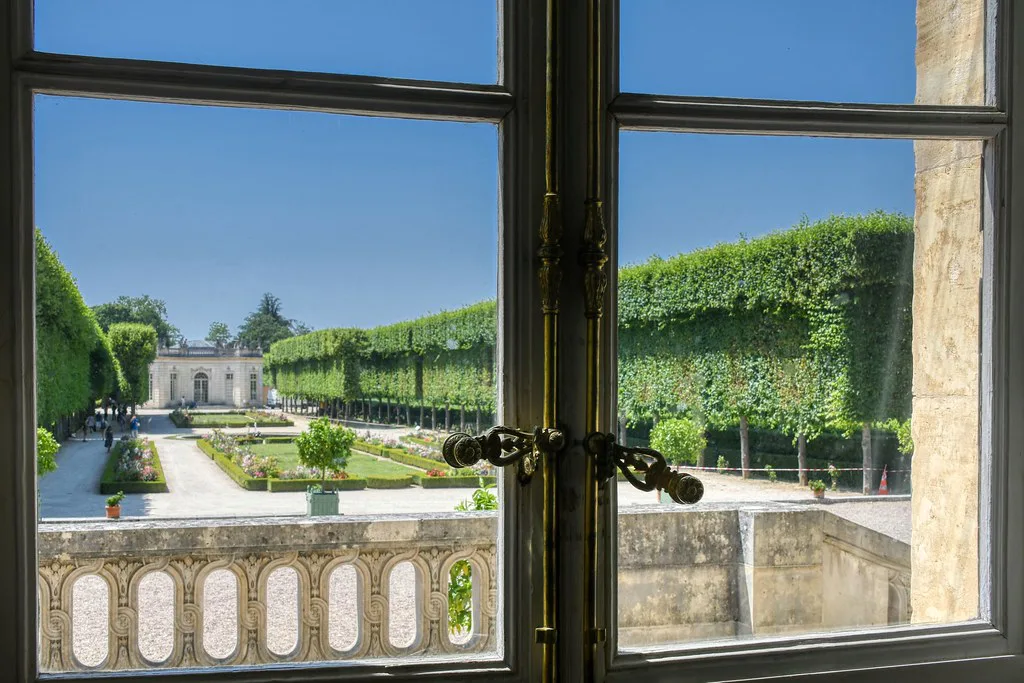
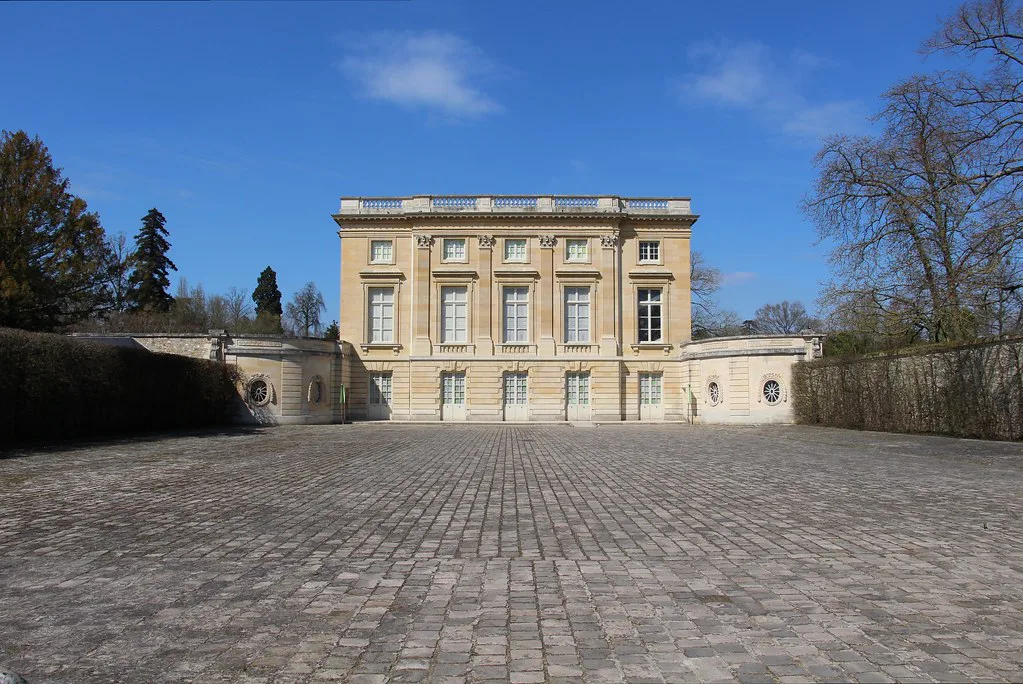
The distinctive façades are worth looking at from outside before you go in. The south side faces the Honour Courtyard with four pilasters over the three central bays; the north echoes it but with one less floor because the ground drops away; the west side, facing the French Gardens, is the richest, with four Corinthian columns and steps and terraces running down to the garden. Because the palace sits on a slope, the first-floor reception rooms open straight onto the gardens.
Where the Petit Trianon sits on the Trianon estate
The Trianon estate adjoins the Petit Parc, at the far end of the northern branch of the Grand Canal, and you reach it from either the town of Versailles or the main estate. The Grand Trianon, built from 1687 for Louis XIV under Jules Hardouin-Mansart, stands as a separate palace with its Peristyle and pink marble façades. The Queen's Hamlet, built between 1783 and 1786 under Richard Mique, is the third cluster of buildings, a rustic village with a windmill and dairy inspired by Norman architecture.
Treat the estate as a landscape to move through rather than a single museum. Louis XV's botanical collections were largely replaced after his death, with the French Garden kept and the rest reworked into landscaped grounds for Marie-Antoinette around a hamlet of cottages. That change explains why the view today is informal parkland rather than the ordered beds Louis XV knew.
Getting there from the Palace
There are three ways to cover the distance from the Palace: on foot through the gardens, which takes about 30 minutes; on the little train, getting off at the Grand Trianon or Petit Trianon stop; or by small electric vehicles. Walking is the cheapest and most flexible option and puts you in the gardens, but it costs you roughly an hour of the day in total. The train and the electric vehicles save your legs and suit anyone with limited time or mobility.
Note that the gardens themselves carry an admission charge on days when the fountains are running, unless you hold a Passport, Musical Gardens or Musical Fountains Show ticket. So a decision to walk across the gardens on a fountain day is also a ticketing decision. If you are heading straight from the Château de Versailles, buy or check your estate ticket before setting off rather than at the far end.
Tickets and prices
The Estate of Trianon ticket costs 15 € at the standard rate and 12 € at the reduced rate, and it covers the Grand Trianon, the Petit Trianon and their gardens, the Queen's Hamlet from noon, and temporary exhibitions held there. Holders of a Paris Museum Pass must still obtain a free ticket for the estate rather than walking up to the gate. Only the Passport ticket grants access to the whole Versailles estate, including the Palace and Gardens, and guarantees entry to the Palace.
The estate ticket is separate from Palace admission, so budget for both if you plan to see the state apartments and the Hall of Mirrors (Galerie des Glaces), Versailles before heading out to the gardens. Tickets are sold as non-refundable and non-exchangeable, which makes deciding your day and your ticket type in advance worthwhile.
Opening hours and closures
The estate of Trianon is open from 12.00 pm to 6.30 pm and is closed on Mondays, 25 December, 1 January and 1 May. The noon start is the detail that catches people out: a morning spent at the Palace cannot roll straight into the Petit Trianon, so either take the Palace first and arrive after midday, or reverse the order.
The ground floor
You enter through a gate flanked by two small pavilions at the end of a walkway lined with Lombardy poplars, into a walled Honour Courtyard that gives the place the feel of a private mansion. Inside, the Honour Staircase rises through the centre of the building under abundant natural light, its floor of green and white marble and its forged-iron and gilded-bronze banister carrying Marie-Antoinette's monogram in place of Louis XV's. The Billiards Room keeps a bust of the queen and one of Élisabeth Vigée-Lebrun's portraits of her.
Two small rooms explain how the palace worked. The warming-up room held food brought from the kitchens before it went to the royal table, and Marie-Antoinette had it closed soon after arriving because of the smells; the chimney hood remains. Beside it, the fruit repositories were where Louis XV planned retractable flying tables to raise set tables to the dining room above, a scheme abandoned when the engineer's price proved too high, and the Silverware Room displays where cutlery and Sèvres services, including a 1781 service of 295 pieces, were stored.
The chapel, built by Gabriel in 1772 over two floors, is deliberately plain, lit by high windows two of which are only painted on because the servants' quarters adjoin it. The altar is flanked by columns and topped by a painting by Joseph Marie Vien installed in 1776. It is a quick room to see, but it completes the picture of a house designed for private life rather than display.
The first floor
The Buffets Antechamber is the first room you reach upstairs, heated in Louis XV's day by two stoves, and it still opens directly onto the terrace and French Gardens. Marie-Antoinette had the small windowpanes replaced with large panes of glass, a luxury at the time, to blur the line between inside and out. It now holds Vigée-Lebrun's Marie-Antoinette with a Rose.
The Main Dining Room, where Louis XV dined for the first time on 11 September 1769, could seat 50, its panelling and blue marble fireplace decorated with laurels and garlands and its four paintings celebrating the seasons. The Small Dining Room next door seated twenty and is where Louis XV had considered the flying tables before abandoning the idea. Beyond them, the Reception Room has intricate carved panelling with Louis XV's monogram and a gilded bronze light fitting commissioned by the queen in 1784, alongside a piano-forte and a harp.
The Movable Mirrors Boudoir is the room to linger in. Marie-Antoinette had Louis XV's private staircase removed and turned this corner into a private retreat whose panels and movable mirrors could be raised or lowered by a mechanism on the floor below, concealing the doorways entirely. Louis XVI later copied the system for his bedchamber at the Château de Saint-Cloud.
Upstairs: the queen's rooms and the attic apartments
Marie-Antoinette took over the bedchamber from Madame Du Barry and had it redecorated by Jean-Démosthène Dugourc with furniture carved with wheat sheaves, ivy and jasmine to reinforce the rural character of the house. The library, created in 1780 by Richard Mique after the private staircase was removed, held literary, theatrical and botany books bound in marbled calfskin stamped with the queen's arms. It was used mainly by the queen's reader, sent to fetch titles at her request.
The attics hold a small apartment Gabriel converted for Louis XV and a run of rooms for the household. Louis XVI, who came for the day or for supper, kept his ancestor's décor but preferred to sleep at the Palace, so the gilded canopy bed is a replacement rather than an original, its crimson and white silk rewoven in Lyon from a 1769 inventory.
The rooms that follow are the reason to go up rather than turn back at the stairs. Madame Élisabeth, Louis XVI's sister, occupied the first, with floral printed cotton wallcoverings reproducing 1780s Jouy patterns and a portrait attributed to Vigée-Lebrun. Madame Royale, the queen's daughter, had her apartment converted in 1782 when she was four, close to her governess the Duchess of Polignac, and the Empress Marie-Louise's toilette room and bedroom recall the later imperial use of the house.
Marie-Antoinette and the Petit Trianon
Louis XVI gave the Petit Trianon to his wife in 1774, and she quickly made it her own, commissioning an extensive redesign of the grounds. It was in this building, in April 1774, that Louis XV suffered the first symptoms of the smallpox that killed him days later, so the gift and the change of reign are closely tied to the house itself.
Her most visible legacy is outside the walls. Louis XV's botanical gardens were replaced with an Anglo-Oriental landscaped garden in the fashion of the day, which the queen kept adding to, and the Queen's Hamlet followed in the 1780s as a rustic village for promenades and for her children's education. During the Revolution the palace briefly served as a hostel and the gardens narrowly escaped being split into allotments, before Napoleon restored palace and grounds, first for his sister Pauline and later for the Empress Marie-Louise.
Guided tour option
A guided tour, Marie-Antoinette's Petit Trianon, lasts 1½ hours, costs 10 € and meets at the Petit Trianon, and that price is in addition to admission. Otherwise the palace can be visited at your own pace. For anyone who wants the sequence of rooms and the court context explained rather than read from a panel, the supplement buys a coherent hour and a half; for a first visit with limited time, the self-guided route covers the same interiors.
How long to allow
Give the Petit Trianon itself an hour, and the Trianon estate half a day if you add the Grand Trianon, the gardens and the walk out and back. The 30-minute walk each way is the main cost, and it is the part most people underestimate when they book a Palace slot for late morning. Arriving at noon when the estate opens puts you ahead of the crowd that drifts out after lunch.
If your weekend in Versailles is short, decide between the Palace interiors and the Trianon estate rather than trying to do both properly in one day. The Palace rewards an early start and several hours; the Trianon rewards a slower afternoon. A sensible split is Palace in the morning, Trianon from noon, with the gardens as the link between them.
Nearby on the Trianon estate
The Grand Trianon is a short walk from the Petit Trianon and worth the extra time for the Peristyle and the Mirror Room where Louis XIV held council. The Queen's Hamlet sits further into the grounds, its interior accessible only on a guided tour, with access starting at noon, so the cottages cannot be counted on as a drop-in stop. The English Gardens around the Petit Trianon are where Marie-Antoinette's apartment looks out towards the Love Monument.
On Tuesdays, Thursdays, Saturdays and Sundays, the Beautiful Waters of Trianon opens the fountains of the Grand and Petit Trianon gardens, including the Buffet d'Eau restored in 2023, from noon to 4 pm. If fountains are the draw, match your day to that schedule and check current dates and times with the Château de Versailles before you travel, since garden admission rules apply on fountain days.
Plan Your Visit
The Petit Trianon works best as an afternoon in its own right: estate ticket in hand, arrive for the noon opening, look at the façades before going in, then work up from the ground floor to the attic rooms before walking the gardens. Build the day around the Monday closure and the separate Palace ticket, and the rest falls into place.
Explore more Versailles guides
Frequently Asked Questions
What is the Petit Trianon at Versailles?
It is a small neoclassical palace designed by Ange-Jacques Gabriel and completed in 1768 for Louis XV, set in the gardens on the Trianon estate rather than beside the main Palace. Louis XVI gave it to Marie-Antoinette in 1774, and she remodelled the grounds around it.
How do you get to the Petit Trianon from the Palace?
You can walk through the gardens in about 30 minutes, take the little train and get off at the Grand Trianon or Petit Trianon stop, or use the small electric vehicles. The gardens carry an admission charge on fountain days unless you hold a Passport, Musical Gardens or Musical Fountains Show ticket.
How much does it cost to visit the Petit Trianon?
It is covered by the Estate of Trianon ticket, which also includes the Grand Trianon, the Queen's Hamlet from noon and temporary exhibitions there. Paris Museum Pass holders still need to obtain a free ticket for the estate, and the optional guided tour is charged on top of admission.
Is the Petit Trianon open on Mondays?
No. The estate of Trianon opens from 12.00 pm to 6.30 pm and is closed on Mondays, 25 December, 1 January and 1 May.
How long should I allow for the Petit Trianon?
Allow about an hour inside the palace and half a day for the whole Trianon estate if you add the Grand Trianon and the gardens. The 30-minute walk each way from the Palace is the part most visitors underestimate.
Can you go inside the Queen's Hamlet?
The interior of the Queen's House is accessible only on a guided tour, and access to the hamlet starts at noon. The gardens and exterior are seen as part of the estate visit.
What should I see first on the ground floor?
Start in the walled Honour Courtyard, then take in the Honour Staircase with Marie-Antoinette's monogram, the Billiards Room, the warming-up room, the Silverware Room and the chapel before going upstairs.
Do I need a separate ticket for the Palace?
Yes. The Estate of Trianon ticket is separate from Palace admission, and only the Passport ticket covers the whole Versailles estate, including the Palace and Gardens, and guarantees entry to the Palace.