
Hall of Mirrors (Galerie des Glaces), Versailles: A Visitor's Guide
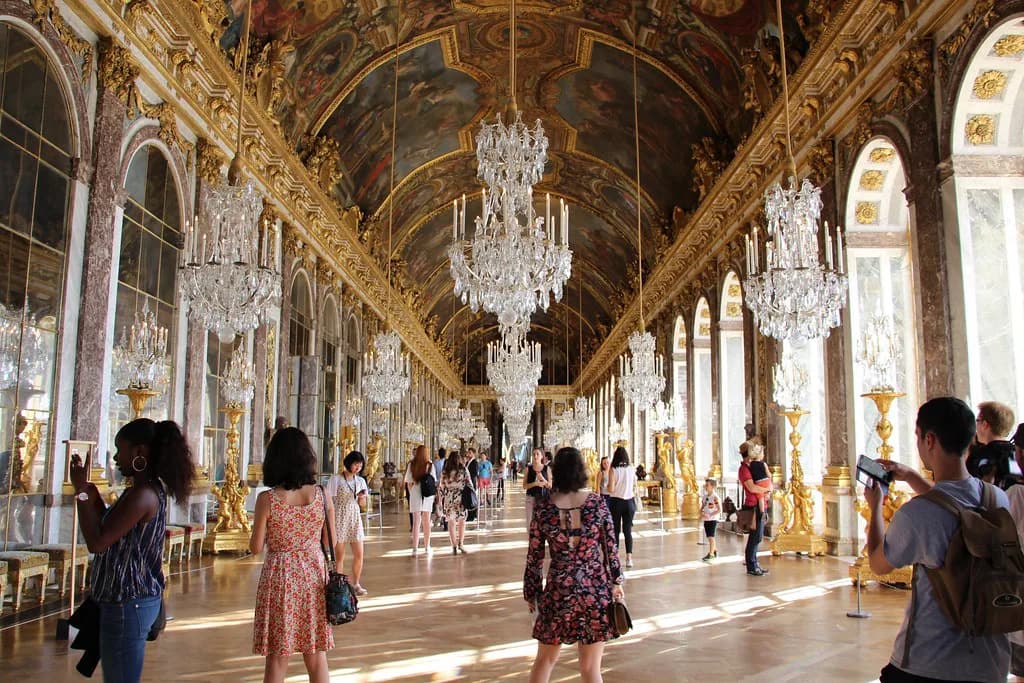
The Hall of Mirrors is the great gallery at the centre of the Palace of Versailles, a 73-metre room lined with 17 windows facing the gardens and 17 matching bays of mirror on the opposite wall. It sits on the first floor between the War Room and the Peace Room, so you reach it by walking through the King's and Queen's state apartments rather than finding it as a standalone stop. Treat it as the hinge of your palace visit, not a detour.
The gallery is famous well beyond France because the Treaty of Versailles was signed in it on 28 June 1919, ending the First World War, and French presidents have received official guests there since. Knowing that history helps you read the room: it is both a showpiece of royal display and a working stage for modern diplomacy.
What the Hall of Mirrors Is
The Galerie des Glaces is a long first-floor gallery built on the garden side of the palace, replacing an outdoor terrace designed by Louis Le Vau. Jules Hardouin-Mansart began construction in 1678 and the decoration was completed in 1686, which is why the room reads as the mature centrepiece of Louis XIV's building campaigns rather than an afterthought.
In its original use it was a thoroughfare: courtiers and visitors crossed it daily, and it doubled as a place to wait and meet. Ceremonies and diplomatic receptions were rarer occasions, when the throne was carried in from the Salon d'Apollon and set on a platform at the end near the Peace Room. That double life explains why the room feels more like a route than a chamber.
Where It Sits Inside the Palace
The gallery links two state suites. At one end the War Room connects it to the King's apartments, whose seven rooms are each dedicated to a planet and its Roman deity; at the other, the Peace Room opens onto the Queen's apartments. You pass through these rooms to reach the hall, so the visit unfolds as a sequence rather than a single reveal.
The War Room celebrates the military victories that closed the Dutch War of 1672 to 1678, and its walls carry marble panels with gilded bronze trophies; an oval relief by Antoine Coysevox shows Louis XIV on horseback. The Peace Room is its deliberate mirror image, with the same marble and gilt treatment but a programme praising the benefits of peace. Look at one, then the other, and the political argument of the whole suite becomes clear.
The Salon d'Apollon lies alongside this route and originally served as the king's bedchamber before becoming a throne room and music room. It is easy to pass quickly, but it is the room from which the throne was moved into the gallery for formal occasions, so it is worth a minute of your time.
Getting There from Paris
The palace stands in the town of Versailles, southwest of Paris, and the gallery is inside the main building rather than in the gardens or the estate's smaller palaces. Once you are through the entrance and security, follow the visitor route through the state apartments; the Hall of Mirrors comes partway along it, and you cannot step straight into the room from outside.
Because you arrive on the first floor via the apartment circuit, the gallery is a natural pause rather than a destination you navigate to separately. If your priority is this one room, walk the apartments briskly and slow down when the windows and mirrors appear on your right. Save the gardens for afterwards, when you will see them from the windows first and then from below.
What to Look at on the Walls
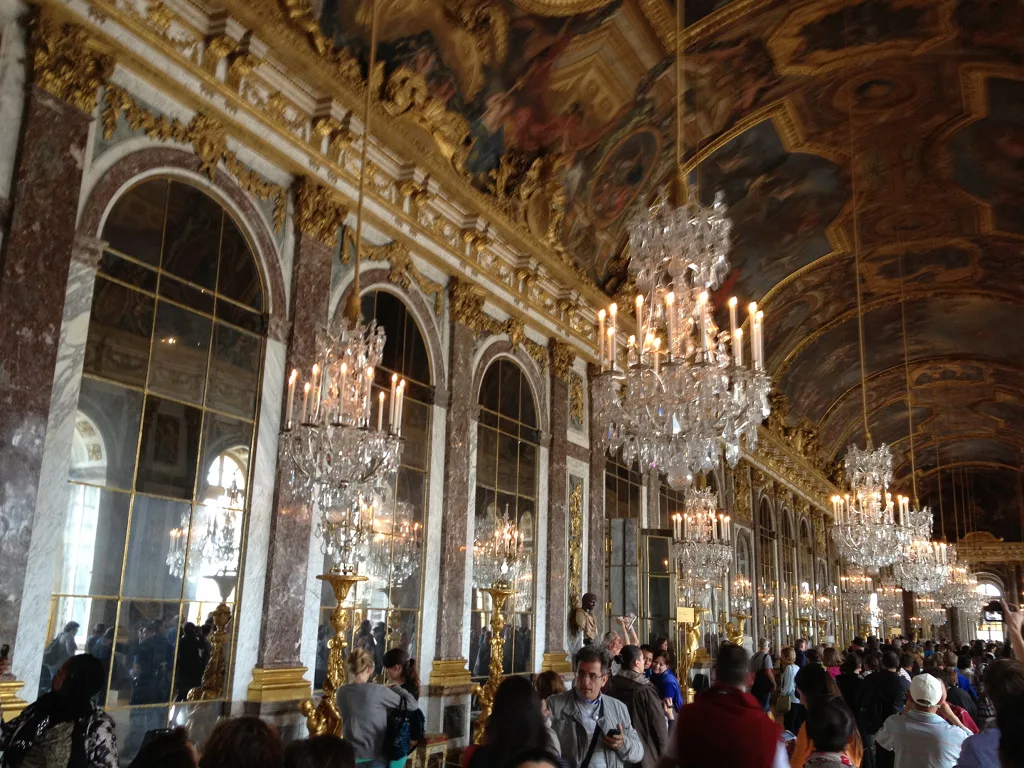
The architecture is a matched pair: 17 windows open towards the gardens, and opposite them 17 equally large mirror bays are assembled from more than 350 individual mirror panels. The effect is deliberate, bouncing the garden light back into the room and doubling the sense of depth. Stand at the mirror wall and look across, then at the windows and look out.
The gilded bronze and fleur-de-lis detailing throughout the gallery underlines the royal programme, but the mirrors themselves are the real subject. Because each bay is made of many small pieces, the reflections break slightly rather than reading as a single sheet, a detail that rewards a close look.
The Ceiling: Le Brun's Thirty Scenes
Charles Le Brun designed the vault decoration, 30 painted scenes that trace Louis XIV's political achievements from 1661 through to the peace treaties that ended the Dutch War. Read as a sequence, they move from the start of his personal rule to the settlements of the 1670s, with allegorical figures from antiquity standing in for the king's own deeds.
The ceiling is high and the light from the windows is strong, so give your eyes time to adjust and pick out one or two panels rather than trying to read all thirty. The ones nearest the War Room end sit above the military narrative, which makes them the easiest starting point.
Why Mirrors Were a Statement
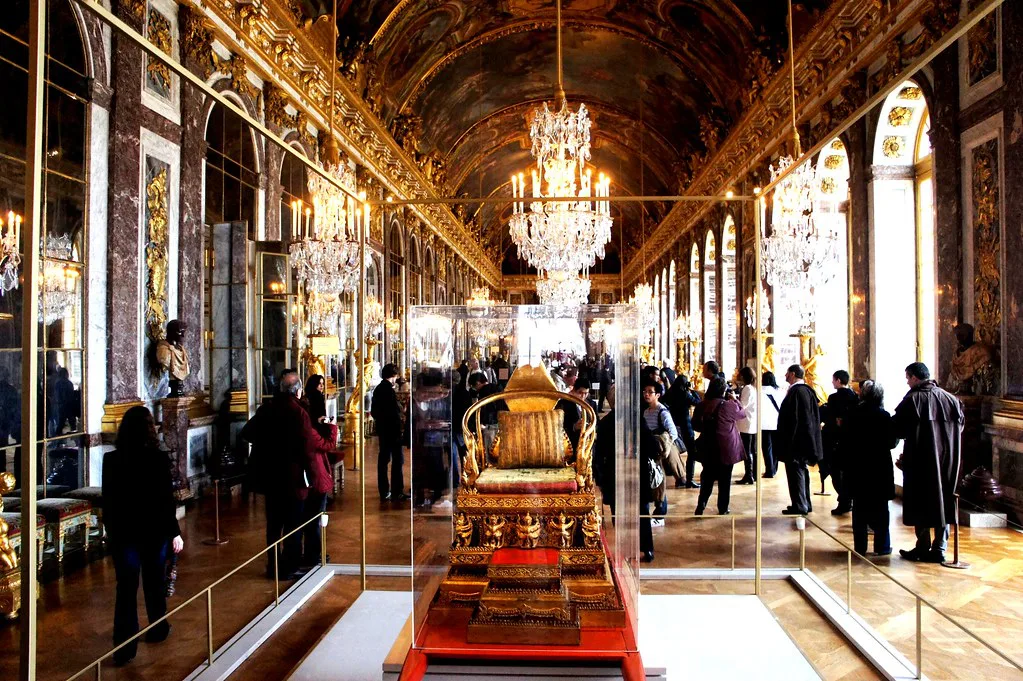
In the seventeenth century mirror glass was an expensive luxury controlled by a Venetian monopoly, so a room of this size was an economic claim as much as an artistic one. Jean-Baptiste Colbert founded a royal mirror factory to make France self-sufficient in luxury goods, and the gallery showed the results off at scale.
The room's original solid silver furniture was melted down and coined in 1689 to fund Louis XIV's wars, and much of the furnishing was lost in the Revolution; what you see along the walls today, including the sculpted candle holders, was made in the nineteenth century. Knowing that stops the room reading as an untouched survival.
The Room's Later Life
The Treaty of Versailles was signed in the gallery on 28 June 1919, and French presidents have continued to receive official guests there since. It is the reason many visitors recognise the room before they ever see it, and it is why parts of the hall can be screened off for protocol.
How Long to Allow
The gallery is 73 metres from end to end, and the visitor route through the apartments means you enter at one end and leave at the other, so you cannot loop back without rejoining the flow. Walking straight through takes only a couple of minutes; stopping at the windows, reading a few ceiling panels and looking at the War and Peace Rooms turns it into half an hour or more.
Budget your day in two parts: the gallery and its flanking state rooms, then everything else in the palace. If you are short of time, keep the apartments to a single pass and give the gallery the minutes you have saved, because the rooms either side are smaller and quicker to read. The gardens deserve their own slot afterwards rather than being squeezed in.
What's Nearby Inside the Palace
Beyond the state apartments, the palace holds the royal Chapel of Saint Louis, completed in 1710, whose tall vault breaks the otherwise flat roofline, and the Orangerie built by Hardouin-Mansart between 1684 and 1686. Both sit off the main circuit and are easy to miss if you follow the crowd towards the exit.
If the gallery has whetted your appetite for the wider estate, the Grand Trianon and the Petit Trianon are separate buildings in the grounds with their own visitor routes, reached on foot or by the estate's little train. They suit a longer day rather than a half-day visit, so decide before you arrive whether you are doing the palace alone or the palace plus the estate.
The View from the Windows
The west-facing windows line up with the garden axis laid out by André Le Nôtre, so from the gallery you look straight down onto the Bassin de Latone, the long grass avenue called the Tapis Vert, the Bassin d'Apollon and finally the Grand Canal, 1,500 metres long and 62 wide. Because the palace terrace sits above the garden, the view steps down in stages.
The Grand Canal was built between 1668 and 1671 and was designed both for boating parties and to collect water drained from the fountains, pumped back uphill to supply them. The whole axis faces due west, so late in the day the sun sits at the end of the canal, which is the effect Louis XIV traded on with his Sun King imagery.
Use the windows as a preview: note the fountain you want to reach, then exit into the gardens and walk the axis from the Bassin de Latone downwards. The scale reads very differently from ground level, and distances that look short from the gallery take longer on foot.
Tickets and Opening Times
The palace publishes its opening days, ticket types, prices and any timed-entry rules on its official site, and these change with the season and with special events, so check there before you book. Passport-style tickets that include the estate and the gardens are sold alongside palace-only tickets, which matters if you plan to add the Trianon buildings.
Because the Hall of Mirrors sits on the main palace route, any palace ticket that admits you to the state apartments includes it; there is no separate ticket for the gallery. Confirm the day's arrangements on the official site the week you travel, particularly if you want to combine the palace with the gardens.
Practical Tips for the Gallery
Security checks and bag rules apply at the palace entrance, and the visitor route runs one way, so carry only what you need and keep your ticket accessible for the whole circuit. The gallery is indoors, but the windows are open to the gardens and the light is bright on a sunny day.
If the room is busy, keep moving and drift back towards the windows or the ceiling rather than stopping dead in the middle of the route, which is what slows everyone behind you. A quick first pass end to end, followed by a slower second look at one end, usually covers more than trying to study everything at once.
Making the Most of the Gallery
The Hall of Mirrors works best when you treat it as the climax of the state apartments rather than a separate sight: the War and Peace Rooms set up the politics, the windows frame the gardens, and the ceiling finishes the argument. Give it half an hour at leisure and the rest of the palace its own time.
Build the rest of the day around what you have just seen: the gardens along the Bassin de Latone axis, and further out the Grand Trianon or the Petit Trianon if you have the hours. Check the official palace site for the day's opening and tickets before you set out.
Explore more Versailles guides
Frequently Asked Questions
How long does it take to walk through the Hall of Mirrors?
Walking the 73 metres end to end takes a couple of minutes, but the gallery sits partway along the state apartment route and you enter at one end and leave at the other. Plan around half an hour if you want to look at the windows, read a few of the ceiling panels and see the War and Peace Rooms on either side. Visitors who rush the apartments to reach the hall usually end up wishing they had saved time elsewhere.
Why is the Hall of Mirrors famous?
It is a 73-metre gallery with 17 garden-facing windows matched by 17 bays of mirror made from more than 350 panels, built as a display of French wealth at a time when mirror glass was a costly luxury. It is also where the Treaty of Versailles was signed on 28 June 1919, and French presidents have received official guests there since. That mix of royal showmanship and modern diplomacy is why the room is familiar even to first-time visitors.
What can you see from the Hall of Mirrors windows?
The windows face west along the garden axis, giving a stepped view down to the Bassin de Latone, the long grass avenue of the Tapis Vert, the Bassin d'Apollon and the Grand Canal, which runs 1,500 metres to the edge of the park. Because the palace terrace stands above the garden, you see the whole layout at once and can pick out what you want to walk to afterwards.
Who painted the ceiling of the Hall of Mirrors?
Charles Le Brun designed the vault decoration, 30 scenes that follow Louis XIV's political achievements from 1661 to the peace treaties that ended the Dutch War in the 1670s, with allegorical figures from antiquity standing in for the king. The room itself was built by Jules Hardouin-Mansart from 1678, with decoration completed in 1686. Pick out two or three panels rather than trying to read all thirty.
Can you visit the Hall of Mirrors without entering the palace?
No. The gallery is on the first floor of the palace and sits on the main visitor route through the King's and Queen's state apartments, so there is no separate entrance or standalone ticket. Any palace ticket that admits you to the state apartments includes it, and you pass through the War Room and Peace Room to reach either end.
When was the Treaty of Versailles signed in the Hall of Mirrors?
The treaty ending the First World War was signed in the gallery on 28 June 1919. The room had been used for ceremonies and diplomatic receptions under Louis XIV, when the throne was moved in from the Salon d'Apollon for special occasions, so the 1919 signing continued an existing tradition of using the hall for state business.
How do you get to the Hall of Mirrors from Paris?
Travel to the town of Versailles, southwest of Paris, and enter the palace, then follow the visitor route through the state apartments on the first floor; the gallery appears partway along it. There are no short cuts into the room from outside, and security checks apply at the palace entrance, so allow time before your slot.
Where can you check Hall of Mirrors tickets and opening times?
The palace publishes its opening days, ticket types, prices and timed-entry rules on its official site, and these vary with the season and with special events. Check the day before you book, and check whether your ticket covers just the palace or the wider estate including the Grand Trianon and Petit Trianon.