
Quartier Montreuil, Versailles: The Old Village Beyond the Château
The Quartier Montreuil sits on the far side of the butte du Montbauron, away from the château and the crowds that queue for it. It is the part of Versailles that was not Versailles at all until the late 18th century, which is why its streets feel like a village that was quietly absorbed by a royal town rather than planned around a palace.
Treat it as a short detour to slot around a Versailles weekend, not a substitute for the château and gardens. The pay-off is a calm residential quarter with a parish church at its heart and a legible history in its street names; the cost is a half-day you could have spent in the gardens. If you are weighing a second day outside the palace gates, our guide to things to do in Fontainebleau offers a comparable château-plus-forest trade-off.
What the Quartier Montreuil is
Montreuil was a genuine village until its annexation to Versailles in 1787, and residents of the royal town had to leave the town to reach it. A local history chronicle describes it as a settlement set back behind the butte du Montbauron, within roughly a league of the village of Versailles, with its own church, its own small trades and its own taxes.
Its name goes back further than the kings. The chronicle traces the place to a Merovingian-era monastery founded by Saint Germain under the patronage of Saint Symphorien d'Autun, and to a medieval seigneurie held by vassals of the count of Montfort and the abbey of Saint-Germain-des-Prés. That deep origin explains the old parish dedication you can still see in the quarter's modern church, even though the medieval building itself is gone.
If you are working out where to base yourself rather than which quarter to wander, start with the area guides.
Where it sits and how it grew
The old village was not one cluster but two, split by the hill. One hamlet gathered around what is now the rue de Montreuil, the other along the chemin du petit Montreuil, which corresponds to today's rue de Vergennes and led toward the route de Sceaux. Reading a map with those two names in mind makes the quarter's odd, elongated shape suddenly sensible.
The decisive break came under Louis XIV, when the redesign of the great approach roads to Versailles cut the new avenue de Paris across the landscape and pulled the petit Montreuil toward the rue des Chantiers. The hill and the avenue between them kept the village physically separate even after the crown began buying its way in.
Louis XV set the process in motion in 1723, ordering a valuation of the Célestins' lands at 17,990 livres, and the religious order held out for years before accepting a land exchange on 1 January 1748 that was only ratified in September 1760. Louis XVI finished the job in 1787, annexing Montreuil to Versailles for fiscal reasons and to shut down small-scale smuggling between the two. All of this is 18th-century history, not a description of the quarter today.
The neighbouring Chantiers quarter, which took in the petit Montreuil, has its own approach to the same stretch of town.
Église Saint-Symphorien and the parish story
The parish church you find in the heart of the quarter is not the medieval one. As Montreuil became the third parish of Versailles after Notre-Dame and Saint-Louis, the old church on the edge of the village, at the crossing of the former route de Paris and today's rue Champ-Lagarde, was judged too remote and too peripheral, so it was demolished and replaced by a new building at the centre of the village.
The new church kept the ancient dedication to Saint Symphorien, a deliberate nod to the monastery that started the settlement. For a visitor, the point of the building is precisely that layering: a Merovingian origin, a vanished medieval church, a late 18th-century replacement standing on the village's central spot.
No opening hours, entry charge or visiting conditions for the church are listed here. Check the parish's own notices on the door or the town's church information before building a walk around going inside.
Arriving by train
The quarter has its own rail stop, listed at 8 Allée des Horticulteurs, 78000 Versailles. Knowing the address before you travel matters, because it tells you the stop is inside the residential quarter rather than at the château end of town, so your walk starts in the old village and heads toward the palace rather than the reverse.
Train frequencies and journey times vary by day, so check the current timetable with Transilien SNCF for your date rather than relying on a guidebook figure. If you are coming from central Paris, the practical question is simply which departure gets you to the Montreuil stop at a sensible morning hour.
Who the quarter suits, and who it does not
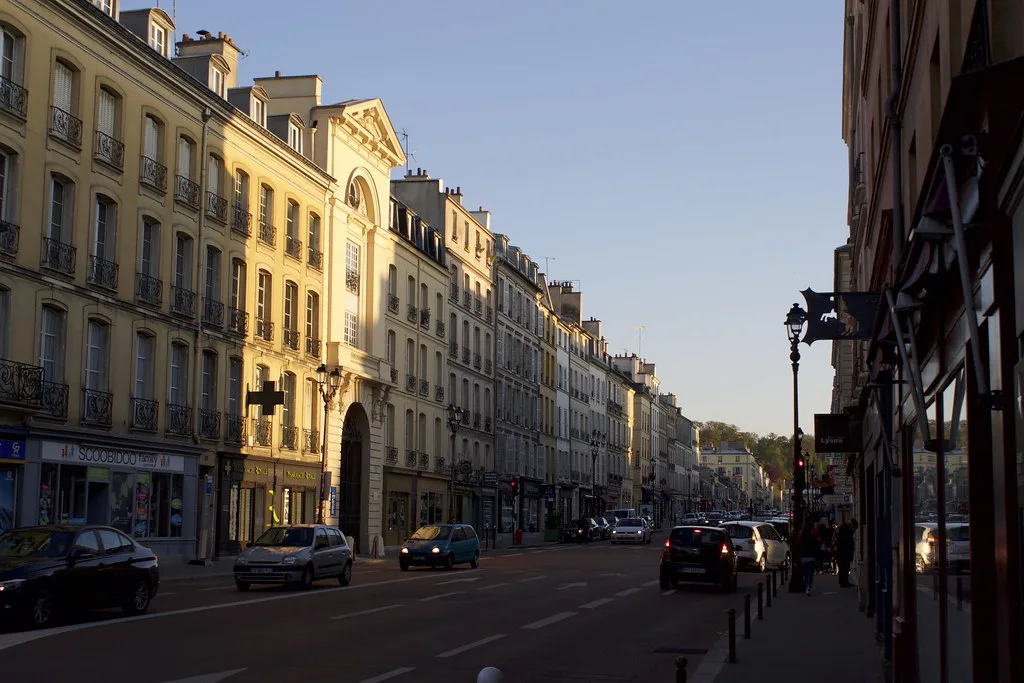
Montreuil rewards travellers who have already seen the château and want a quieter half-day in a real residential quarter with a story to follow. It suits anyone interested in how French towns absorbed their neighbours, and it suits slow walkers who prefer street names and old boundaries to another ticketed attraction.
It is a poor choice if this is your only day in Versailles, or if you want cafés, shops and a buzz around you. The quarter's appeal is historical and topographical, and much of what the chronicle describes, from the leper hospital at the foot of Montbauron to the wine plots on the côte de Picardie, has vanished. Do not go looking for buildings that no longer exist.
Eating and drinking: what the record shows
On the eve of the Revolution the village had a reputation as a Sunday playground for Versailles, with cabarets and guinguettes that drew townspeople out to enjoy themselves. That is history, not a current restaurant list, and no present-day address in the quarter is named here because none is documented in the sources for this guide.
For eating, plan around the centre of Versailles and treat Montreuil as a walk rather than a meal stop. The quarter's older trades were bakers, pork butchers, barbers, laundresses and market gardeners supplying the court with rye, hay, vegetables and a little wine, which tells you the place was always more productive than fashionable.

Within walking distance
The butte du Montbauron is the quarter's landmark and the reason for its shape; the two old hamlets lay on either side of it. Climbing it or skirting it gives you the orientation the street plan refuses to provide, and the rue des Chantiers leads you back toward the centre of Versailles on foot.
Porchefontaine, the neighbouring quarter on the same side of town, was historically bound up with Montreuil: the two seigneuries were bought and sold together in the 14th century, and the château of Porchefontaine stood in a pond there.
For the contrast, the Quartier Saint-Louis shows what a planned royal quarter looks like, laid out in grid form rather than grown from hamlets around a hill.
Fitting Montreuil into a Versailles weekend
Give Montreuil two to three hours on foot, plus the walk back. Come on a weekday if you want the residential streets at their calmest, and remember that many French museums and shops keep their own weekly rhythms, so check the specific place you intend to enter rather than assuming a Sunday or Monday opening.
The honest trade-off is against time inside the château and gardens, which is where most first-time visitors should spend their limited hours. Montreuil works best on a second visit, or as an early-morning loop before a timed château entry, and it pairs naturally with the wider list of things to see in town.
Plan Your Visit
Montreuil is the quarter that explains Versailles' edges: a former village, split by a hill, swallowed by a royal town in 1787, with a church at its centre that remembers a Merovingian monastery. Walk it for the street pattern and the history, not for attractions with queues.
Slot it around the château rather than in place of it, arrive via the Montreuil stop at 8 Allée des Horticulteurs, and use the hill and the rue des Chantiers to find your way back into town.
Explore more Versailles guides
Frequently Asked Questions
Where is the Quartier Montreuil in Versailles?
It lies on the far side of the butte du Montbauron, away from the château, and grew from two hamlets either side of the hill: one around today's rue de Montreuil, the other along the former chemin du petit Montreuil, now rue de Vergennes.
Is Montreuil part of Versailles?
It is today. Montreuil was a separate village until Louis XVI annexed it to Versailles in 1787, partly for fiscal reasons and partly to stop small-scale smuggling between the two.
What is there to see in the Quartier Montreuil?
The main landmark is the Église Saint-Symphorien at the heart of the old village, a late 18th-century replacement for an older parish church that stood on the village edge. The street pattern around the hill, with the rue de Montreuil and rue de Vergennes, is the other thing worth following.
How do you get to Montreuil in Versailles by train?
There is a Montreuil rail stop at 8 Allée des Horticulteurs, 78000 Versailles. Departure times vary by day, so check current details for your date.
Is the Quartier Montreuil worth visiting on a weekend in Versailles?
Yes if you have already seen the château and gardens and want a quiet half-day in a residential quarter with a clear history. On a first and only day in Versailles, the palace and gardens should come first.
When was Montreuil annexed to Versailles?
In 1787, under Louis XVI, after Louis XV had begun buying up the area decades earlier with a valuation of the Célestins' lands in 1723 and a land exchange accepted in 1748.
Can you go inside the Église Saint-Symphorien?
Visiting conditions are set by the parish rather than fixed for tourists, so check the notices at the church or the local parish information before planning a walk around going inside.