
Abbaye Saint-Serge, Angers: What to See Inside the Abbey Church

The Abbaye Saint-Serge is a former Benedictine monastery just north of the old centre of Angers, and the part you can actually visit is its abbey church, which still serves the parish. Everything worth seeing is under one roof: an 11th-century transept, a 13th-century choir and a 15th-century nave, three building campaigns you can read in the stone as you walk through. The monastic range beside it now belongs to a school, so plan the visit around the church rather than expecting a museum complex.
What the Abbaye Saint-Serge is
A Merovingian royal foundation of the 7th century, Saint-Serge was reformed around the year 1000 when the bishop of Angers installed Benedictine monks, and the church was rebuilt and consecrated in 1059 under the support of the counts of Anjou. It sits outside the medieval walls, which left it exposed to pillaging during the Hundred Years' War and the Wars of Religion; the nave had to be rebuilt after that damage. Thirteen monks were dispersed in 1790, and the conventual buildings later passed to the diocesan seminary before becoming part of the Lycée Joachim-du-Bellay. It is the only one of Angers' four reformed Benedictine monasteries whose church survives.
Where it is and how to get there
The church stands at Avenue Marie-Talet, place Bachelot, on the northern edge of the historic centre, on the left bank of the Maine. From the château and the old town it is a straightforward walk of roughly twenty minutes across the river and up through the Saint-Serge quarter, and the approach passes the Jardin des Plantes, so you can fold both into one outing. Allow a little extra time if you are coming from the station side of town.
Opening hours for the abbatiale
The abbey church is open all year, Monday to Saturday from 9am to 7pm and Sunday from 2pm to 6pm, according to the Ville d'Angers heritage page. Those are the published hours for the building rather than a guarantee for any given week, so a quick look at the same page before you set out is worthwhile if you are travelling for this alone. Because it remains an active parish church, visits fit around services rather than the other way round.
The 13th-century choir
The choir is the reason to come. Six columns more than eight metres high carry twelve vaulted bays over a space of about 21 metres by 14 metres, and the unknown 13th-century architect took the hall of the Hôpital Saint-Jean on the other bank as his model, then refined it with slimmer, taller columns and multiple lierne ribs. The effect is deliberate contrast: heavy, austere walls below, a light web of vaulting above. The six-windowed apse chapel was copied in small rural churches across the region, which tells you how well the design worked.
The carved keystones to look for
Roughly a hundred sculptures decorate the main keystones and the small keys at the ends of the ribs, arranged to a coherent programme close to the portals of the great Gothic cathedrals. In the choir, the risen Christ sits at the centre, surrounded by nine apostles in the outer bays. Along the main axis you can pick out Abraham's bosom receiving the saved, the Coronation of the Virgin and the Paschal Lamb; in the north side chapel the Christ of Judgement appears with the ox and lion of the evangelists Luke and Mark. Walk the choir slowly and look up rather than ahead.
The 15th-century nave and its windows
The nave was rebuilt in the middle of the 15th century in the Flamboyant style, using the classic Angevin elevation of tall arcades, a narrow gallery and windows above. The four nave keystones form a Tree of Jesse, and the glass is a matched set: Old Testament prophets on the north side, apostles on the south. The windows date from 1462-63 and are by André Robin, who also made the glass in the cathedral transept. A late 15th-century sacrarium and the bell tower of 1480 belong to the same campaign.
The Romanesque transept and the old north chapel
The oldest surviving masonry is in the transept, where the crossing and the north arm keep traces of an 11th-century Romanesque window, and the alternating brick and stone on the buttresses of the south arm shows the same date. The abbé Vulgrin raised the crossing tower, which is still visible in the roof space, and the transept received its vaults only in the 13th century. On the south side, the wall of a 12th-century apsidole survives as the baptistery chapel, the earliest fragment you can see at eye level.
The conventual buildings, seen from outside
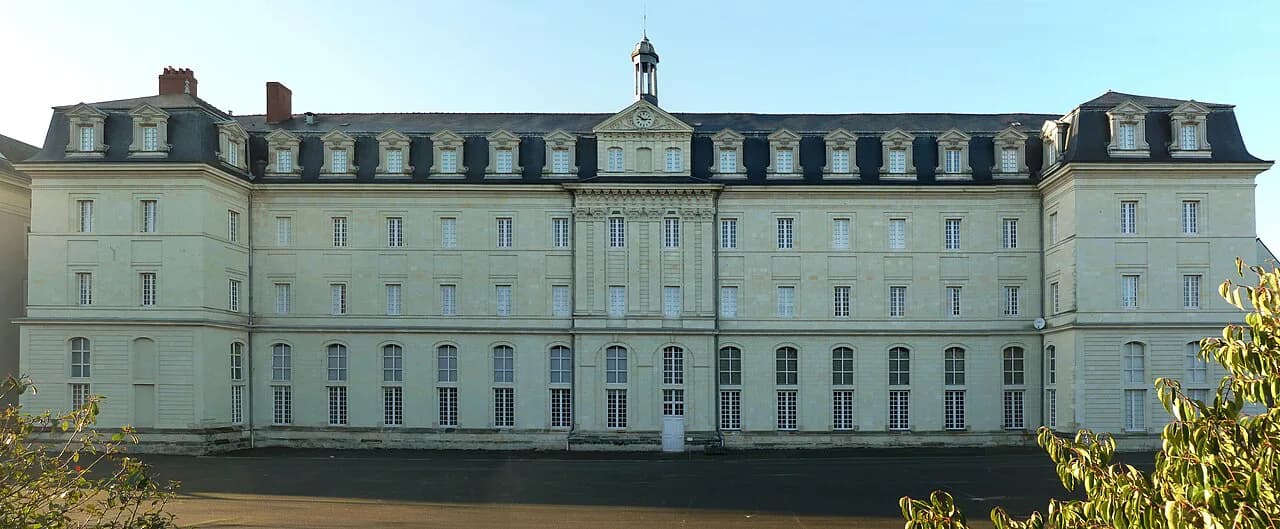
The monastic range next door was rebuilt by the Maurist congregation, with the first stone laid in 1694 and work finished in 1726: a long, sober elevation with a colossal order and a pediment on the east front, now carrying a clock. Instead of the traditional closed cloister it opens onto a two-gallery space completed in 1734, and traces of the interior survive, including the chapter room panelling and refectory vaults on carved cherub corbels. These buildings house the Lycée Joachim-du-Bellay and are not open to visitors as a museum, so treat them as architecture to look at from the street and put your time into the church.
How long to allow
An hour is enough to see the church properly: fifteen minutes for the nave and its windows, twenty for the choir and the keystones, and the rest for the transept and chapels. Add half an hour if you like reading inscriptions and glass slowly, and less if you are squeezing it into a lunch break. It is a single-room visit, not a complex, so it works well as a first stop in the morning before the bigger sights open.
Nearby: the Jardin des Plantes and old Saint-Samson
The parish church of Saint-Samson once stood beside the monastic enclosure, and its 12th-century portal is still visible in what is now the Jardin des Plantes next door. The garden makes an easy pairing with Saint-Serge: see the church, then walk the beds and find the Romanesque doorway on your way out. If you are building a day, the château and the Apocalypse Tapestry are a twenty-minute walk back towards the centre.
Practical notes for your visit
Guided visits for groups are arranged through the Amis de l'Abbatiale Saint-Serge, and Destination Angers, the city tourist office at 7 place Kennedy, handles general enquiries about the abbey. If you want a guided tour as an individual, ask the tourist office what is running during your dates rather than turning up and hoping. The heritage page lists both contacts if you prefer to write ahead.
Is Saint-Serge Worth Your Time?
Yes, if you have any interest in Gothic architecture: the choir and its carved keystones are first-rate, and the 15th-century glass gives the nave a coherence many larger churches lack. It is also refreshingly unfussy — a working parish church rather than a ticketed attraction, so you can drop in without planning a slot. Pair it with the Jardin des Plantes and you have a solid half-day on the north side of the city.
Build the rest of your Angers itinerary around the château, the cathedral and the tapestry, and slot Saint-Serge in as the quieter morning stop. Checking the parish and tourist office pages before you go covers any change to the published hours.
Explore more Angers guides
Frequently Asked Questions
Is the Abbaye Saint-Serge in Angers open to visitors?
The abbey church, the Abbatiale Saint-Serge, is open to visitors all year. The monastic buildings beside it belong to the Lycée Joachim-du-Bellay and are not open as a museum, so the visit is the church itself.
What are the opening hours of the Abbatiale Saint-Serge?
The Ville d'Angers heritage page gives Monday to Saturday 9am to 7pm and Sunday 2pm to 6pm, open all year. It is an active parish church, so visits fit around services, and the same page is the place to confirm before travelling.
What can you see inside the Abbatiale Saint-Serge?
The highlights are the 13th-century choir with its six columns and carved keystones, the 15th-century Flamboyant nave with André Robin's windows of 1462-63, and the Romanesque transept with the 12th-century baptistery chapel. Allow about an hour.
How old is the Abbaye Saint-Serge?
The monastery was founded in the 7th century and became Benedictine around the year 1000. The church was consecrated in 1059, the choir rebuilt around 1220-25, and the nave after the Hundred Years' War in the mid-15th century.
Is the abbey church free to enter?
No admission price is published on the heritage page, which lists the opening hours and contacts rather than ticketing. Ask Destination Angers if you need to confirm before you go.
How long does a visit to Saint-Serge take?
About an hour covers the nave, choir, transept and chapels at an unhurried pace. Add time for the Jardin des Plantes next door, where the portal of the old Saint-Samson church still stands.
How do you get to the Abbaye Saint-Serge from central Angers?
The church is at Avenue Marie-Talet, place Bachelot, north of the historic centre across the Maine. It is roughly a twenty-minute walk from the château, passing the Jardin des Plantes on the way.
Can you book a guided tour of the Abbatiale Saint-Serge?
Group guided visits are arranged through the Amis de l'Abbatiale Saint-Serge, and Destination Angers is the general contact. Ask the tourist office what is scheduled during your dates.