
Château d'Angers: Visiting the Castle of the Dukes of Anjou
The Château d'Angers is a walled medieval fortress on the highest ground in Angers, looking down over the River Maine, and its single unmissable sight is the Apocalypse tapestry, 104 metres long, shown in a gallery rebuilt for it. Most of a visit happens inside the enormous outer walls rather than in the towers themselves, so budget your time for the tapestry and the courtyard rather than for climbing.
What the Château d'Angers is
The castle is the former stronghold of the Dukes of Anjou, a schist-and-tufa fortress covering 22,000 square feet with a 2,600-foot outer wall perimeter. It sits in the Maine-et-Loire department on the high point of the city, above the River Maine, which is why it reads as a fortress first and a palace second. Inside the walls, the courtyard and buildings were laid out by Saint Louis around 1230, with royal chambers, a chapel and a châtelet added across the 14th and 15th centuries. If you are comparing princely residences, the Château de Fontainebleau offers a very different, palace-first experience.
Its later life explains why so much of the site feels austere: from the 16th to the 20th century it served as a prison, then a garrison, and finally a munitions depot during the Second World War. You are walking through a building that spent far longer as state infrastructure than as a princely court, and the courtyards and galleries make more sense once you know that.
Where it sits and how to reach it
The château sits at the entrance to the city, whose medieval core spreads below it, making it the natural place to start a walk through the old town rather than a detour. Arrive on foot from the centre: the approach climbs the high ground of the city, so you get the river side of the castle and its setting before you reach the gate.
If you are planning the castle as one stop among several, build the rest of the day around the old town and the streets below the walls, since the site itself is compact enough to leave by early afternoon. The Angers Neighborhoods guide helps you work out which quarter to wander afterwards without doubling back across the river.
The walls and the 17 towers
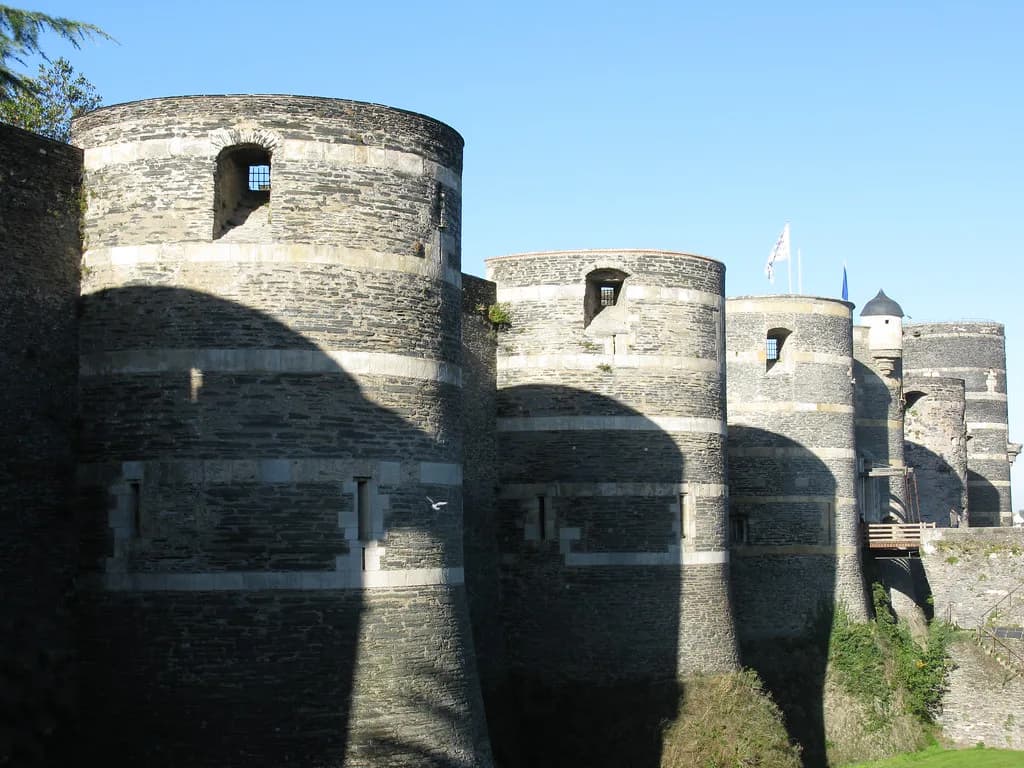
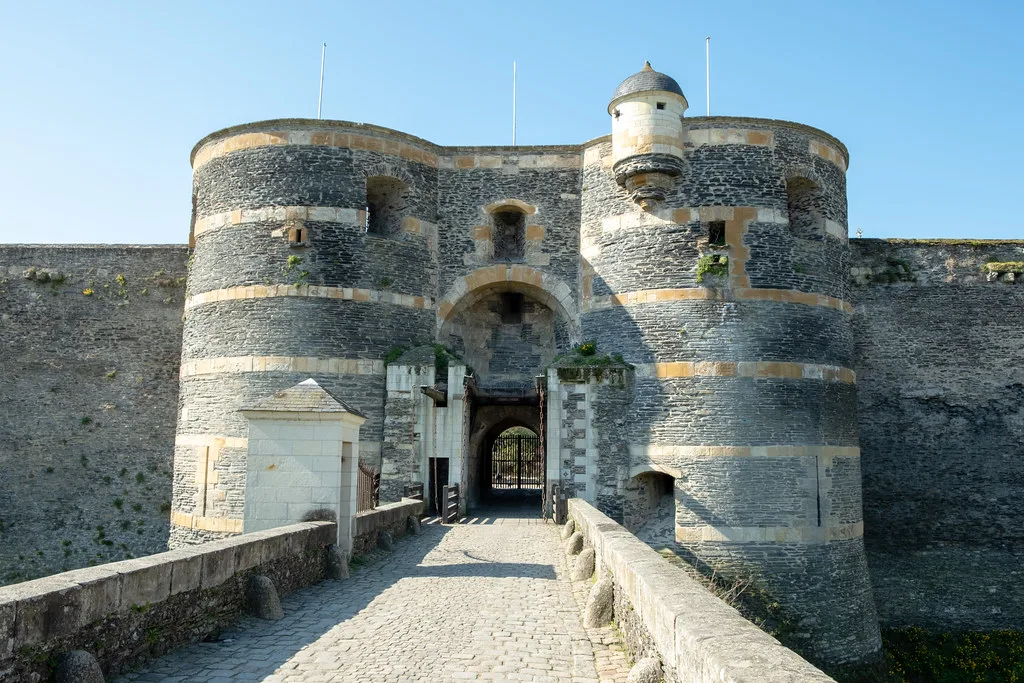
The fortress is ringed by an outer wall running about 2,600 feet around, reinforced by 17 enormous towers built of schist and a limestone called tufa. The scale surprises first-time visitors: from the courtyard the walls read as an enclosure you walk inside, not a single keep you climb.
Walk the circuit slowly enough to notice how the schist and tufa alternate in bands; it is the clearest visual record of how the fortress was built and repaired over centuries. The walls also frame the best free views over the city and the river, so keep the camera for the courtyard edge rather than the entrance.
Inside: courtyard, chambers and chapel
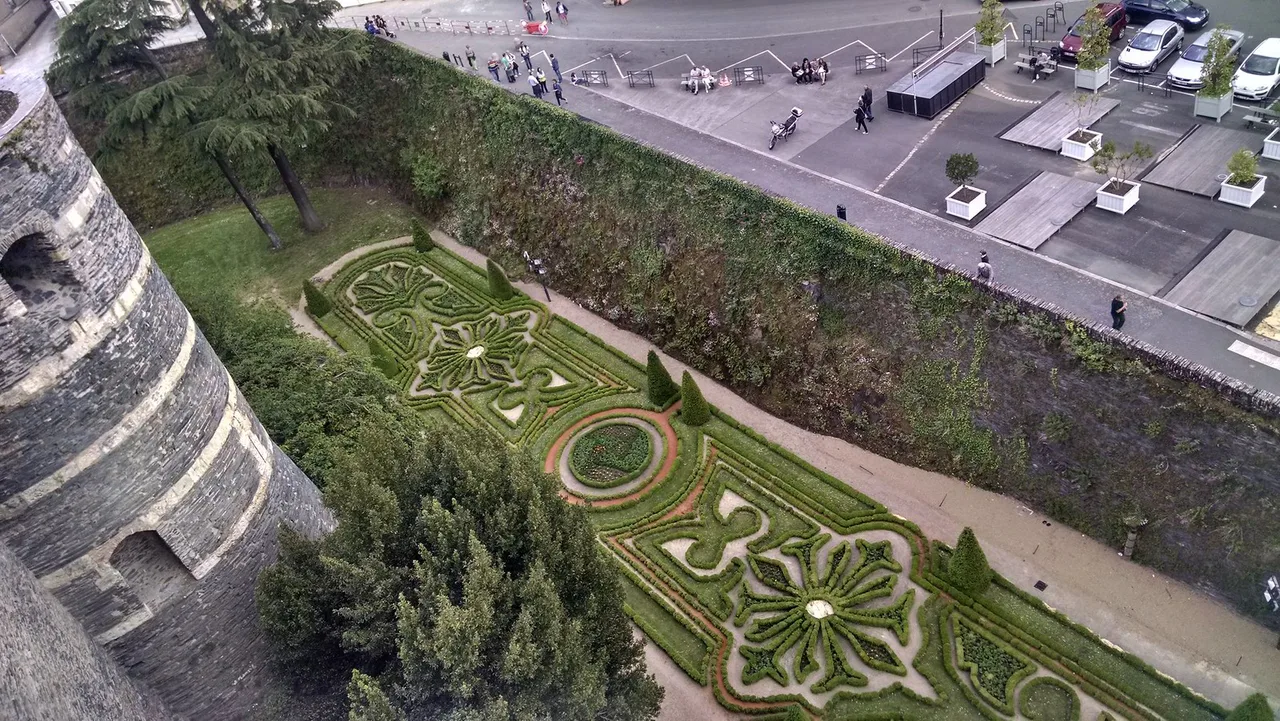
Inside the walls, the interior courtyard planned under Saint Louis near 1230 holds formal gardens and the surviving buildings, among them the royal chambers, the chapel and the châtelet. The courtyard is the calmest part of the visit and the easiest place to slow down between the galleries, so treat it as a pause rather than a corridor. Some of the original structures have disappeared, replaced later, most visibly by the gallery built for the tapestry.
The Apocalypse tapestry
The Apocalypse tapestry, commissioned by Duke Louis I of Anjou at the end of the 14th century, runs 104 metres and depicts the Book of Revelation across a sequence of woven scenes. It is the largest medieval tapestry of its kind, and it is exhibited in a purpose-built gallery with light and climate controls designed to slow its deterioration, which is why the display feels more like a modern museum room than a castle interior.
Give the tapestry real time. Read the panels from the beginning in order; the sequence is the point, and visitors who drift in halfway through often leave thinking it is one long decorative piece rather than a narrative. The gallery is the reason to buy a ticket at all, so put it first in your visit, not last.
Other tapestries on show
Beyond the Apocalypse cycle, the castle holds a collection of tapestries from the 15th and 16th centuries, shown alongside the main gallery. These are smaller and less celebrated, but they give you a sense of what the dukes' court actually hung on its walls, and they are easy to see if you are not rushing to leave.
How long to allow
Most visitors should plan on two to three hours: roughly an hour for the tapestry gallery, another hour for the courtyard and buildings, and the rest for the walls and a slow exit through the old town. If you have only a short stop, go straight to the tapestry, because the courtyard and walls are the parts you can appreciate in a walk-through.
The terrain matters. You climb to the castle, walk over cobbles and stone inside the walls, and stand for long stretches in the tapestry gallery, so wear shoes you can walk in for a couple of hours. In wet weather the courtyard and walls are exposed, so keep them for a dry spell and start with the interior galleries.
Opening hours and seasonal timing
The published timetable varies by season. A listing gives 9.30am to 6.30pm from 2 May to 4 September, which is a seasonal schedule rather than a year-round one, so confirm the current hours for your dates before you build a day around the castle. Check on the day you arrive in Angers as well, since closing times can shift at the end of the season.
Tickets and booking
Entry is ticketed, and the ticket covers both the fortress and the tapestry gallery. Prices change, so check the current euro rate and any booking requirement on the castle's own site or at the ticket office rather than relying on older figures. Buying ahead is most useful in high season, when the gallery is the part you least want to queue for.
Nearby sights to pair with the castle
Angers Cathedral (Cathédrale Saint-Maurice) is the obvious companion, a short walk from the castle in the old town, and combining the two makes a natural half-day route. The cathedral and the castle together cover the city's main medieval sights without any further travel.
If you have time for a second stop, the Jardin des Plantes is an easy outdoor break after the galleries, while the Abbaye Saint-Serge and the Collégiale Saint-Martin, Angers suit anyone following the city's religious architecture. None of them needs more than an hour, so pair one with the castle rather than trying to see them all.
Planning your visit
Go for the Apocalypse tapestry, allow two to three hours, and treat the courtyard and walls as the walk between the things you came for. Check the current hours and euro ticket price for your dates before you set out, since both are seasonal or subject to change. The 104-metre tapestry is the one sight in Angers that repays an unhurried hour.
Frequently Asked Questions
What is there to see inside the Château d'Angers?
The main draw is the Apocalypse tapestry, shown in a dedicated gallery, alongside a collection of 15th- and 16th-century tapestries. Around it you can walk the interior courtyard laid out under Saint Louis near 1230 and see the royal chambers, the chapel and the châtelet.
How long does a visit to the Château d'Angers take?
Plan on two to three hours. The tapestry gallery alone rewards an hour, the courtyard and buildings another hour, and the walls and towers fill the rest. Shorter visits are best spent inside the tapestry gallery, since the courtyard and walls can be appreciated on a walk-through.
How long is the Apocalypse tapestry at Angers?
The Apocalypse tapestry runs 104 metres and depicts the Book of Revelation across a long sequence of woven panels. It was commissioned by Duke Louis I of Anjou at the end of the 14th century and is displayed in a purpose-built gallery with climate controls.
When was the Château d'Angers built?
The courtyard and buildings inside the walls were laid out under Saint Louis around 1230, on a site occupied long before. The royal chambers, chapel and châtelet followed in the 14th and 15th centuries, and the fortress later served as a prison, a garrison and a wartime munitions depot.
Is the Château d'Angers worth visiting?
Yes, if you care about the tapestry. The Apocalypse cycle is the largest medieval tapestry of its kind and the reason to buy a ticket, while the walls, towers and courtyard give you the setting. If you have limited time in Angers, put the tapestry first.
What are the opening hours for the Château d'Angers?
Hours change with the season, and published times for past seasons should not be relied on for your trip. Check the castle's current timetable before you go and again on arrival in Angers, since closing times can shift at the end of the season.
How much does it cost to visit the Château d'Angers?
Entry is ticketed and covers the fortress and the tapestry gallery. Prices change, so confirm the current euro rate on the castle's site or at the ticket office before you travel.
What else is near the Château d'Angers?
Angers Cathedral (Cathédrale Saint-Maurice) is a short walk away in the old town and makes a natural pairing. The Jardin des Plantes, the Abbaye Saint-Serge and the Collégiale Saint-Martin, Angers are all worth an hour each if you have time left after the castle.