
The Apocalypse Tapestry in Angers: What to See Inside the Château
The Apocalypse Tapestry is a medieval narrative hanging displayed inside the Château d'Angers, in the Maine-et-Loire department of north-west France. It is the city's single most important artwork and the reason many visitors build a weekend in Angers around the castle rather than passing through. Allow it real time rather than treating it as a photo stop on the way to the ramparts.
The tapestry is not a decorative wall hanging but a woven transcript of the Book of Revelation, made to be read scene by scene. Knowing that structure in advance turns a long gallery into a story you can follow. The sections below cover location, layout, history and how the visit fits into a short break.
The Apocalypse Tapestry in Angers: the short answer
The tapestry is held in a display area within the Château d'Angers, which itself sits in the centre of the city. UNESCO dates the work to 1373/75–1380/82 and describes it as the oldest and largest narrative tapestry in the world, covering 800 square metres. That scale is what makes the viewing unusual: you are looking at a sequence, not an object.
Because the tapestry belongs to the château, one ticket covers both the fortress and the hanging, and the castle's own opening arrangements govern your timing. For opening days, ticket prices and any closures, check the official château website before you fix a date.
Where the tapestry is: inside the Château d'Angers
Angers is the capital of the historic duchy of Anjou, and the château occupies the middle of the city, an easy reference point for anyone arriving on foot. The tapestry is part of the château visit rather than a separate museum elsewhere in town. Plan your day around the castle as a single destination.
The medieval fabric of the castle is part of the experience, and the display space was purpose-built for the tapestries rather than being an original medieval hall. Expect a modern hang inside a historic building, with the panels protected behind glass. This is also why the light levels and distances are controlled.
How to get there and how long to allow
The castle sits within walking distance of the central hotels, shops and restaurants of Angers, so most weekenders reach it on foot without needing transport. If you are arriving by train, allow time to cross the centre rather than expecting the château at the station. Aim to arrive in the morning when you are fresh, because the visit requires sustained attention.
Give the tapestry a focused block rather than a quick pass. Ninety scenes are recorded across the original six tapestries, so even at a brisk pace the gallery absorbs an hour or more of looking. Add the castle walls, gardens and other rooms and the château becomes a half-day rather than a stop.
What you are actually looking at: the Book of Revelation woven as scenes
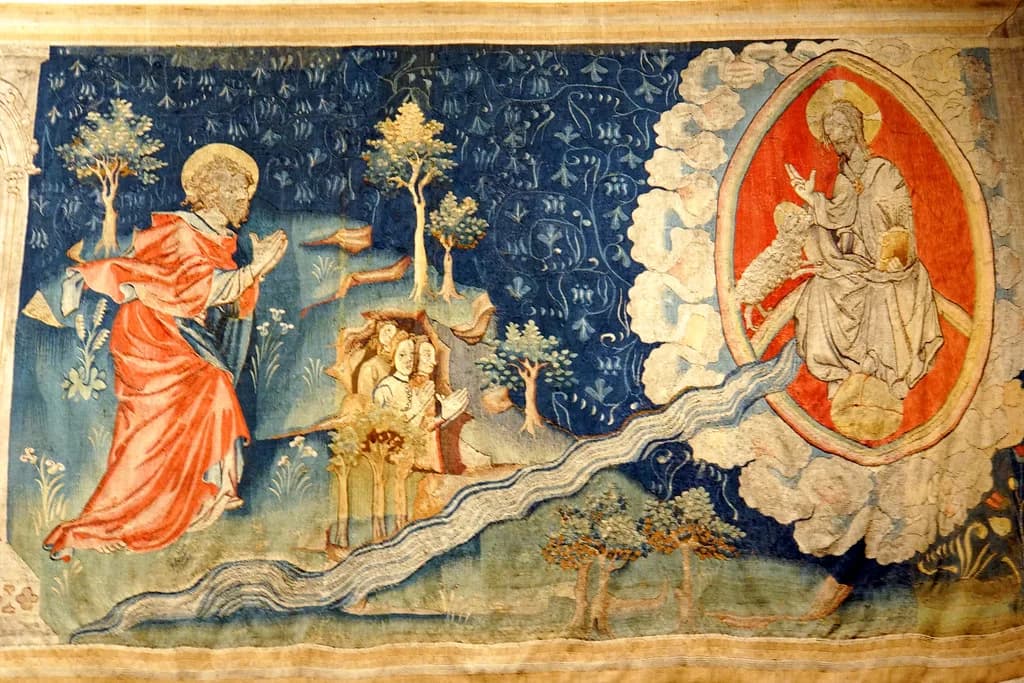
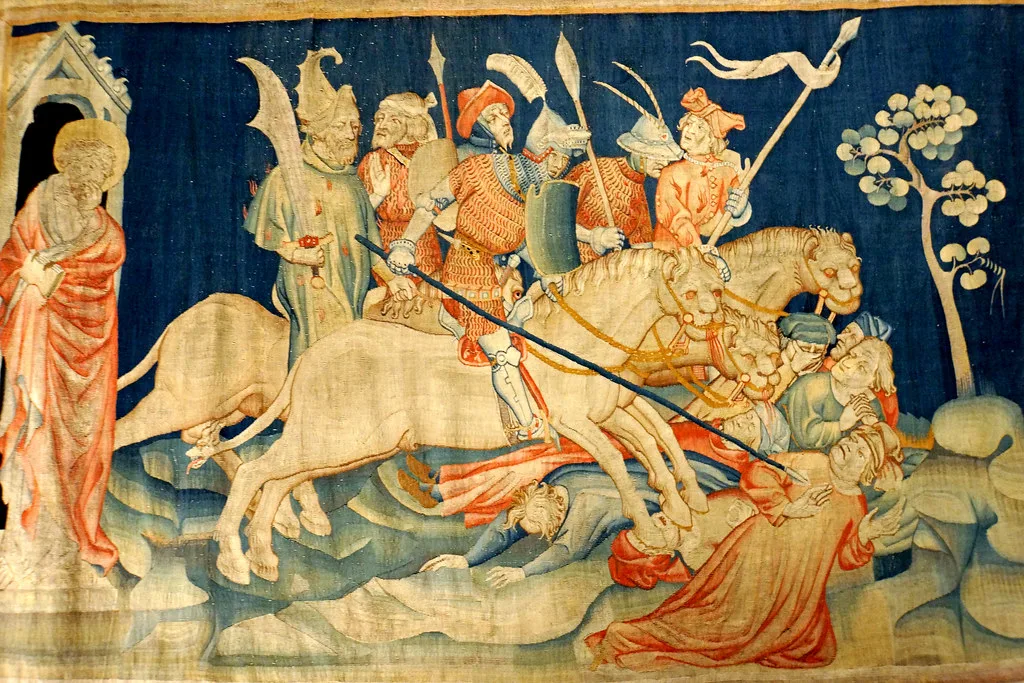
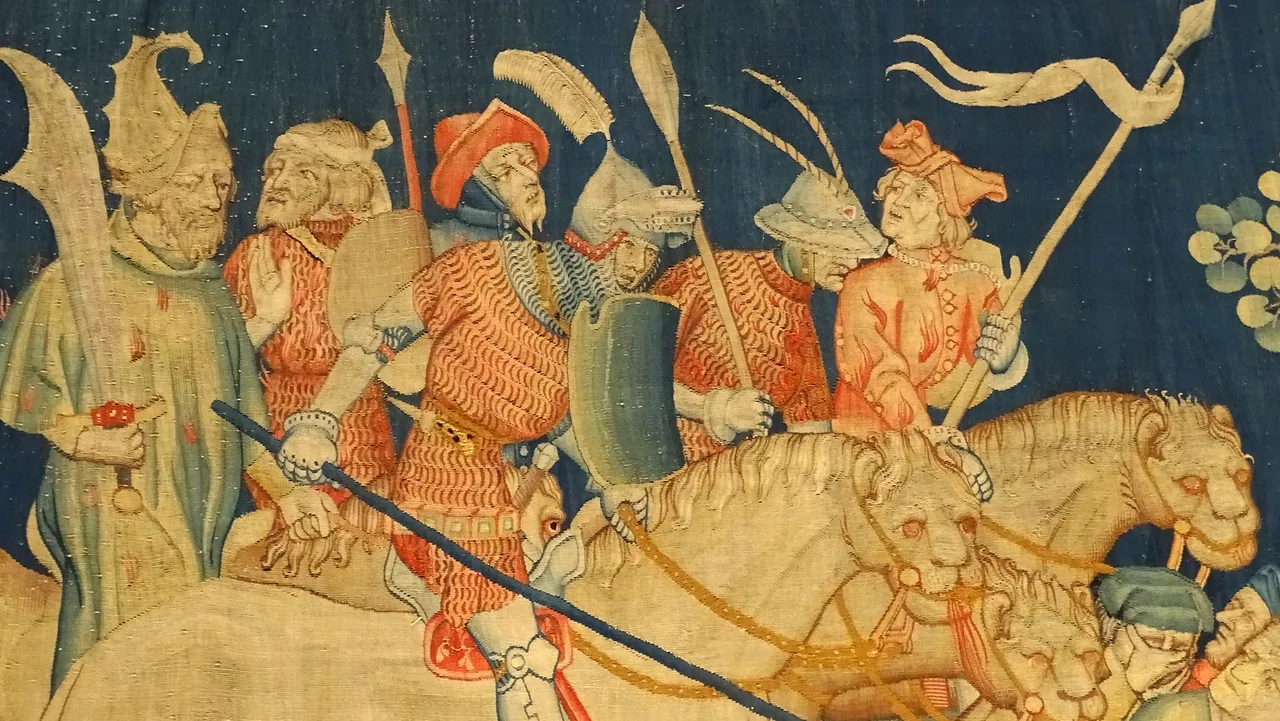
Each panel illustrates St John's visions from the final book of the Bible, arranged in the order of the text rather than as free-standing pictures. The images derive from illuminated Anglo-Norman manuscripts of the Book of Revelation, which the tapestry translates into wool on a monumental scale. Knowing the source helps you recognise why the compositions feel like enlarged manuscript pages.
The subject is the end of the world and the heavenly court, not a saints' calendar. The work also carries a political reading, documenting how the Apocalypse was understood in France during the Hundred Years' War with England. Treat the hang as an argument in pictures and the visit becomes much more than decorative art.
Who commissioned it and when
Louis I of Anjou, second son of King Jean II of France and first Duke of Anjou, commissioned the set, and it was woven in Paris in the late fourteenth century. UNESCO gives the commission as 1373/75 and completion around 1380/82; the weaving itself is placed between 1377 and 1382. Either way, you are looking at a product of the 1370s and 1380s.
In 1480 René, Louis's grandson and third successor to the title, gave the tapestries to the cathedral of Angers, where they remained until the French Revolution. That gift explains why a ducal commission ended up as a church treasure in the city rather than staying with the family. The walk between the château and the cathedral today traces the same short distance.
What survives: the losses and the recoveries
The set was cut into pieces during the Revolution and put to uses such as covering crops in barns for winter storage. The surviving sections were recovered in 1848, but fourteen scenes from the book and two of the reader panels had been lost. The third and fourth tapestries survive intact, while the sixth is the most badly damaged.
There is a recent twist: in 2020, thirty more fragments were found in a Parisian art gallery and have since been given to the castle museum in Angers. This matters for expectations, because you are seeing a reconstruction with visible absences rather than a complete cycle. Look for the gaps as well as the images.
Reading the panels: the reader and the scene order
Each tapestry begins on the left with a man seated under a Gothic baldachin, reading the Apocalypse from a book on a stand. After that reader, fourteen scenes of St John's visions follow left to right, first across the upper row and then the lower. That pattern gives fifteen panels per tapestry.
Use the reader as your anchor and follow the rows rather than wandering between panels. The first panel, showing St John on Patmos and the opening of the Apocalypse, is lost, so the sequence begins with the letters to the seven churches rather than the island vision. Knowing that keeps you from hunting for a scene that is not there.
Size and scale: what the dimensions mean for viewing
Six tapestries measuring roughly 20 feet high and almost 79 feet long were made for the set, each carrying ninety scenes in total across the six. UNESCO's figure of 800 square metres describes the same object in metric terms. The height is what changes the viewing experience: figures above eye level read differently from a book illustration.
Step back to take in a whole panel before moving close to the wool and detail, then repeat. The hang rewards that rhythm because the compositions were designed to be seen at a distance in a ceremonial setting. Give yourself permission to sit or stand still rather than drifting past.
UNESCO Memory of the World status
The tapestry is inscribed on UNESCO's Memory of the World register, having been submitted by France and registered in 2023. UNESCO treats it as a documentary source: a woven manuscript recording a political-religious reading of the Apocalypse, used in public ceremonies. That framing is the best preparation for the visit because it explains why the work matters beyond its beauty.
The register also notes how the work reflects relations between Europe and the Middle East in its imagery and outlook. Read the panels with that in mind and the exotic detail in the visions makes more sense. It is also the strongest argument against rushing the gallery.
Practical decisions: tickets, opening times and closures
Tickets, opening hours and any seasonal closures are set by the château and can change, so check the official Château d'Angers website for the date you plan to visit. Book for the morning if you can, so that the tapestry gets your best attention before lunch and the rest of the town.
The display area is indoors and the château visit involves walking between buildings, so dress for a mix of interior and outdoor time even on a warm day. Photography inside the tapestry gallery is controlled by the château's rules, which are posted on site.
Nearby options in Angers to pair with the tapestry
Angers Cathedral, which received the tapestries in 1480, is the natural companion visit and lies a short walk through the old centre. Its own history and windows are worth a separate stop rather than a glance on the way back. Pair the two and you have the tapestry's story in both places it lived.
For something lighter after the intensity of the Revelation scenes, the Jardin des Plantes gives you open air and greenery within the city. The Collégiale Saint-Martin and the Abbaye Saint-Serge both suit a slower second afternoon.
If you want to fill a full weekend rather than a single day, the city's neighbourhoods repay wandering between the sights. The guide to things to do in Angers covers the wider spread of museums, streets and riverside.
The Apocalypse Tapestry in a two- or three-day Angers weekend
With two days, give the château and tapestry a whole morning and use the afternoon for the cathedral and the old streets; keep the second day for a slower wander and the gardens. With three days, split the castle and cathedral across separate mornings so neither gets compressed. The tapestry does not need more time than the rest of the city put together.
Do not place the tapestry at the end of a long day, after shopping or a late lunch: the detail is fine and the story dense, and tired eyes miss most of it. Put it first.
Table: key facts about the Apocalypse Tapestry
| Fact | Detail | |---|---| | Where | Inside the Château d'Angers, Angers, Maine-et-Loire | | Made | 1373/75–1380/82 per UNESCO; woven in Paris 1377–1382 | | Commissioned by | Louis I of Anjou | | Given to Angers | By René of Anjou in 1480, to the cathedral | | Scale | 800 square metres; six tapestries, ninety scenes originally | | Layout | Reader panel first, then fourteen scenes left to right, upper row before lower | | Surviving | Third and fourth tapestries intact; sixth badly damaged | | Status | UNESCO Memory of the World, registered 2023 | | Tickets and hours | Set by the château; check the official site |
Plan Your Visit
The Apocalypse Tapestry rewards preparation more than most attractions: know the reader-and-scenes layout and the lost panels, then give the gallery a proper block of time inside your château visit. Build the rest of your Angers weekend around the cathedral and one or two quieter sights. Check the château's site for the day's opening and ticket arrangements before you travel.
Explore more Angers guides
Frequently Asked Questions
Where is the Apocalypse Tapestry?
It is displayed inside the Château d'Angers, in the centre of Angers in the Maine-et-Loire department of north-west France. The tapestry is part of the château visit rather than a separate museum, so one entry covers both the castle and the hanging.
How big is the Apocalypse Tapestry?
UNESCO describes it as 800 square metres, the oldest and largest narrative tapestry in the world. The original set comprised six tapestries measuring roughly twenty feet high and almost seventy-nine feet long, with ninety scenes across the six.
Who commissioned the Apocalypse Tapestry?
Louis I of Anjou, second son of King Jean II of France and first Duke of Anjou, commissioned the work. It was woven in Paris in the late fourteenth century, and in 1480 René of Anjou gave the tapestries to the cathedral of Angers.
How many scenes are in the Apocalypse Tapestry?
The original cycle had ninety scenes across six tapestries. Each tapestry opens with a reader under a Gothic baldachin, followed by fourteen scenes of St John's visions running left to right, upper row first. Fourteen scenes and two readers were lost.
How long do you need to see the tapestry in Angers?
Allow an hour or more for the tapestry gallery alone, and treat the château as a half-day with the ramparts and gardens included. The hang is dense and reads best when you are not rushed, so put it early in your day.
Is the Apocalypse Tapestry inside the Château d'Angers?
Yes. It is held in a purpose-built display space within the château, protected behind glass, and the medieval fortress itself is part of the same visit. The castle's own website sets opening days, ticket prices and any closures.
Why is the tapestry on the UNESCO Memory of the World register?
France submitted it and it was registered in 2023 as a documentary source: a woven transcript of the Book of Revelation that also records a political-religious reading of the Apocalypse during the Hundred Years' War.
What happened to the tapestry during the French Revolution?
It was cut into pieces and used for purposes such as covering crops in barns for winter storage. The surviving sections were recovered in 1848, though fourteen scenes and two reader panels were lost, and thirty further fragments found in 2020 were later given to the castle museum.