
Les Alyscamps: Arles' Roman Necropolis and Van Gogh's Alley
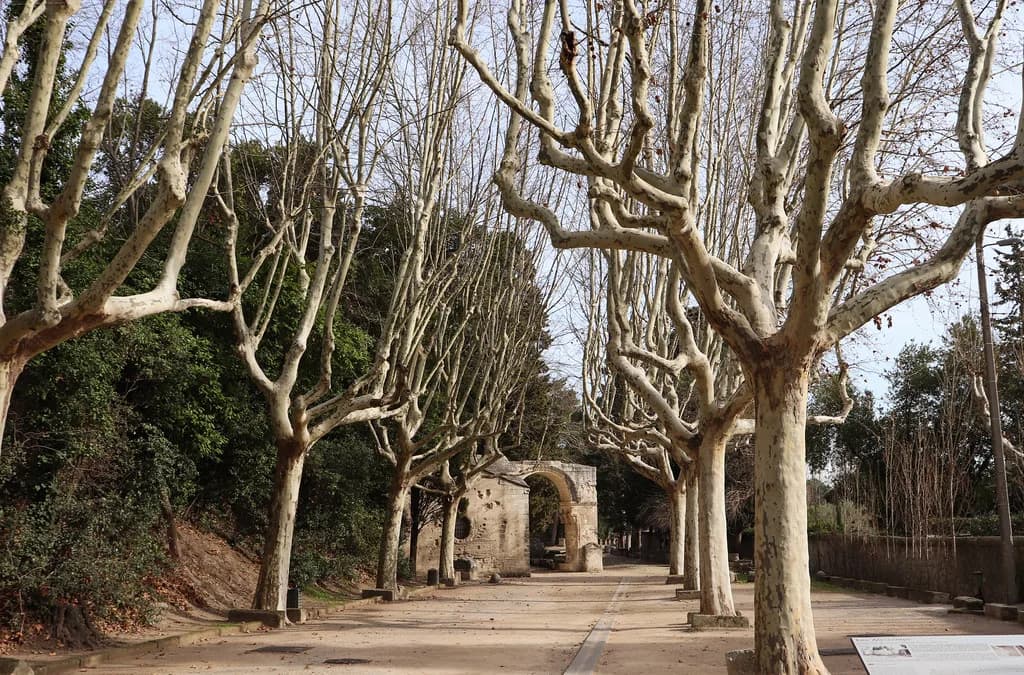
Les Alyscamps is Arles' ancient burial ground, a necropolis that served the city for close to 1,500 years and now reads as an open-air museum of stone sarcophagi lined along a cypress avenue. It sits on Avenue des Alyscamps, just outside the old walls, which is exactly why it looks the way it does.
The visit is short but distinctive: a straight walk between tombs and chapels, the 12th-century church of Saint-Honorat at the heart of it, and a modern skyline of LUMA's tower in the background. Entry is inexpensive and the site suits a two-day Arles break better than a rushed day trip.
What Les Alyscamps is: a Roman necropolis on the Aurelian Way
Roman cities banned burials inside their walls, so tombs crowded the roads leading out of town. The Alyscamps grew along the Aurelian Way at the end of which travellers approached Arles' gates, and it became the city's main cemetery for nearly 1,500 years, holding memorials from plain sarcophagi to elaborate monuments.
The name is a worn-down version of the Latin Elisii Campi, the Elysian Fields, and the site's reputation travelled far: Dante mentions it in The Inferno and Ariosto in Orlando Furioso. In the Middle Ages bodies were shipped down the Rhône for burial here, a trade that kept boatmen busy carrying coffins to Arles.
Christianity reshaped rather than ended the site. Saint Genesius, beheaded in 303, was buried here and drew a cult, followed by Saint Trophimus, Arles' first bishop; by the 4th century the ground held several thousand tombs and sarcophagi were stacked three deep. The necropolis is listed as a UNESCO World Heritage Site as part of Arles' Roman and Romanesque monuments.
Where it is on Avenue des Alyscamps and how to reach it
The address is Avenue des Alyscamps, 13200 Arles, on the south-eastern edge of the centre. From the old town the walk is short and flat, and it puts you within easy reach of the Roman monuments afterwards, so it works well as one leg of a loop rather than a separate excursion.
The regional tourism board lists a car park at the site and notes that animals are not accepted, which matters if you are touring with a dog. It also flags that while most of the site is accessible to visitors with reduced mobility, some areas may be difficult to reach.
Walking the alley of sarcophagi and chapels between the cypresses
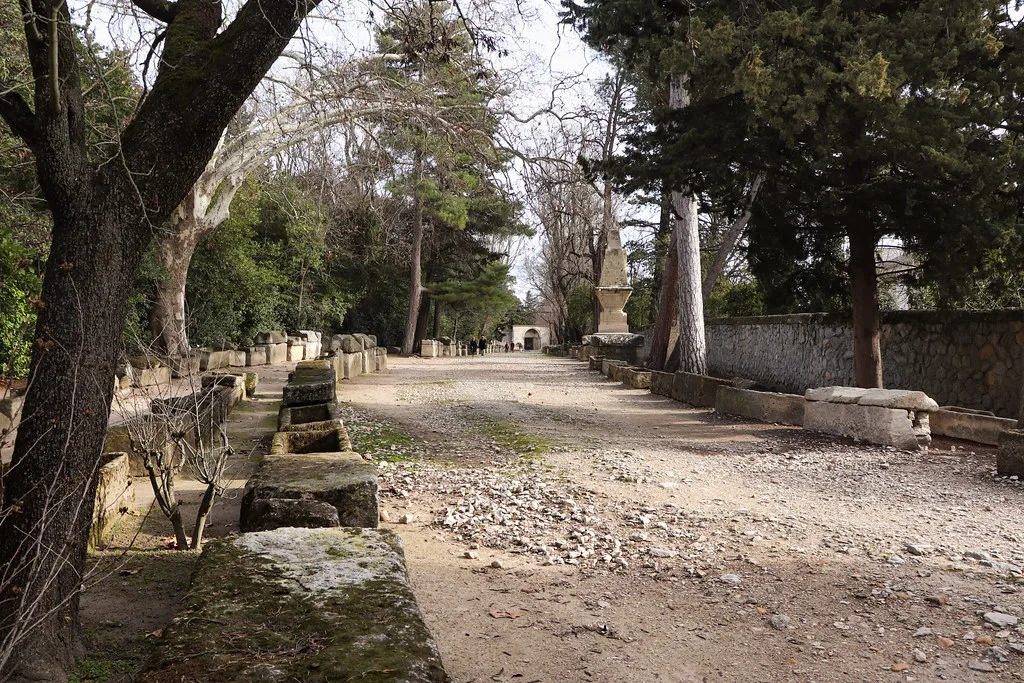
The core of the visit is a straight alley bordered by rows of stone sarcophagi and the remains of chapels, with slender cypresses standing over them. It is the kind of place where you slow down rather than tick off sights, and the compressed layout means you see most of it on foot in a single pass.
Much of what stood here was lost. The site's prestige fell in 1152 when Saint Trophimus' relics moved to Arles Cathedral, Renaissance councillors handed sarcophagi to visiting dignitaries, locals reused funerary stone as building material, and in the 19th century a railway and a canal were cut straight across the ground. What you walk today is partly restored, and that layered damage is part of what you are looking at.
The church of Saint-Honorat and the start of the Chemin d'Arles
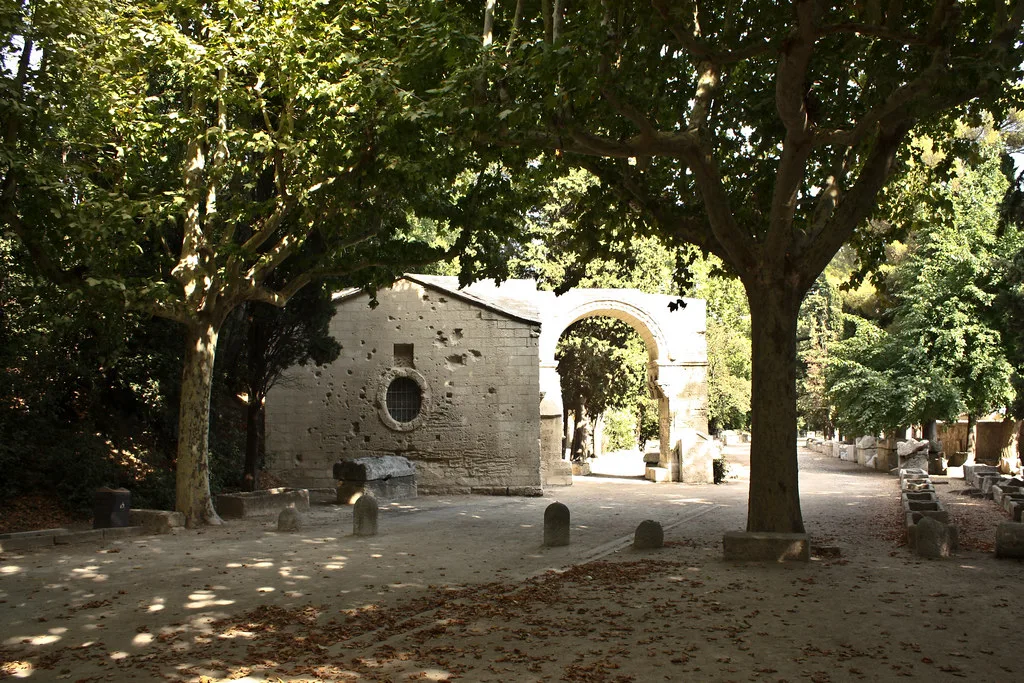
At the centre of the site stands the church of Saint-Honorat, a 12th-century building with a carved portal. It marks the starting point of the Chemin d'Arles, one of the main French routes to Santiago de Compostela, so you will often be sharing the alley with pilgrims at the beginning of a long walk rather than sightseers alone.
For anyone piecing together Arles' Romanesque heritage, this church is a natural companion to Saint-Trophime in the centre, whose cloister is another of the city's UNESCO-listed monuments. Do the church first if you want the pilgrimage story fresh before walking back into town.
Van Gogh and Gauguin painting side by side in October 1888
In October 1888 Vincent van Gogh and Paul Gauguin chose the Alyscamps as the first location for their painting expeditions and worked side by side among the tombs. Knowing this changes how you walk the alley: the cypresses and sarcophagi are the composition they were chasing, not just background scenery.
If the painting connection is your reason for coming, pair the visit with the Fondation Vincent van Gogh Arles in the centre, which deals with the artist's legacy in the city rather than the Roman dead. It gives the necropolis a context that the stones alone cannot.
Opening hours by season, last entry and the May 1 closure
Opening hours change with the season. From 1 May to 30 September the site runs 09:00 to 19:00, October shifts to 09:00 to 18:00, and from 2 November to the end of February it opens only 10:30 to 16:30, with last entry at 16:00. Spring dates from 1 March to 30 April return to 09:00 to 18:00.
The site closes on 1 May, as well as on 1 January and 25 December in the winter block. The tourism board lists the Alyscamps as unsecured hours rather than guaranteeing them, so in winter check the day's opening before you set out — a short winter afternoon leaves little room for error.
Tickets: full and reduced prices, and the Arles pass
Entry costs 5 euros full price and 4 euros reduced, as published for 2 January 2026 to 31 December 2027. For a site you can see properly in under an hour, that is a low-risk addition to a day built around the amphitheatre and the theatre.
If you plan to visit several monuments, the tourism board recommends a pass bought through its online ticketing, which covers the city's museums and monuments more economically than paying individually. Compare the pass against the number of sites you will realistically fit into two days before committing, since a packed itinerary is what makes it pay.
How much time to allow and when the light is kindest
Allow around 45 minutes for the alley, the sarcophagi and the church, which is also the length of the guided tour run in French during school holidays. That makes the Alyscamps a natural half-hour-to-hour stop slotted between the bigger Roman sites rather than a half-day in itself.
Go early or late in the day when the site is quiet, and treat the winter closing time as the hard limit: with last entry at 16:00 between November and February, a late lunch can eat your visit. Summer evenings, when the gates stay open until 19:00, give the most relaxed light along the cypress row.
Nearby: the amphitheatre, the Roman theatre and LUMA
Back in the centre, the Arènes d'Arles is the city's biggest Roman set piece and the obvious next stop after the necropolis. It is a working monument as well as a ruin, and it anchors any shortlist of Arles attractions for a weekend.
The Roman Theatre of Arles, a contemporary of the amphitheatre, still keeps part of its seating and orchestra and sits close enough to combine with the arena in one morning. Pair it with the Alyscamps and you cover the city's Roman burial, spectacle and performance in a single day.
To the north, LUMA Arles and its Frank Gehry tower rise over the Parc des Ateliers, and the tower is visible from the Alyscamps itself, setting the ancient tombs against a contemporary skyline. It is the sharpest contrast in the city and worth an hour of your second day.
If you are still deciding what else to fit in, work from the wider list of Arles Attractions and group monuments by quarter; the old town is compact enough to walk between most of them. The Alyscamps sits slightly apart, which is precisely why it feels quieter than the arena. If you are weighing a longer Provençal break, our Avignon city guide covers the same question of how long a Roman-heavy city deserves.
Plan Your Visit
Les Alyscamps rewards a deliberate hour: come for the sarcophagi avenue, stay for the Saint-Honorat pilgrimage story, and walk it knowing Van Gogh and Gauguin set up their easels here in October 1888. At 5 euros full price it is one of the cheapest ways to add a layer to an Arles weekend that the arena alone cannot give you.
Build it into a morning with the amphitheatre and the Roman theatre, and keep the winter hours in mind if you travel between November and February. For the rest of your shortlist, start with things to do in Arles and slot the necropolis in where the day allows.
Frequently Asked Questions
Is Les Alyscamps worth visiting?
Yes, if you want Arles' Roman and Christian burial history in one compact place and a Van Gogh painting site you can walk through. The alley of sarcophagi, the cypresses and the 12th-century church of Saint-Honorat take under an hour, so it fits easily between the amphitheatre and the Roman theatre without eating a day.
How long does it take to see Les Alyscamps?
Allow around 45 minutes for the sarcophagi alley, the chapels and the church of Saint-Honorat. That is also the length of the guided tour run in French during school holidays. Most visitors combine it with the Roman monuments in the centre rather than treating it as a half-day.
When did Van Gogh and Gauguin paint at Les Alyscamps?
In October 1888, when they chose the Alyscamps as the first location for their painting expeditions and worked side by side among the tombs. The cypress-lined alley and the sarcophagi are the elements they were painting, which is why walking it slowly is more rewarding than photographing it from the entrance.
Do you need tickets for Les Alyscamps?
Yes, there is an entry charge, with a full and a reduced price; the tourism board publishes the current rates and also sells a city pass covering several museums and monuments. If you plan to visit three or more sites in two days, compare the pass against individual tickets before buying.
What are the opening hours at Les Alyscamps?
Hours shift by season: 09:00 to 19:00 from May to September, 09:00 to 18:00 in October and from March to April, and 10:30 to 16:30 from November to late February, with last entry at 16:00. The site closes on 1 May, 1 January and 25 December, and the tourism board lists the hours as unsecured.
Are Les Alyscamps accessible and can I bring a dog?
Most of the site is accessible to visitors with reduced mobility, though the tourism board notes some areas may be difficult to reach. Animals are not accepted, and there is a car park at the site on Avenue des Alyscamps if you are arriving by car rather than walking from the centre.
What is nearby to see after Les Alyscamps?
The Roman amphitheatre and the Roman Theatre of Arles are both a short walk back into the centre, and Saint-Trophime with its cloister completes the UNESCO-listed set. To the north, LUMA Arles and its Gehry tower are visible from the necropolis and make a strong contrast on a second day.