
Arles Amphitheatre: what to see inside the Arènes d'Arles
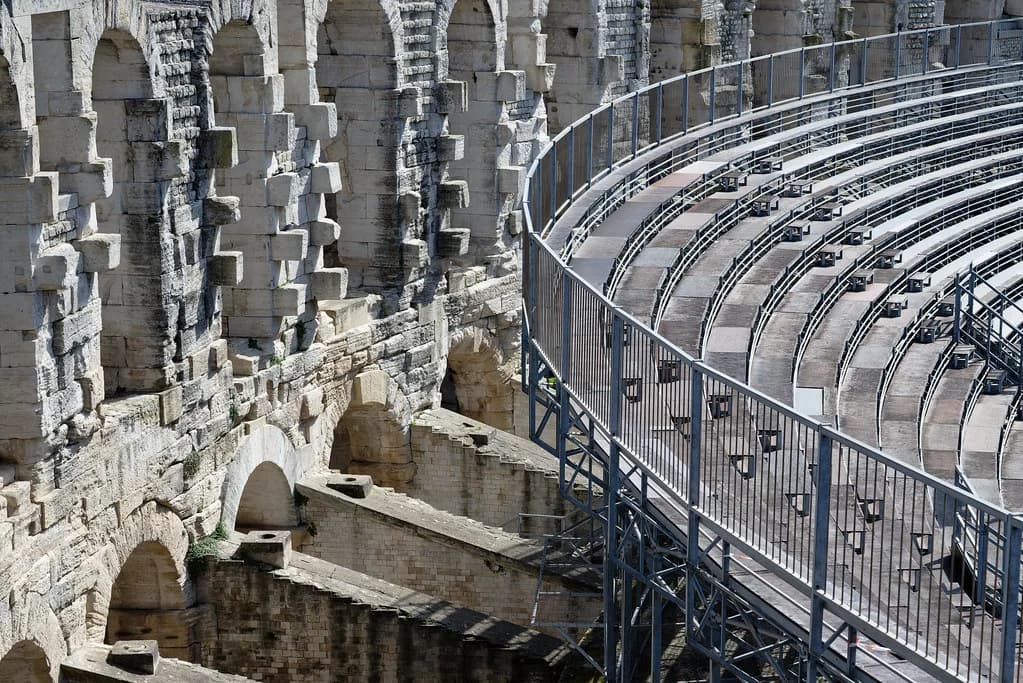
The Arles Amphitheatre is a first-century Roman arena standing in the middle of the old town, and it still works as a venue: the sand hosts bullfights and, in summer, plays and concerts. Because it is a working arena rather than a sealed ruin, you look down at a real seating bowl and up at three tiers of arches, not just at excavated foundations. Allow one to two hours, which is the recommended sightseeing time for the site.
It sits at 1 Rond-point des Arènes, with the Roman Theatre roughly 160 m away, so the two fit into a single loop through the centre. This page covers the arena alone: what it is, how to approach it, what to look at inside and what to do nearby.
What the Arènes d'Arles is
The arena was built at the end of the first century AD, in the reign of the Roman Empire, and was later turned into a fortress in the Middle Ages before being rebuilt as an arena in the 19th century. That layered history explains why it reads as a Roman monument with a medieval and modern afterlife rather than a single-period ruin. Today it is used as a temporary bullring from Easter to September and as an open-air theatre for opera and plays.
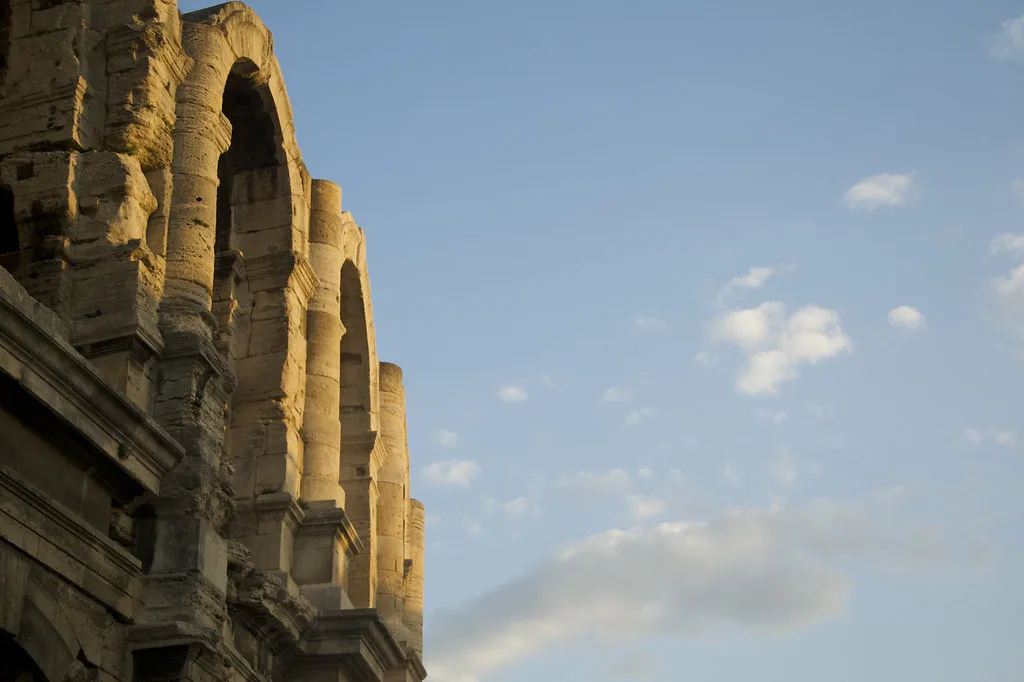
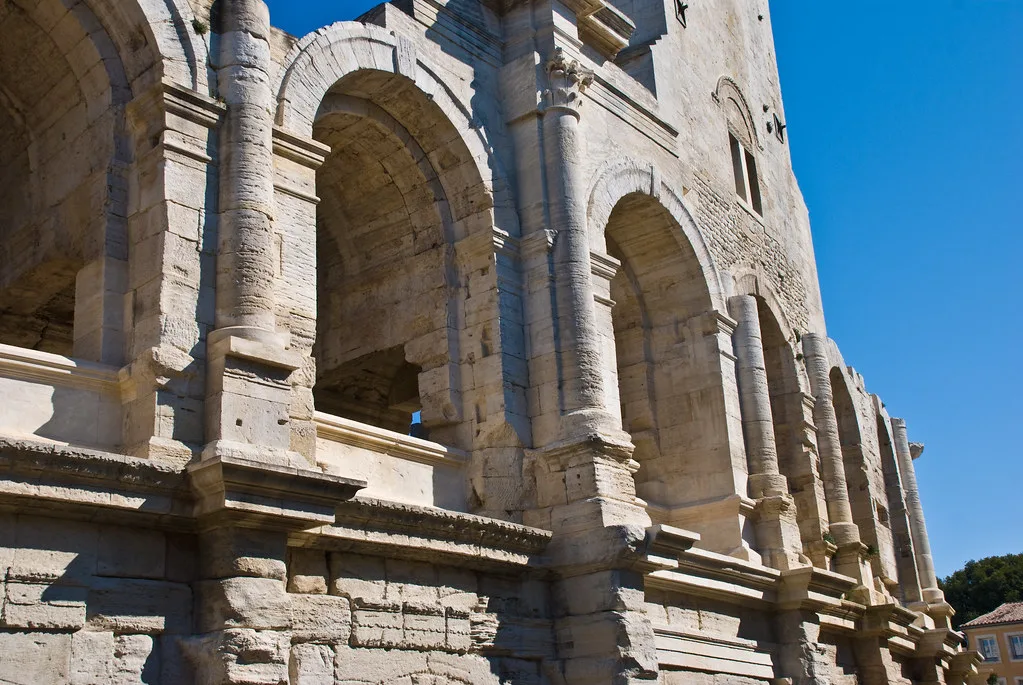
The plan is a vast oval, about 136 m along its long axis and 107 m across the short one, rising 21 m high and wrapped in three storeys of arcades with 60 arches. Classical Greek touches show in the columns, carved stone and decoration, which is part of why the facade rewards a slow lap before you go in.
Where it is and how to get there
The address is 1 Rond-point des Arènes, 13200 Arles, in Bouches-du-Rhône, Provence-Alpes-Côte d'Azur. The arena sits inside the old town, so you arrive on foot through the streets rather than by car at the gate.
Approach from the old town and the arcaded exterior appears all at once across the roundabout; the walk from the surrounding streets is short and flat. The Roman Theatre is about 160 m away, so the two Roman monuments sit within a couple of minutes of each other.
For the wider picture of what else to see and how the city is laid out, the French Weekender guide to Arles Attractions: 6 Visitor Guides puts the arena alongside the city's other main sights. It is worth reading before you fix your days, because museum closing days shape an Arles weekend more than distance does.
Inside the arena: the oval plan and the seating bowl
Inside, the structure resolves into a single oval bowl of raked stands around the sand, with the arcades rising behind. Walk the circuit at stand level before you choose a seat: the light and the view change with each side, and the far end gives you the classic photograph of the whole sweep.
Look at the stonework as much as the sand. The columns, carved capitals and decorative details carry the Greek-influenced finish of the Roman build, and they survive best on the lower tiers where you can get close to them.
Climbing the entrance tower for the view
The reason to look up rather than only at the sand is the tower above the entrance, which you can climb. From the top you get the old town roofs of Arles, the Rhône and the surrounding hills in one frame, and the oval of the arena below you.
Build the climb into your time allowance rather than treating it as an extra: steps, narrow passages and a hot stone stairwell are part of the experience, and it is the single best use of ten minutes on the site.
How long to allow
One to two hours is the recommended sightseeing time for the arena, and that figure covers the circuit of the stands and the tower climb comfortably. If you are photographing the arcades and reading the site panels, take the upper end; if you are slotting the arena into a tight walking route, an hour is realistic. If you are weighing a longer Roman itinerary, our Avignon city guide covers how that city's sights compare.
The trade-off is the sun. The arena is an open bowl with limited shade on the stands, so a midday visit in summer is hotter and harsher on the eyes than a morning or late-afternoon one.
Tickets and opening hours
The arena is listed as opening at 09:00 and closing at 18:00, and as closed on the day the listing was captured, so the published hours are not the same every day of the week. Check the current hours and ticket prices with the site before you travel, since both are seasonal.
There is a ticket enquiry line on +33-4-90493636 and +33-891700370 if you want to confirm access in advance. No admission price is stated here because none is confirmed; buy at the gate or through the Arènes d'Arles ticket desk once you have the current figure.
The Roman Theatre and L'espace Van Gogh nearby
The Roman Theatre of Arles is around 160 m away: a first-century theatre begun under Augustus, built next to the amphitheatre, and now a fragment of seating and stage with two standing columns. It is smaller and quieter than the arena, and the pair makes a natural half-day in the centre.
L'espace Van Gogh is about 460 m from the arena and free to enter, which makes it the easiest add-on after the Roman pair. It is a garden and cloister setting rather than a museum of paintings, so treat it as a pause rather than a collection.
If you want a third anchor in the old town, Saint-Trophime in Arles is the Romanesque church with the carved portal, and it sits within the same walking circuit as the arena. LUMA Arles, the arts campus in the Parc des Ateliers on the site associated with Maja Hoffmann, is the other major stop, but it is a separate visit rather than a five-minute detour.
Practical points: heat, shade and footing
The stands are stone and the steps between tiers are uneven, so flat shoes matter more than they do on a city pavement. There is shade in the arcades and the stairwells but very little on the open seating, which is why a hat and water are worth carrying in summer.
Allow for the arena being a working venue: on performance days parts of the interior may be set up or in use, and the atmosphere is busier than a ruin's. That is also the point of coming here, so check what is on before choosing your day, and go early if you want the stands quiet.
Where the arena fits into a weekend in Arles
The arena is a natural first morning: start at opening, do the stands and the tower while it is cool, then walk the two minutes to the Roman Theatre. From there L'espace Van Gogh is a short walk, and the rest of the day can go to the old town without doubling back.
Les Alyscamps, the Roman burial avenue just outside the centre, is the other classical stop worth fitting in, and it works well as a late-afternoon walk rather than a morning one. With two days in the city, the arena, the theatre and the Alyscamps give you the Roman layer, leaving the museums and churches for the rest of the time.
Plan Your Visit
The Arènes d'Arles rewards a focused visit: one to two hours, a lap of the arcades, a circuit of the stands and the tower climb for the view over the roofs and the Rhône. Go early for cooler stone and quieter stands, and keep the Roman Theatre and L'espace Van Gogh for the same walk.
Explore more Arles guides
Frequently Asked Questions
How long does it take to visit the Arles Amphitheatre?
Allow one to two hours, the recommended sightseeing time for the site. That covers the circuit of the stands, a look at the arcades and the climb up the entrance tower for the view over the old town and the Rhône. Photographers should plan for the upper end of that range.
What are the opening hours of the Arènes d'Arles?
The arena is listed as opening at 09:00 and closing at 18:00, with the listing showing it closed on the day it was captured, so hours vary by day. Confirm the current times with the site before you travel, especially outside summer.
How much does it cost to enter the Arles Amphitheatre?
Admission is ticketed, but no current price is confirmed here. Check the price with the arena's ticket line or at the gate when you arrive, and ask whether a combined ticket with the Roman Theatre is available.
Where is the Arles Amphitheatre?
It stands at 1 Rond-point des Arènes in the centre of Arles, in the Bouches-du-Rhône department of Provence. You reach it on foot through the old town, and the Roman Theatre is about 160 m away.
What is near the Arles Amphitheatre?
The Roman Theatre of Arles is roughly 160 m away and L'espace Van Gogh about 460 m, with free entry to the latter. Saint-Trophime and the rest of the old town are within the same walking circuit.
Is the arena still used for events?
Yes. It operates as a temporary bullring from Easter to September and is also used for opera, plays and concerts in summer, which is why parts of the interior can be set up or in use on performance days.