
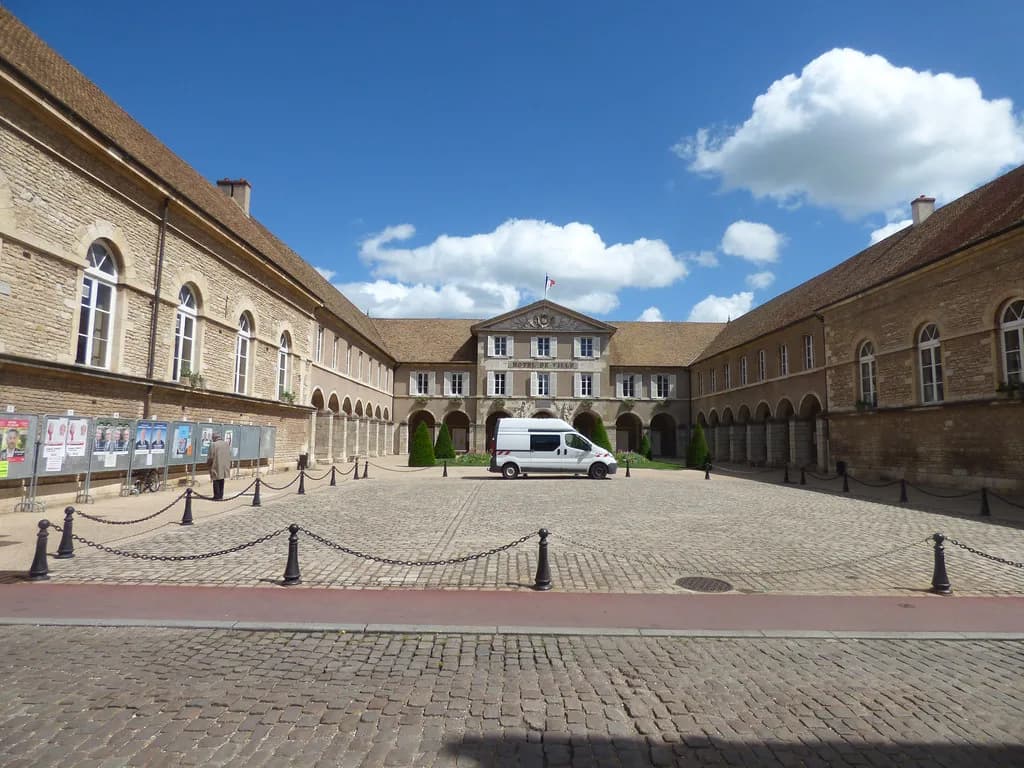
Hôtel de Ville de Beaune: Visitor Guide to the Town Hall
Beaune's Hôtel de Ville is the town hall, so ignore any instinct that reads the name as a somewhere-to-sleep. It stands in the old centre of Beaune, in the Côte-d'Or department of Bourgogne-Franche-Comté, within a short walk of the buildings most weekenders actually come to see. Plan it as a 10-15 minute look at the facade and the square, then move on to the Hôtel-Dieu and the collégiale Notre-Dame.
The building is listed in the base Mérimée, the architectural heritage database kept by the French Ministry of Culture, under reference PA00112106, which tells you it is a protected historic structure rather than a functioning visitor attraction.

What the Hôtel de Ville de Beaune is and where it sits
The Hôtel de Ville is Beaune's municipal headquarters, the French equivalent of a town hall or city hall. The word hôtel in this context has nothing to do with accommodation, so a search for hotels near Beaune will return a completely different set of results. Address your navigation to the old centre of Beaune rather than to any particular street, and you will meet the building as you cross the historic core.
Beaune sits on the Route des Grands Crus in Burgundy and is often described as the capital of Burgundy wine, with the vineyards of the Côte de Beaune around it. The historic centre is compact enough to cross on foot, so the town hall works as a waypoint rather than a destination in its own right. If you want the wider picture of what the town offers, start with the Beaune Attractions overview before you set a route.
The building sits in the Quartier Saint-Jacques, the neighbourhood that covers this part of Beaune, where the surrounding streets are characterised as calm with an agricultural landscape beyond. That description is more useful for setting expectations than for finding the door: expect a working town centre rather than a museum quarter.
How to get there and what to use as your landmark reference
Use the old centre as your reference point rather than a street number. The town hall belongs to the same cluster as the Hôtel-Dieu, the collégiale Notre-Dame and the Musée du Vin de Bourgogne, all of which sit close together and are the easiest things to aim for first. Once you have found one of those, the others follow within a few minutes on foot.
If you are arriving by train, Beaune station is the practical anchor; the station sits roughly 2.3 km from the Saint-Jacques area, which is a walk or a short hop rather than a stroll from the platform to the town hall door. Two high-speed services stop at Beaune, one running between Paris and Chalon-sur-Saône via Lyon and Dijon, and the Dijon-Nice line that also calls at Lyon and Marseille.
By car, Beaune is about 30 miles south-west of Dijon and just over 90 miles north of Lyon, reached from Paris and Lyon via the A6 motorway. Parking in a walled historic centre is the usual constraint, so decide before you arrive whether you are leaving the car at the edge and walking in.
The building from the outside: what to look at
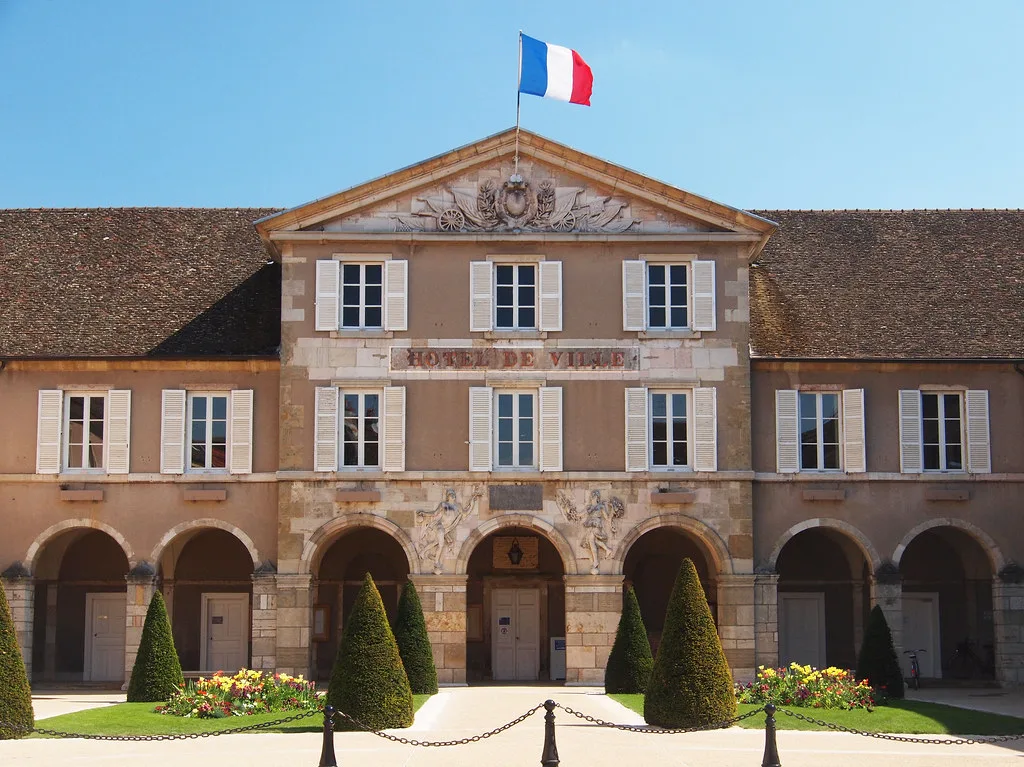
Treat this as a facade and square stop. Look at the stonework, the roofline and the way the building holds its position in the street, then read the surrounding architecture, which carries the heritage of the period when Beaune was for a time the capital of the Dukes of Burgundy. The old ducal palace buildings are visible in the town centre and give you a comparison for the town hall's scale and date.
The real architectural spectacle in Beaune is a few minutes away and looks nothing like a municipal office. The Hospices de Beaune, founded in 1443 by Nicolas Rolin, chancellor to the Duke of Burgundy, and his wife, are famous for flamboyant Gothic buildings with glazed Burgundy tiles in colourful geometric patterns. Seeing both in one morning makes the town hall legible as civic architecture beside religious and charitable architecture.
Whether you can go inside and where to check
Do not build your day around getting inside the town hall. Municipal buildings in France often admit the public for specific services or by arrangement rather than for general sightseeing, and there is no reliable published visitor programme for this one. Ask at the town hall itself or at the Beaune tourist office before you travel if interior access matters to you, and keep the Hôtel-Dieu as your bookable visit instead.
The Hôtel-Dieu is the sure thing: it is a museum housed in the former Hospices de Beaune, with themed rooms including the famous room of the poor with its two rows of crimson-curtained beds, an old apothecary, and Rogier van der Weyden's Last Judgement altarpiece. Because it is a ticketed museum, its access is governed by published arrangements rather than by the goodwill of a council office.
How long to allow and how to slot it into a Beaune walk
Give the town hall 10-15 minutes: enough to look properly at the exterior, read any plaque, and get your bearings on the street layout. It is an orientation stop, not a sight in its own right, so resist the urge to schedule a slot for it. The value comes from where it puts you, which is in the middle of the old centre with everything else in reach.
A sensible half-day runs: town hall exterior, then the collégiale Notre-Dame, then the Hôtel-Dieu, then the Musée du Vin de Bourgogne in its 14th-century former palace of the Dukes of Burgundy. If you have a full weekend, put the museum-heavy stops on separate days so you are not reading labels for four hours straight. Our things to do in Beaune guide sets out the wider list if you want to extend the walk.
If you want green space to break up the stone, the Parc de la Bouzaize is a romantic park created in 1883 around the source of the Bouzaize, at the foot of the vineyards on the edge of the centre. It is a genuine change of pace after the old streets, and a reasonable place to end an afternoon rather than start one.
Nearby sights within a few minutes: the Hôtel-Dieu and the Hospices de Beaune
The Hospices de Beaune are the reason most people come to the town, and they sit close enough to the town hall to combine without planning. The complex includes the Hôtel-Dieu museum, whose best-known room is the one with two rows of beds behind crimson curtains, familiar from the film La Grande Vadrouille. Two further rooms hold an old apothecary with its counter, bottles and earthenware jars.
The Hospices also own around 60 hectares of vineyards, and an auction of those wines takes place in the courtyard of the Hôtel-Dieu on the third Sunday of November. That is worth knowing if your weekend falls in mid-November, because the town behaves differently; otherwise ignore it and enjoy the empty courtyards.
Nearby sights: the collégiale Notre-Dame and the Musée du Vin de Bourgogne
The Romanesque Notre-Dame collegiate church stands near the Hospices de Beaune, so the two naturally pair. Notre-Dame de Beaune is a short stop architecturally but a strong one, and it gives you a quiet interior between the busy Hôtel-Dieu rooms and the street. Read the Notre-Dame de Beaune guide before you go if you want to know what you are looking at inside.
The Musée du Vin de Bourgogne occupies a 14th-century palace that was the former palace of the Dukes of Burgundy, and it traces viticulture and wine from antiquity to the present. It is the natural complement to the town hall stop: one building explains the town's civic life, the other explains its economy.
Beaune also has a museum of fine arts, and while the better-known collection of that name is in Tours, the principle is the same: a former palace setting, a mixed collection and a garden. Check locally for what is on before adding it, and keep it as a wet-afternoon substitute rather than a fixed slot.
Practical points: access, street context and when it is busy
Beaune's centre is walkable and the town hall sits inside it, so the practical question is footwear and pace rather than transport. Cobbled streets and a lot of standing make a difference over a weekend, and the vineyards climb immediately beyond the edge of town, which adds gradient if you walk out towards them.
Expect the streets around the Hôtel-Dieu to be at their most crowded in the middle of the day and in high season, since the Hospices are the town's headline sight. Do the town hall and the church first thing, then take the museum when the queues build. The Parc de la Bouzaize and the Remparts de Beaune give you somewhere to retreat to when the centre feels packed.
Beaune hosts a baroque opera festival in summer and a jazz festival in autumn, plus a police film festival held since April 2009 after moving from Cognac. These change how the town feels rather than what you can see, so check the dates for your weekend on the town's own listings before booking.
Where to check current opening and visiting details
For the town hall itself, the town of Beaune publishes its own municipal information, and that is where any decision about public access would be announced. The tourist office for the Beaune area handles visitor-facing questions and can tell you what is currently open. Neither source has published a standing visitor schedule for the building, so a quick enquiry before you go is the honest approach.
For the sights around it, buy or book as you go: the Hôtel-Dieu is a ticketed museum, and the Musée du Vin de Bourgogne and Notre-Dame each run to their own arrangements. Check the official pages for each before you travel rather than relying on an old guidebook.
Plan Your Visit
The Hôtel de Ville de Beaune is a 10-15 minute exterior stop that earns its place by where it puts you: in the middle of the old centre, minutes from the Hôtel-Dieu, Notre-Dame and the wine museum. It is not a headline attraction, and interior access is not something to count on; ask at the Beaune tourist office about visiting inside if it matters to you. Build the rest of your morning around the sights that are reliably open, and check current opening days before you go.
Explore more Beaune guides
Frequently Asked Questions
Can you go inside the Hôtel de Ville in Beaune?
There is no published standing visitor programme for the building, which is Beaune's working town hall. Ask the town hall or the local tourist office directly before you travel if interior access is important to you, and plan the Hôtel-Dieu museum as your guaranteed indoor visit instead.
Why is it called an Hôtel de Ville?
In French, hôtel de ville simply means town hall or city hall. The word hôtel once referred to a substantial town house or public building, which is why the same term appears in Hôtel-Dieu, a hospital. It has nothing to do with booking a room.
How long do you need at the Hôtel de Ville de Beaune?
Allow 10-15 minutes to look at the exterior and get your bearings on the surrounding streets. It works as an orientation stop at the start of a walk rather than a scheduled visit, so treat any extra time as a bonus rather than part of the plan.
What is there to see near the Hôtel de Ville de Beaune?
The Hôtel-Dieu museum, housed in the former Hospices de Beaune, is the headline sight and a few minutes away. The Romanesque collégiale Notre-Dame and the Musée du Vin de Bourgogne in the former palace of the Dukes of Burgundy are also within easy walking distance of the old centre.
Do you need tickets for the Hôtel de Ville?
No ticket is sold for the town hall as a visitor attraction, since it is a municipal building rather than a museum. The ticketed visits in the old centre are the Hôtel-Dieu and the Musée du Vin de Bourgogne, each with its own arrangements, so check those before you go.
Is the Hôtel de Ville de Beaune the same as the Hôtel-Dieu?
No. The Hôtel de Ville is the town hall; the Hôtel-Dieu is the former hospital founded in 1443 by Nicolas Rolin and Guigone de Salins, now a museum famous for its glazed Burgundy roof tiles and the room of the poor. They are separate buildings within a short walk of each other.
How do you reach Beaune from Paris or Lyon?
Two high-speed rail services call at Beaune, one between Paris and Chalon-sur-Saône via Lyon and Dijon, and the Dijon-Nice line via Lyon and Marseille. By road, the A6 motorway connects Paris and Lyon, with Beaune about 30 miles south-west of Dijon.
Sources
- Parc de la Bouzaise – Itinéraires randonnée & vélo | Komoot
- Quartier Saint-Jacques à Beaune (21200) - Avis, Données et Statistiques | Chacun Son Lieu
- Museum of Fine Arts | Touraine Val de Loire
- Beaune Travel Guide: Best of Beaune, Bourgogne-Franche-Comté Travel 2026 | Expedia.co.uk
- File:Beaune Hotel de Ville02.jpg