
Hospices de Beaune: A Visitor's Guide to the Hôtel-Dieu
The Hospices de Beaune is the Hôtel-Dieu, a medieval hospital founded in 1443 that sits in the middle of Beaune's old town and is the reason most short-break visitors stop in Beaune at all. Its courtyard and the coloured roof above it are the sight; the wine domaine and the November auction are a separate story attached to the same institution. Budget around an hour inside, more if the museum rooms hold your attention.
This page treats the Hospices as one place to visit rather than a city guide. If you are still deciding how to split a weekend, start with our Beaune Attractions: 6 Visitor Guides and come back here for the detail on the Hôtel-Dieu itself.
Hospices de Beaune in brief: the Hôtel-Dieu and its roofs
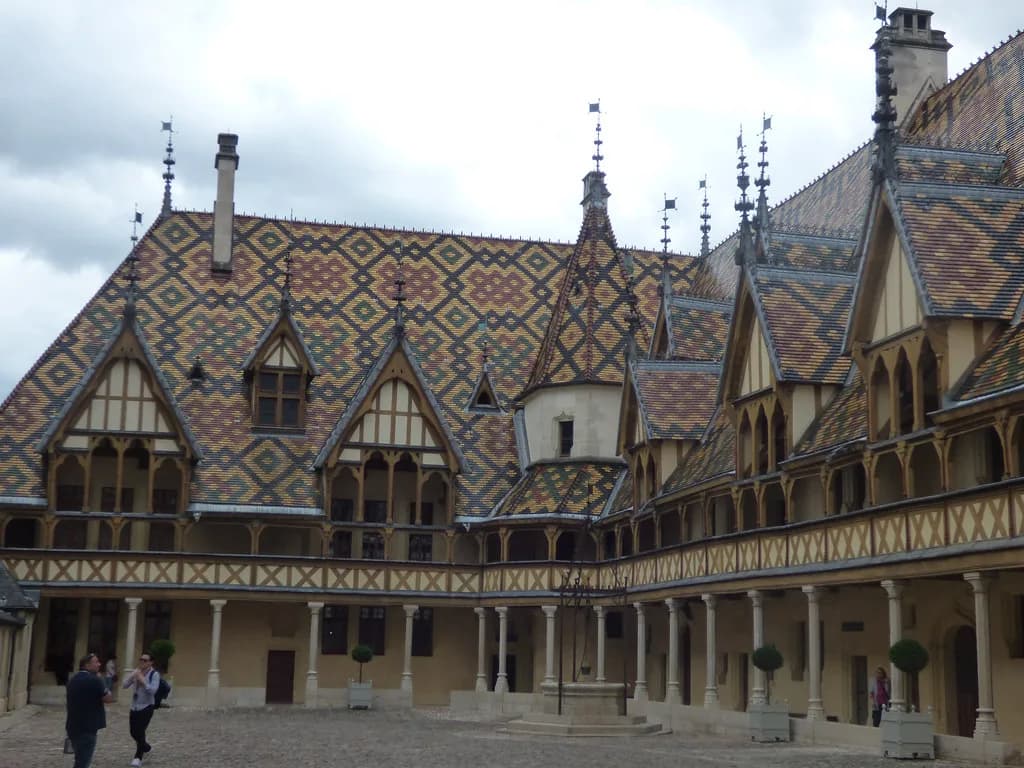
The Hospices Civils de Beaune is an institution with two halves: a historic monument, the Hôtel-Dieu, and a wine domaine of around 60 hectares across the best appellations of Bourgogne. Visitors queue for the first, not the second. The Hôtel-Dieu is the building with the steep, patterned roof of glazed tiles in burgundy, yellow and green, and it stands in the pedestrian heart of Beaune, which is why it fits easily into a two- or three-day break.
Treat the visit as a look at a working charitable foundation's oldest possession rather than a wine experience. Nothing about the Hôtel-Dieu tour is a tasting, and the wine side of the Hospices is handled elsewhere.
Where the Hôtel-Dieu sits and how to reach it
The Hôtel-Dieu occupies the block around Avenue Guigone de Salins in central Beaune, named for one of its founders. From the town's central squares and the main shopping streets, you reach it on foot in a few minutes; Beaune is compact enough that the old town, the ramparts and the Hôtel-Dieu sit within one continuous walk. Our Beaune Neighborhoods: 4 Area Guides sets out how the centre is laid out if you want to orient yourself first.
Coming from outside the centre, Beaune's station is on the western edge of the old town, and the walk in passes the Remparts de Beaune before you reach the hospital block. Allow a quarter of an hour or so on foot from the station with luggage, or take a taxi if you are heading straight to a timed entry.
The founding story: Nicolas Rolin and Guigone de Salins
The Hospices Civils de Beaune began in 1443, when Nicolas Rolin and Guigone de Salins set out to build a hospital, the Hôtel-Dieu. Their endowment combined charity with patronage, and that double act is the reason the institution survived with both a monument and a wine estate: the vines came from legacies and donations by benefactors from the region over the centuries that followed. Knowing this changes how you read the rooms inside, which were designed as a functioning ward rather than a palace.
The wine estate became the funding mechanism. Grapes from donated vineyards are sold each year, and the proceeds support the hospital institution, which is why the domaine and the hospital are talked about in the same breath even though visitors only see the medieval building.
What to see inside: the courtyard and the hospice rooms
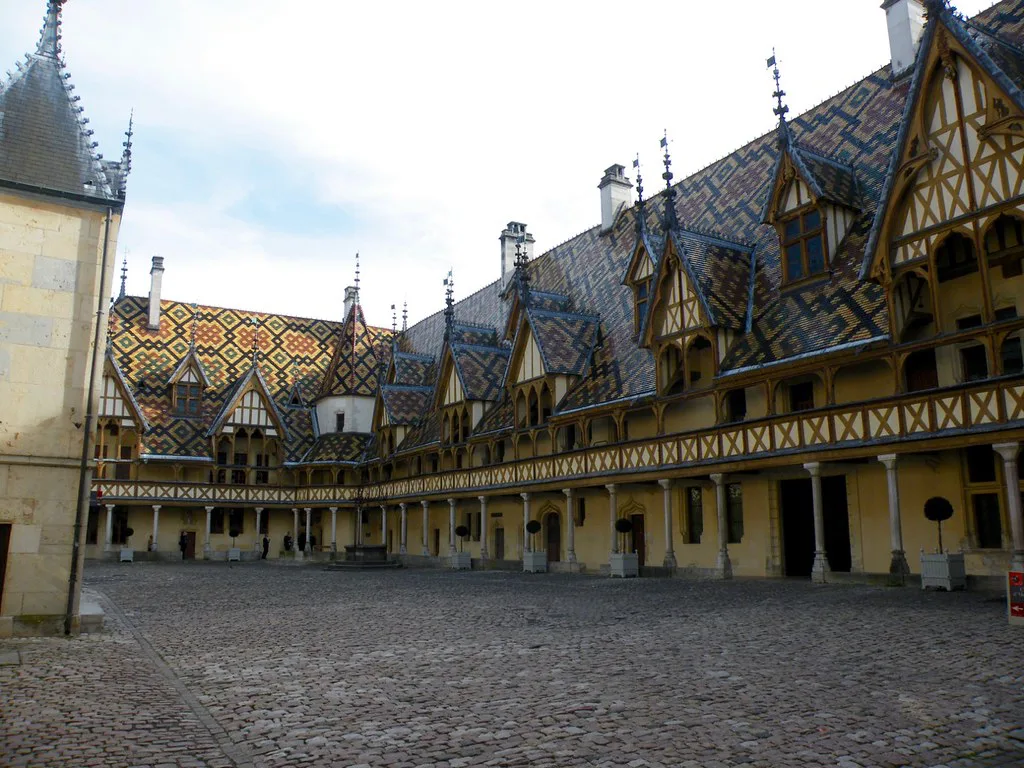
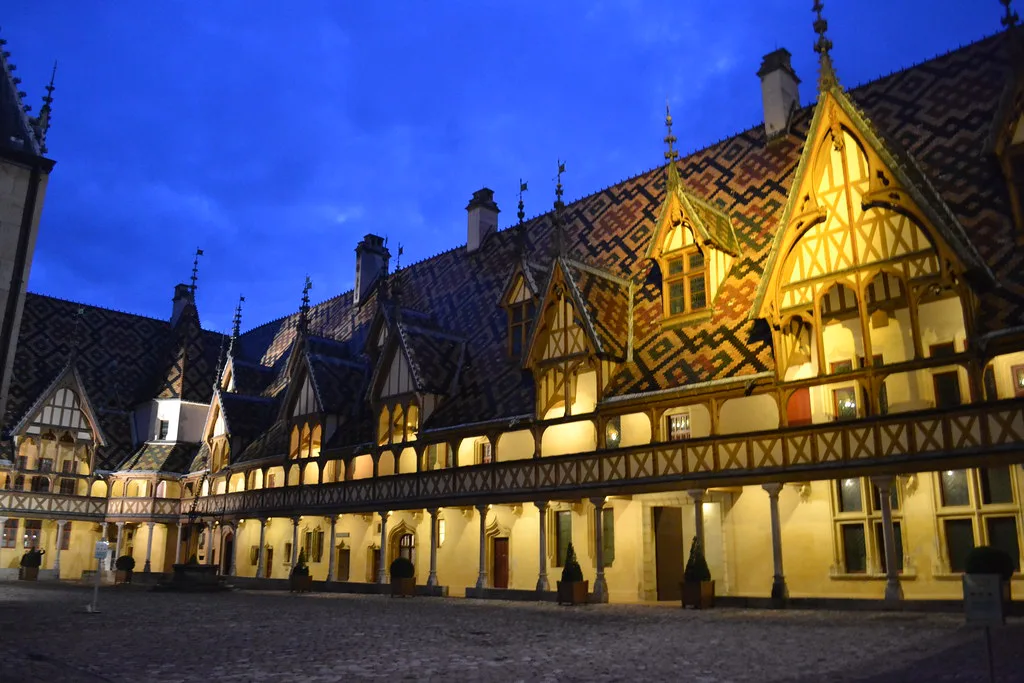
You enter through the courtyard, and the first thing to do is stop and look up at the roof. The Flemish-style roofscape, with its geometric patterns of glazed tiles, is the image people carry away, and it is best seen from the courtyard rather than from the street outside. The visitor route then takes you through the charitable hospice rooms, the wards and the objects that show how the hospital functioned.
Visitors consistently single out the restored interiors and the roof as the highlights. The restored state of the building is part of the point: it is a charitable hospice, not a royal residence, and the scale is domestic rather than grand, which is why the visit does not swallow a whole afternoon.
The wine domaine and the November auction, in context
The Hospices' wine estate covers roughly 60 hectares, looked after by a team of 23 under a régisseur who has held the post since 2015, and it produces the 53 historic cuvées sold each year. The sale itself traditionally falls on the third Sunday of November and is billed as the most famous charity auction in the world; each year a 228-litre barrel, the pièce de charité, is sold for one or more charities. If your dates land on that weekend, expect the town to be busy.
None of this is part of the Hôtel-Dieu ticket. The domaine is not a tasting room you drop into, and the auction is an event with its own procedures. Do not plan a visit around buying or tasting wine at the Hospices; plan it around the building.
How much time to allow
An hour covers the courtyard, the roof view and the main hospice rooms at an unhurried pace; two hours lets you read the displays and linger. The building is compact, so the risk is not running out of time but arriving with too little: twenty minutes is frustrating when you have queued.
Go early in the day if you can. The courtyard is the bottleneck and the interior rooms are small, so late morning and early afternoon are the least comfortable slots in high season. Since the town itself rewards wandering, pair the Hôtel-Dieu with a slow loop of the centre rather than stacking three ticketed sights into one morning.
Tickets and opening: confirm before you travel
Ticket prices and opening times for the Hôtel-Dieu change, so check the official visitor page before you set out. Buy or reserve online where the site allows it, particularly for weekend slots, and note that a timed entry is easier to fit around lunch than an open ticket.
The main practical warning is the lunchtime gap that shapes many French museums and shops. If you plan to visit around midday, check the day's hours on the official page before setting out, since the Hôtel-Dieu can close over lunch.
What to see nearby once you leave
Notre-Dame de Beaune is a short walk away and takes a fraction of the time, making it an easy add-on after the Hôtel-Dieu. The Musée des Beaux-Arts de Beaune is the other natural pairing if you want a second indoor stop, though check its opening days first because French museums often close one day a week.
For a break between sights, the Parc de la Bouzaize gives you green space on the edge of the centre, and the Hôtel de Ville de Beaune anchors the main square area. Both are free to wander and make a sensible pause rather than a destination in themselves.
Who the Hôtel-Dieu suits, and when to skip it
The Hôtel-Dieu suits anyone who wants a single, striking medieval building with a story attached, and it works well for a mixed group because the visit is short and the roof alone justifies the stop. It is less appealing if you have already seen a lot of medieval wards and are chasing wine instead; in that case, spend the time on the town and the surrounding streets.
Skip it if your only interest is the auction or the domaine. Those are not part of the visit, and the building will not answer questions about the wines.
Plan Your Visit
The Hospices de Beaune is the Hôtel-Dieu: one building, one courtyard, one roof, and a founding story that starts in 1443. Give it an hour, go early, and treat the wine domaine and the November auction as separate matters.
Build the rest of your day around the old town on foot and check the official visitor page for current tickets and hours before you travel.
Frequently Asked Questions
What is the Hôtel-Dieu des Hospices de Beaune?
It is the medieval charity hospital founded in 1443 by Nicolas Rolin and Guigone de Salins, now a historic monument with a patterned Flemish-style roof that visitors come to see in central Beaune.
How long does a visit to the Hospices de Beaune take?
Allow around an hour for the courtyard, the roof view and the main hospice rooms, and up to two hours if you read the displays carefully. The building is compact.
Who founded the Hospices de Beaune and when?
Nicolas Rolin and Guigone de Salins founded the hospital in 1443. Their endowment of charity and patronage is the reason the institution survived with both a monument and a wine estate.
Is the Hospices de Beaune visit the same as the wine auction?
No. The Hôtel-Dieu is the museum building you visit; the wine domaine and the November auction are separate parts of the institution and are not included in the visit.
Can you stay at the Hospices de Beaune?
The Hôtel-Dieu is a historic monument open to visitors, not accommodation. Plan your stay elsewhere in Beaune and treat the hospital as a daytime sight.