
Maison Picassiette: A Visitor's Guide to Chartres' Mosaic House
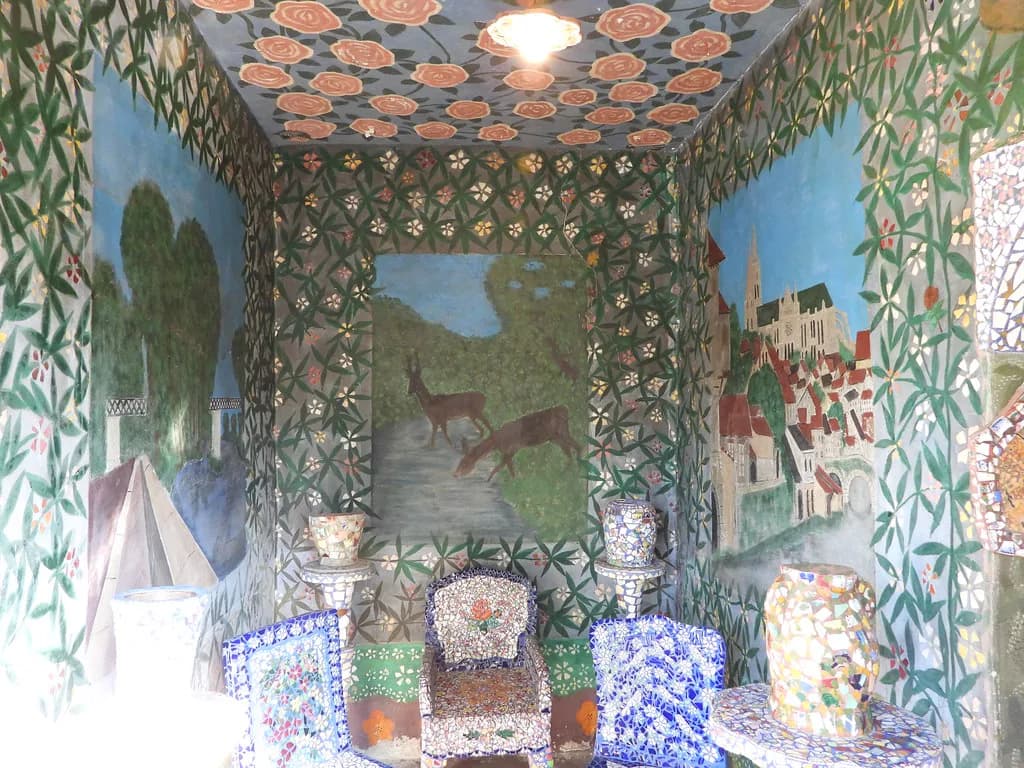
Maison Picassiette is a modest house at 22 rue du Repos in Chartres, decorated from floor to ceiling in mosaics of broken faience and glass, with the garden treated the same way. It is a museum of art brut, the label used for work made outside formal artistic training, and a visit takes you through a series of distinct spaces rather than one continuous gallery.
The house sits in the Saint-Chéron quarter, away from the cathedral hill, and the Filibus network serves it directly with a stop named Picassiette on line 4. Budget an hour or two rather than a whole afternoon, and treat it as one half of a Chartres day alongside the old town.
What Maison Picassiette is
Raymond Isidore, known as Picassiette, worked on the house from the late 1930s onwards, covering interior walls, ceilings, floors and furniture, then moving outside to the facade, paths and garden walls. The materials were shards of crockery and glass set into cement, and the result is classed as naïve architecture rather than conventional decoration. The city's own page on the house sets out its history and the spaces you walk through.
The site has been recognised as remarkable contemporary architecture by the French culture ministry since 2017, which matters for how you read it: this is listed heritage, not a folk curiosity in someone's back garden. Looking closely at individual panels pays off, because faces, animals, flowers and buildings emerge from fragments at close range.
Where it is and how to get there
The address is 22 rue du Repos, 28000 Chartres, in the Saint-Chéron district south-east of the historic centre. On the Filibus bus network, take line 4 to the Picassiette stop, which puts you at the door rather than on a main road half a kilometre away.
If you are building a day around Chartres, the mosaic house works well as a contrast to the ecclesiastical sights uphill. The Cathédrale Notre-Dame de Chartres and the Église Saint-Pierre, Chartres are the obvious pairings for the same outing, and the broader Chartres Attractions: 5 Visitor Guides hub helps you sequence them without doubling back.
The story in brief
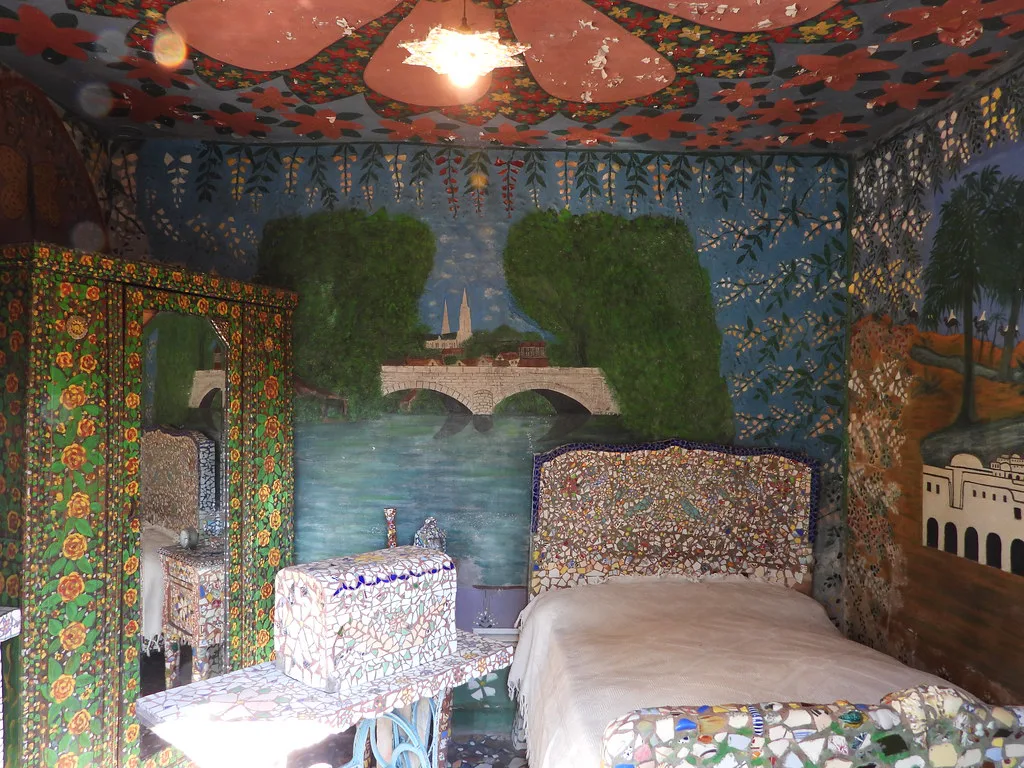
Isidore settled in the Saint-Chéron house from a modest background and began picking up pieces of glass and faience on his walks, turning them into mosaics to embellish the building. He started the interior decoration once the main structural work was done, from 1938, at first reproducing postcards before the walls, ceilings and furniture were entirely covered. The city's account of the house traces that progression from collected shards to total surface.
His widow described the effort as some 29,000 hours of work and around four million pieces of broken crockery, roughly 15 tonnes of material. He carried on refining details to the end, which explains why the later garden structures feel more resolved than the earliest interiors.
The main house: floor, walls and furniture
Start indoors, where the principal rooms show the full extent of the mosaic treatment: paint and mosaic meet on walls, ceilings and floors, and even the furniture is encrusted. Early panels copy postcards, which gives you a way into reading the imagery before the more personal compositions take over.
The main facade and the interior are the two halves of this first section, so give the exterior wall a proper look before stepping inside rather than hurrying past to the door. Rooms are small and the detail dense, which is why a slow pass beats a quick circuit.
The chapel
The chapel was built between 1953 and 1956, and its decoration leans on Christian imagery: crosses, churches, madonnas and Jerusalem, mixed with rural scenes. That blend of religious and everyday motifs is the thread running through the whole site.
Read it as a room rather than an exhibit case, and look at how the mosaic carries across surfaces in different materials and scales. It is the point where the domestic building starts to behave like a small monument.
The cour noire and its cathedral
The cour noire takes its name from the black chosen to represent earthly life, and it is an open-air space built around a three-dimensional stone cathedral resting on a black mosaic-covered tomb, with a further representation of Chartres above the city wall. Niche-like openings in the wall reveal churches and cathedrals, and a black throne faces the tomb.
This is the most architectural part of the visit, so allow time to walk around the throne and tomb rather than viewing them from one angle. The contrast between the black ground and the pale stone cathedral is the effect the space was built for.
The summer house and the passage étroit
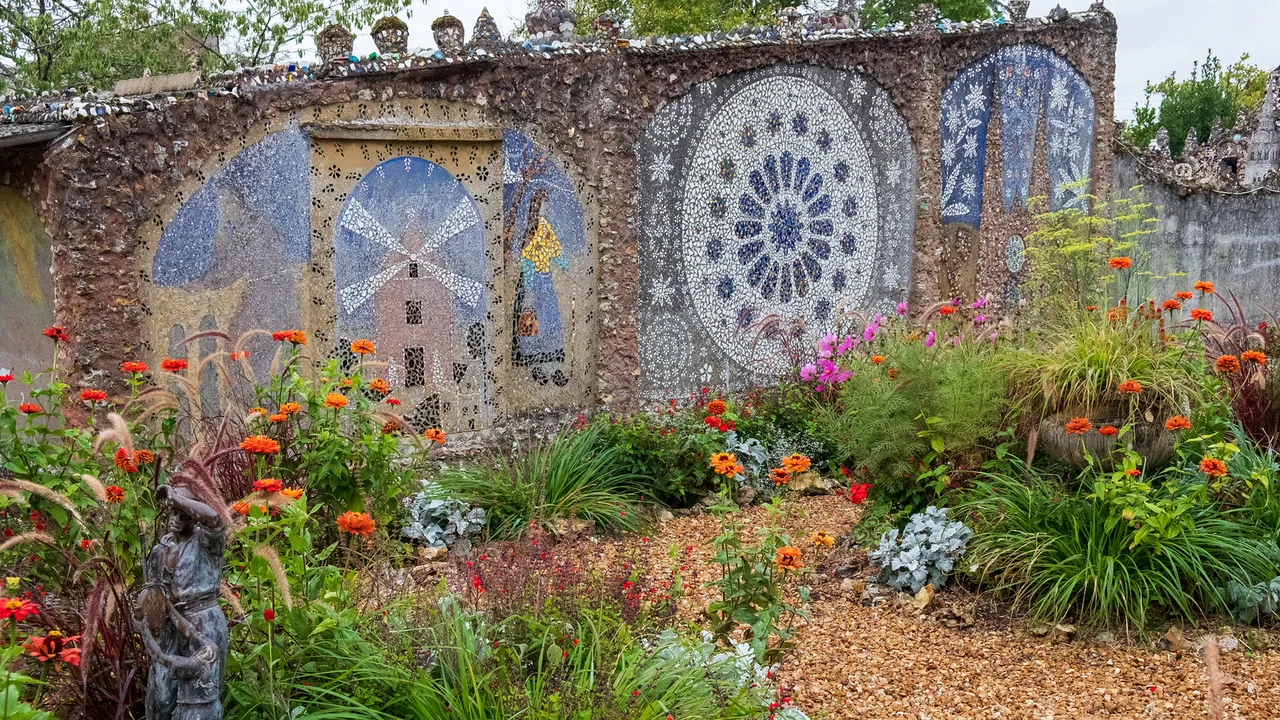
The summer house was built at the same time as the chapel to extend the living quarters, with clumsy paintings covering the interior walls. Outside, the narrow passage carries scenes including the Annunciation and a stag, surrounded by many female faces, before leading to a door painted with birds in flight and flanked by two pillars, each bearing eight familiar animals: the Porte du Paradis.
Beyond that door is a covered passage brightened by funny and unexpected paintings, including a Mona Lisa, which is easy to miss if you are looking at floor level only. This section rewards looking up.
The Jardin du Paradis
The garden splits into two zones: the statuaire, a planted area with flower beds animated by sculptures, reached by a small path that runs along the boundary wall, and the parvis de Jérusalem, a formal French-style garden arranged around a basin and leading to the blue throne. Behind the throne, high up, is the representation of the city of Jerusalem.
Leave the garden until last, because it is the calmest part of the site and the one where the planting, sculpture and mosaic read together. In wet weather the paths and open ground are the first places to feel uncomfortable, so plan the interiors for the dampest part of the day.
The tombeau de l'esprit
Behind the Jerusalem wall sits the tombeau de l'esprit, built in 1962 and blue to stand for celestial space in deliberate opposition to the black throne. It carries fine mosaics and pious inscriptions, and it was his final creation, though he continued hunting for plate fragments to finish small details.
Ending the visit here gives the whole sequence a shape: domestic interior, chapel, courtyard, garden, tomb. If you only have half an hour, this is the element to keep alongside the main house.
How long to allow and how to pace the visit
Most visitors will want between one and two hours. The circuit is not long in distance, but the density of detail slows you down, and the garden is best taken at a stroll rather than a march.
A sensible order is the main house first, then the chapel, cour noire, summer house and passage, and the Jardin du Paradis last. Photographing mosaics in low light is difficult, so use the outdoor spaces for pictures and keep the interiors for looking.
Opening periods and hours by season
The published opening period runs from 14 February to 31 October 2026, which means the house is closed through the winter. Hours shift by season: February to March, Wednesday to Saturday 10am to 1pm and 2pm to 6pm, with Sunday 12pm to 6pm; April to June, Tuesday to Saturday 10am to 6pm, and Sundays and public holidays 12pm to 6pm; July and August open seven days a week, Monday to Saturday 10am to 6pm and Sundays and public holidays 12pm to 6pm; September to October, Tuesday to Saturday 10am to 6pm, Sundays and public holidays 12pm to 6pm.
The Sunday pattern is the trap for weekend visitors: outside July and August, Sunday opening starts at midday, so a Sunday morning slot will not work. Tuesday openings only begin in April, and February to March does not open on Sunday mornings either.
Tickets and booking
Self-guided admission is published as a range rather than a single price: full rate 9 to 12 euros, reduced rate 5 to 7 euros, and free for under-sixes, with group rates from 20 people. Those ranges reflect different periods or options, so check the tariff page before you travel rather than assuming one figure.
Guided options are priced separately and need booking with the tourist office: a paid Sunday morning guided visit from 12 July to 23 August, a sensory visit from 16 to 29 July, a story-led visit with the guardian of the spirit of the place at 15 to 12 euros full and 8 to 10 euros reduced, and private visits for 5 to 15 people at 15 euros full and 9 to 10 euros reduced. Book through the C'Chartres Tourisme online shop, by phone on 02 37 34 10 78, or by email at picassiette@chartres-tourisme.com.
Practical points for families
The city publishes downloadable cultural activity booklets, including one for ages 6 to 10 and a junior booklet on architecture at the museum. They give children something to hunt for while you read the panels, which suits a site where the interest is in small detail.
The paths, narrow passage and small rooms mean buggies and wheelchairs need a bit of planning; the official site carries accessibility information. Contact details for questions are the phone number and email on the same page.
What to pair with it nearby
Chartres Cathedral is the main reason most people come, and the mosaic house is a good counterweight to it: one is high Gothic ambition, the other is one man's decades of domestic obsession. The Musée des Beaux-Arts de Chartres makes a third stop if you have a full day and want the city's art collection.
If stained glass is your interest, the Centre International du Vitrail, Chartres rounds out the ecclesiastical side of the day. Our things to do in Chartres guide covers the wider list if you are staying longer than a weekend, and if your trip stretches further afield, our Orléans city guide is a natural next stop for another cathedral city.
Plan Your Visit
Pair Maison Picassiette with the cathedral and one other Chartres sight, go on a day when the house is open, and give it an unhurried hour or two. Outside July and August, remember that Sundays start at midday, and from November to mid-February the house is closed.
Tickets are sold in ranges, guided visits need booking with the tourist office, and the bus drops you at the door on Filibus line 4. Check the official tariff page before you go for the current figures.
Frequently Asked Questions
How long does a visit to Maison Picassiette take?
Allow between one and two hours. The circuit is short but dense, with small rooms and detailed mosaics indoors and a garden at the end, so a slow pass takes longer than the floor area suggests.
Where is Maison Picassiette in Chartres?
It is at 22 rue du Repos, 28000 Chartres, in the Saint-Chéron quarter. On the Filibus bus network, line 4 serves the Picassiette stop, which is the simplest way to arrive.
How much are tickets to Maison Picassiette?
Self-guided admission is sold on a sliding scale rather than at one flat rate, with a full rate, a reduced rate and free entry for under-sixes. Guided, sensory and private visits are priced separately and must be booked with the tourist office; the official Maison Picassiette page lists the current self-guided and guided tariffs, so check it before travelling.
When is Maison Picassiette open?
The published season runs from 14 February to 31 October 2026, with hours changing by season. July and August open seven days a week; in other months Sundays and public holidays start at midday, and February to March opens Wednesday to Saturday plus Sunday afternoon.
How do you get to Maison Picassiette by bus?
Take Filibus line 4 to the Picassiette stop. The stop is right by the house, so you do not need a further walk from a main road.
What can you see inside Maison Picassiette?
The main house with mosaics on walls, ceilings, floors and furniture; the chapel built between 1953 and 1956; the cour noire with its stone cathedral, black tomb and throne; the summer house and narrow passage with the Porte du Paradis; the Jardin du Paradis; and the tombeau de l'esprit from 1962.
Who was Raymond Isidore, 'Picassiette'?
He was a Chartres resident who collected broken glass and faience on his walks and used it to cover his house and garden in mosaics, starting the interior work in 1938. His widow described the project as around 29,000 hours and roughly four million pieces of crockery.