
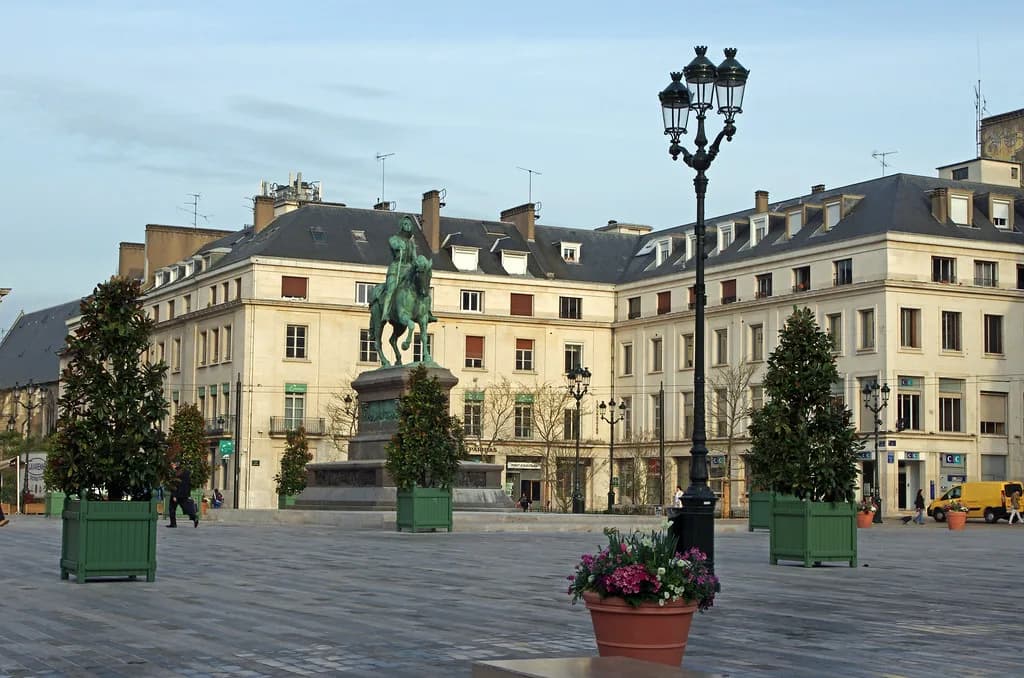
Place du Martroi: Orléans' Central Square and Its Jeanne d'Arc Statue
Place du Martroi is the square at the heart of central Orléans, and the reason most visitors cross it is the bronze equestrian statue of Jeanne d'Arc standing at its centre. It is a public space you pass through rather than a ticketed attraction, so it costs nothing and takes minutes. Treat it as your fixed point in the city: the streets of the old town radiate from here, and the Rue Royale runs off the square.
The statue dates from 1855 and is the work of Foyatier and Vital-Dubray, which makes it the square's one fixed, identifiable landmark. The ground beneath the square carries far more history than the surface shows: archaeological work here uncovered Gaulish and Gallo-Roman settlement and the buried remains of the fourteenth-century Porte Bannier and its moat.
What Place du Martroi Is and Why It Anchors a Visit
This is a city square rather than a museum or a monument you queue for, and that shapes how you use it. Its value to a weekend in Orléans is positional: it sits at the centre of the street pattern, and the main routes through the old town pass through or past it. Give it a look, read the statue, and then let it send you on to the next sight.
Where It Sits: The Rue Royale Axis and the Old Town
Place du Martroi took its present shape in the eighteenth century, when it was laid out as a continuation of the Rue Royale. That axis still explains the square today: approach from the Rue Royale side and the square reads as the head of a long, formal street rather than an enclosed medieval marketplace.
The streets running off the square lead into the older fabric of the city, and the quarter between the square, the Loire and the church of Notre-Dame-des-Miracles is known as the Dunois quarter. If you are working out how the centre fits together before a weekend, the Orléans Neighborhoods: 4 Area Guides are a sensible place to start.
How to Get There and Find Your Way Around
Because the square is the central node of the street plan, the practical approach is to navigate to the square itself and orientate from the statue. From there you can pick a direction by the street name at each corner and walk into the old town without a map in hand. The square is the natural meeting point if your group splits up.
There is an underground car park beneath the square, dug in the 1980s, but it is best treated as the reason archaeologists were able to dig here rather than as parking advice. Arriving on foot keeps the square as a waypoint instead of a destination you have to leave the car at.
A photograph of the square taken from ground level shows the open span of the place and the statue's position at its centre, which helps you recognise the layout before you arrive.

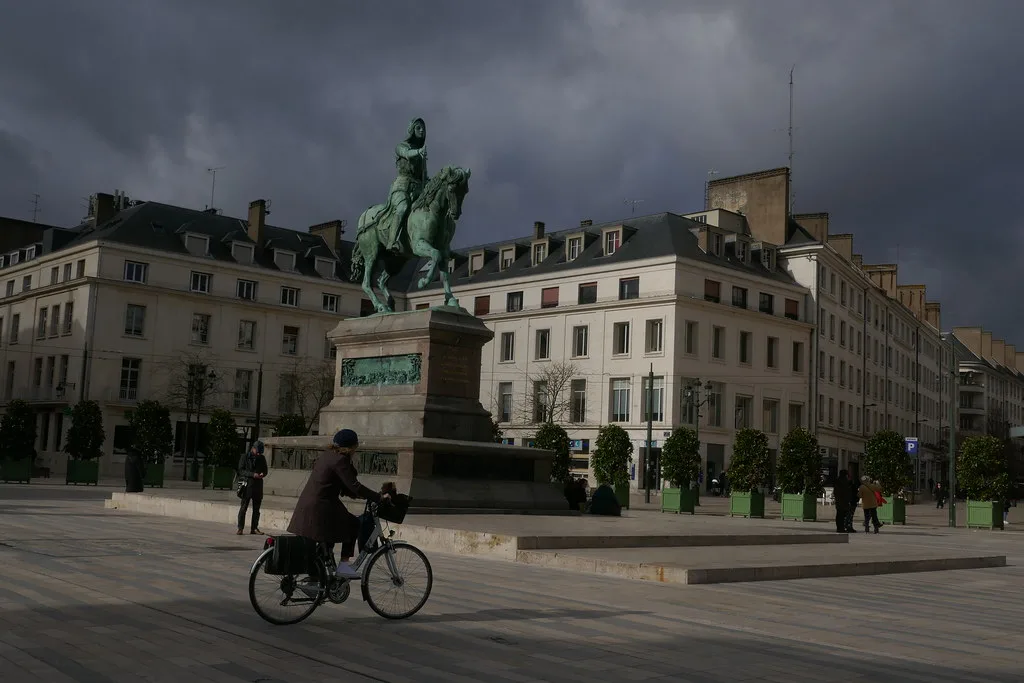
The Jeanne d'Arc Statue: Foyatier and Vital-Dubray's 1855 Bronze
The equestrian statue of Jeanne d'Arc in the middle of the square was made in 1855 by Foyatier and Vital-Dubray. It is the element that gives the square its focal point, and it is worth a few minutes of circling to see it from more than one angle.
Jeanne d'Arc's association with Orléans runs through the city, and the square's statue is the most central of the monuments to her. If you want the fuller story, the Maison de Jeanne d'Arc in Orléans covers her life and the siege in a dedicated setting rather than in open air.
Reading the Square's Layers: What Lies Underfoot
Archaeological investigations in 1986, during construction of the underground car park, and again in 2013, during requalification of the square, revealed occupation from the second century BCE to the tenth century CE. The earliest layers belong to a Gaulish settlement on the northern edge of the square, with timber and earth houses, hearths, storage jars and wine amphorae from Italy.
Above those levels, the Roman period left compacted gravel surfaces that may have been a road or an open place, with stone buildings and wells used into at least the third century. Medieval occupation followed, and the written record names two nearby churches, Saint-Sulpice from 855 and Saint-Pierre-Ensentelée from 930.
The most striking find is the fourteenth-century Porte Bannier, a monumental gate that once stood where the square is now, complete with a drawbridge, a stone bridge that the raised drawbridge rested on, and a moat up to twenty metres wide. Its foundations and the arch of the bridge were found in the excavation, and some remains are visible in the present underground car park.
None of this is on show as an attraction: the archaeology is published in excavation reports rather than laid out on the square for visitors. What you get on the surface is a working city square, so the reading happens afterwards.
How Long to Allow and How to Use the Square as a Fixed Point
Twenty to thirty minutes covers the statue, a circuit of the square and a look at the surrounding facades. That is the honest budget: there is nothing to queue for, nothing to buy a ticket for, and no interior to explore. Anyone planning a full morning here will run out of things to do.
The better use of the square is as an anchor for a walking day: start here, take one street out to a sight, and come back through it in the afternoon. It divides the old town into loops you can walk without retracing your steps, and it gives you a reliable point to regroup at.
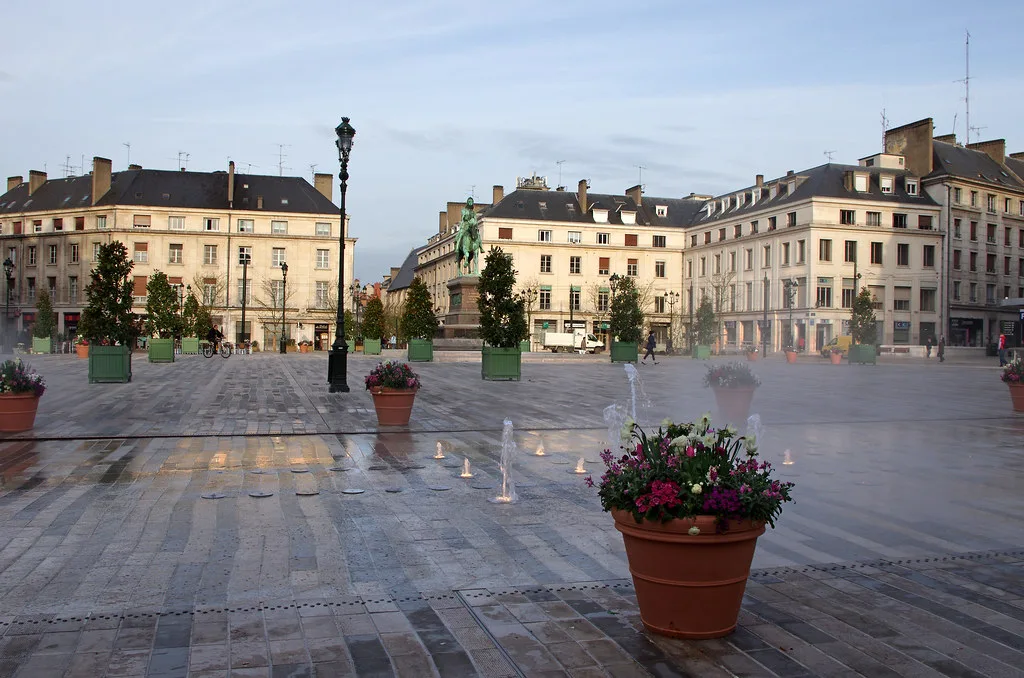
Nearby: The Cathedral, the Loire and What to Head For Next
The Cathédrale Sainte-Croix d'Orléans is the obvious next stop from the centre, and it pairs naturally with the square because both are free to enter and to look at from outside. The cathedral's west front and its place Sainte-Croix setting make it a different kind of space from the Martroi, so do both rather than choosing.
For a collection rather than a monument, the Musée des Beaux-Arts d'Orléans sits on place Sainte-Croix and makes a natural indoor counterpoint to the open square, especially useful if the weather turns.
The Loire lies a short walk from the square, and the riverbank is the simplest way to end a circuit of the centre. If you want green space instead of streets, the Parc Floral de la Source and Parc Pasteur, Orléans are both away from the immediate centre, so they work better as a separate half-day than as an add-on.
Building a wider plan around the square is straightforward once you know the city's sights are close together and mostly free to view from outside. The Orléans Attractions: 6 Visitor Guides lay out the main options so you can slot the square in between them.
Plan Your Visit
Place du Martroi needs no planning beyond knowing where it is: it is free, open to walk through, and small enough to see in half an hour. Come for the 1855 Jeanne d'Arc statue, use the square to orientate yourself, and let the streets and the Rue Royale axis carry you on to the cathedral and the old town.
The archaeology beneath the square, from Gaulish houses to the buried Porte Bannier, is the part most visitors miss because nothing marks it on the ground. Reading up before you go turns a brief crossing into the most interesting ten minutes of the day. The city remains one of the more rewarding stops in the Loire Valley for a short break.
Frequently Asked Questions
What is Place du Martroi known for?
It is the central square of Orléans, known above all for the bronze equestrian statue of Jeanne d'Arc at its centre, made in 1855 by Foyatier and Vital-Dubray. It also sits on the axis of the Rue Royale and is the point from which the old town's main streets radiate.
Do you need tickets to visit Place du Martroi?
No. Place du Martroi is an open public square and there is nothing to buy a ticket for. It is not a museum or a walled monument, so you simply walk in and look around.
How long should you spend at Place du Martroi?
Twenty to thirty minutes is enough to see the statue, walk the perimeter and take in the surrounding buildings. It works best as a starting or meeting point for a longer walk through central Orléans rather than as a stand-alone stop.
Where is the Jeanne d'Arc statue in Orléans?
It stands at the centre of Place du Martroi, the main square in the middle of the city. It is the square's focal point and is visible from the streets leading into it.
What is buried under Place du Martroi?
Excavations in 1986 and 2013 found occupation layers from the second century BCE to the tenth century CE, including a Gaulish settlement and Roman-period surfaces. They also uncovered the fourteenth-century Porte Bannier, its drawbridge structures and the town moat.
What else is near Place du Martroi?
The Cathédrale Sainte-Croix d'Orléans and the Musée des Beaux-Arts d'Orléans, on place Sainte-Croix, are both a short walk away. The Maison de Jeanne d'Arc is also within the centre, and the Loire is nearby.