
Cathédrale Sainte-Croix d'Orléans: A Visitor's Guide
Cathédrale Sainte-Croix d'Orléans is the city's best-known building: a Gothic cathedral on Place Sainte-Croix, at the top of Rue Jeanne d'Arc, free to walk into. Treat it as a 45-minute stop rather than a half-day, then use the square and the lanes behind it to fill out a morning. Its draw is specific and strong: the stained glass that brings the 1429 siege and Joan of Arc into the nave you are standing in.
Cathédrale Sainte-Croix d'Orléans in short
The cathedral sits on Place Sainte-Croix in the old town, on the eastern side of the centre, and entry is free. It opens every day at 9 am according to France Voyager, which gives closing at 6 pm from November to March and 7 pm from April through October, so plan an earlier rather than later slot if you come in winter. The square is a short walk from Place du Martroi and from the Musée des Beaux-Arts d'Orléans, which makes a natural pairing on foot.
Where it is and how to get there
Rue Jeanne d'Arc runs straight from the equestrian Joan of Arc statue on Place du Martroi up to the cathedral's west front, so the approach is one of the easiest in Orléans to navigate and needs no transport. Coming by train, Orléans is about an hour from Paris Austerlitz on direct services, which makes the cathedral reachable as a day trip. If you arrive at the station, the walk into the centre brings you out near the top of Rue Royale, from where the cathedral towers are visible over the rooftops.
Allow ten minutes to walk from the Martroi end of Rue Jeanne d'Arc and build in extra time for the square itself, which is broad and open, with the Hôtel Groslot a couple of minutes west. The old-town streets of Orléans are small enough that the cathedral works as the anchor of a walking loop rather than a separate excursion.
The exterior: the west front and towers
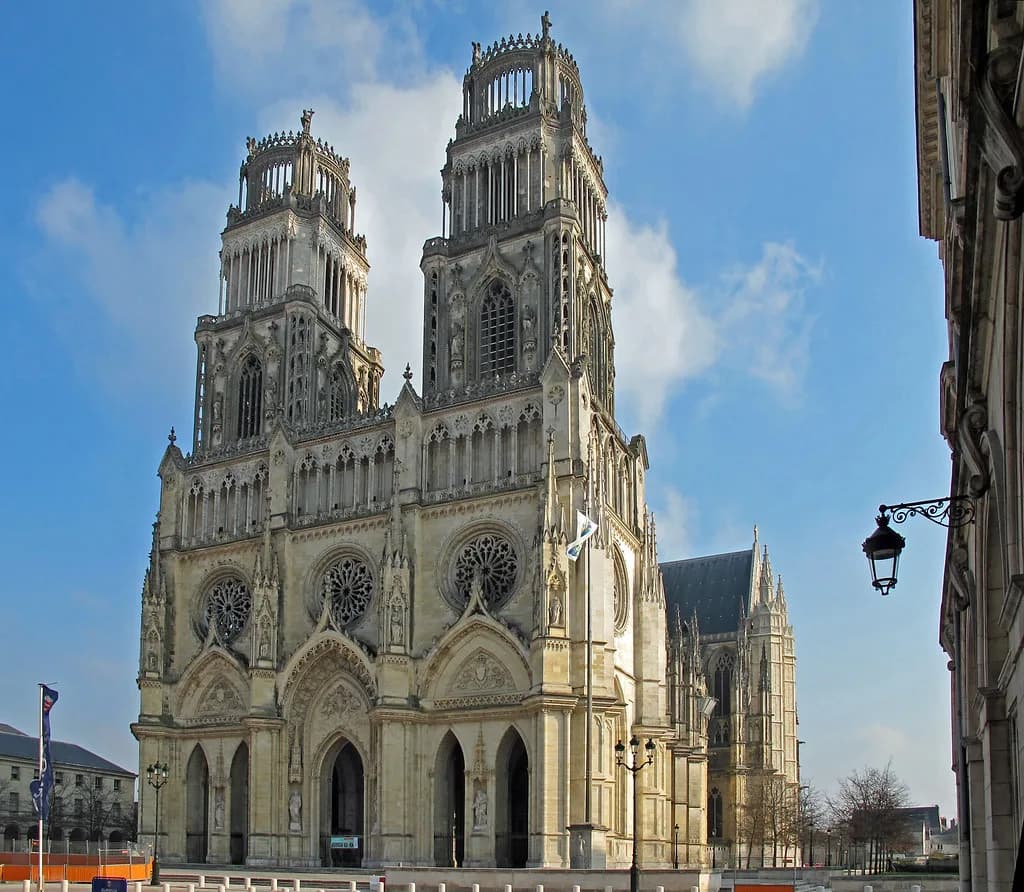
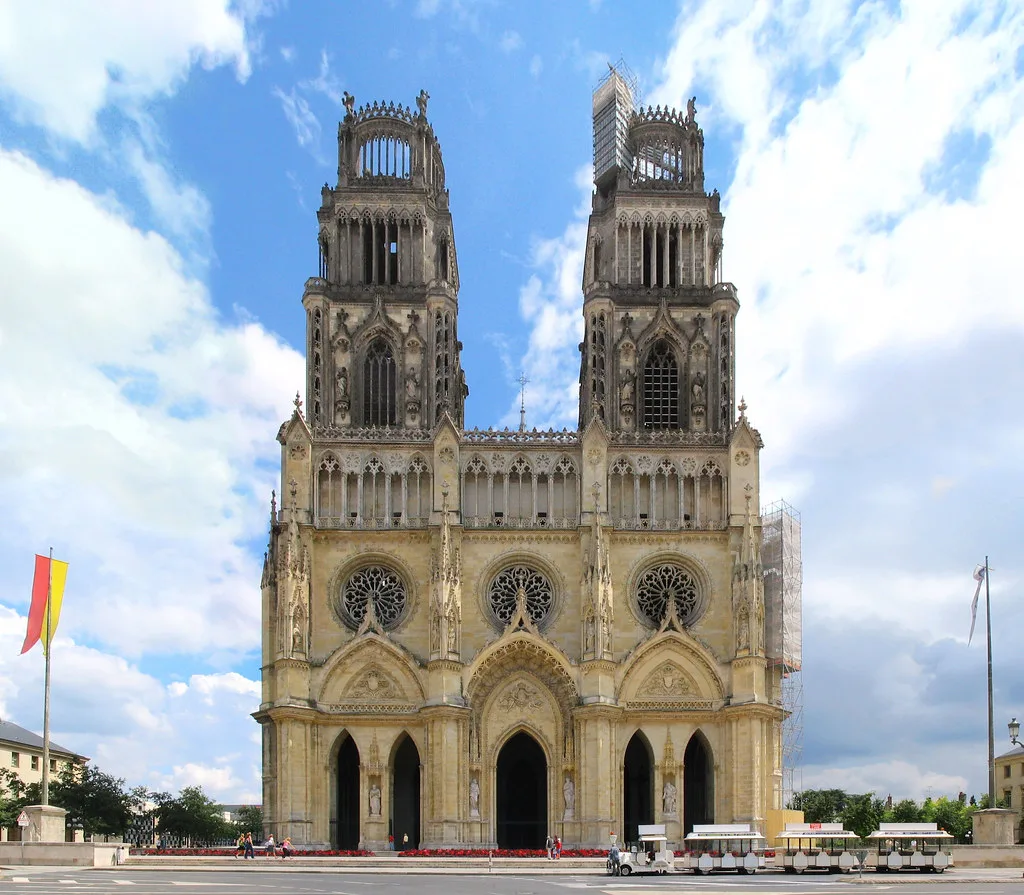
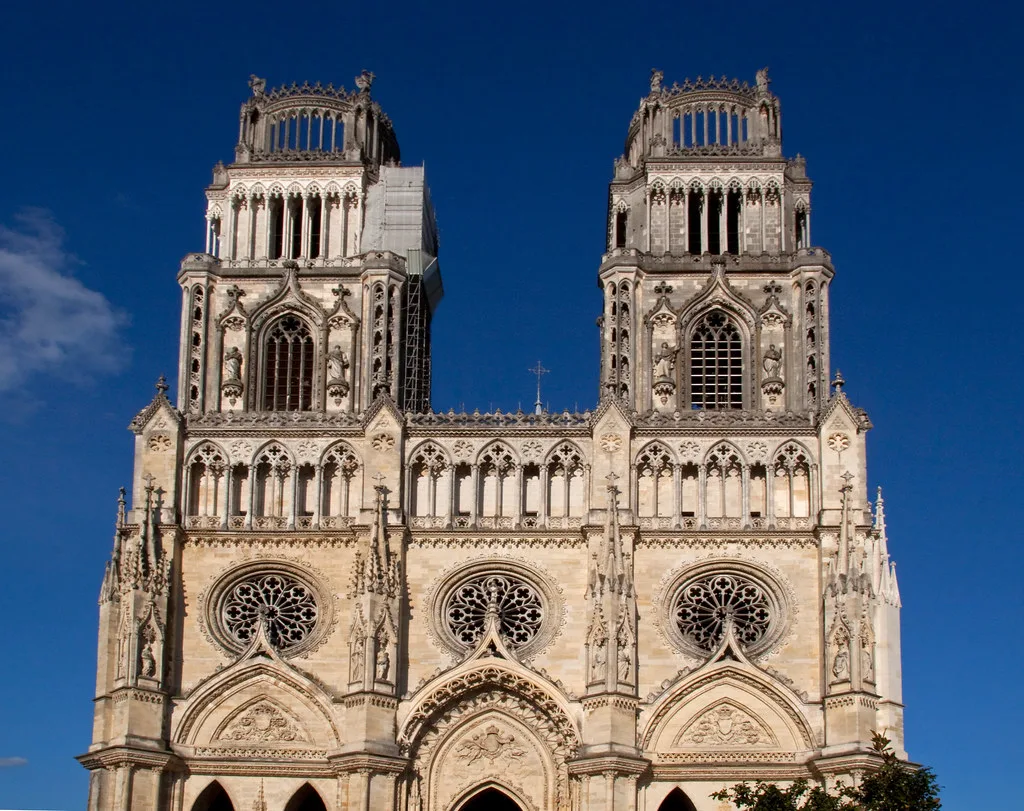
The façade is the image most visitors carry away: two massive towers, flying buttresses and dense stone tracery, and a scale that reads as more Paris or Reims than provincial. The cathedral is 143.85 metres long outside, which puts it among the longer cathedrals in France and explains why it dominates this part of the skyline. Stand back on Place Sainte-Croix to take the towers in properly, then look for the carved detail at eye level on the portals. If you are comparing cathedral façades across France, the smaller Antibes cathedral offers a very different, old-town scale.
Photographers should come in the morning for the front lit from the east, or in the late afternoon for the western face. The square is open and unshaded, so in summer the cathedral front is also a good place to pause in the shade of the building rather than in the middle of the paving.
What to see inside
The interior's highlight for most visitors is the stained glass, which includes windows depicting Joan of Arc and the siege of 1429, alongside the crests and flags that decorate the nave. Look for the Joan of Arc panels before you do anything else, because they tie the building to the event the city is famous for. The vaulted ceiling and the sense of height are the other reason to step in rather than just photograph the outside.
Walk the full length of the nave and the ambulatory rather than turning round at the entrance: the windows read best from a distance, and the side chapels hold the smaller details that most people miss. Silence is the norm, and the cathedral is an active place of worship, so keep voices low and put phones away near anyone praying.
The building's history in brief
Construction began in the 13th century, but much of what you see today is the result of later rebuilding after the church was largely destroyed, so the Gothic front you are admiring is not the uninterrupted medieval fabric it first appears to be. The cathedral has been classified as a historical monument since the 1862 list, which is why the interior has been so carefully maintained and restored. Knowing the rebuilding history makes the coherence of the current façade more impressive, not less.
Opening hours and entry
Entry is free, which makes the cathedral one of the best-value stops in Orléans. The stated pattern is a 9 am opening every day, closing at 6 pm between November and March and at 7 pm from April through October. Confirm the hours on the cathedral's own site or at the door before you build a day around a visit.
Services take priority over tourism: Sunday and holiday mass is at 10:30 am, with a Saturday evening service at 6:30 pm, so those slots are not the time for sightseeing in the nave. Plan around them if you want to look at the glass without a congregation present.
How long to allow
Thirty to forty-five minutes covers the nave, the windows and a slow lap of the side chapels, and a quick look needs twenty. Add another ten minutes on the square for photographs. If you are on a short break in Orléans, the cathedral is worth an hour of your morning and no more, because the old town around it is small and the rest of the city's sights are within a fifteen-minute walk.
Nearby: the square and the old town
Hôtel Groslot faces the square a couple of minutes away, a Renaissance mansion with a garden that gives a good view back at the cathedral towers. The Musée des Beaux-Arts d'Orléans is just behind, on the same Place Sainte-Croix, and holds the largest collection of pastels in France after the Louvre, which makes it an easy add-on in poor weather. Allow it its own two hours rather than squeezing it in before the cathedral closes.
Walk behind the cathedral to the Jardin de l'Évêché, a free garden with lawns looking back at the building's rear and the towers above. Rue de la Poterne and Rue du Boeuf Sainte-Croix, both small streets of timber-framed houses, are within a few minutes, with the latter giving a classic framed view of the cathedral's front. Back towards the river, Place du Martroi and the statue of Joan of Arc are a straight walk down Rue Jeanne d'Arc.
For the Joan of Arc story in more detail, the Maison de Jeanne d'Arc in Orléans is on Place du Général de Gaulle, with an eight-euro day ticket that covers the house, the Museum of Fine Arts, the MOBE museum and the Museum of History and Archaeology, so it is worth checking what is open before you buy. The cathedral is the better first stop, because it gives the siege a context you can see in glass before you reach the house.
Is it worth the stop?
Yes, but calibrate: Orléans was heavily damaged in the war, so its old town is small and the cathedral is the single sight that justifies a stop on its own. If you have come from Paris for the day, the cathedral plus the square, the Jardin de l'Évêché and a walk along the Loire is a satisfying half-day; if you have more time, add the Musée des Beaux-Arts and the Maison de Jeanne d'Arc. What you should not expect is a Reims-scale experience of endless side chapels and towers to climb: the visit is compact and free.
The honest trade-off is time of day. Come mid-morning and the glass in the nave and ambulatory reads clearly; come late on a winter afternoon and the light fades fast. Pair it with the rest of the things to do in Orléans rather than treating the building as a standalone excursion, and you will leave with more than a photo of a façade.
Plan Your Visit
Base your visit on the cathedral square: arrive mid-morning, walk up Rue Jeanne d'Arc from Place du Martroi, spend forty-five minutes inside, then loop through the Jardin de l'Évêché and back along the river. Everything on that route is on foot and, apart from the museums, free. Check the cathedral's own site for hours on the day you go, especially around services.
Explore more Orléans guides
Frequently Asked Questions
Is Orléans cathedral free to visit?
Yes. Entry to Cathédrale Sainte-Croix d'Orléans is free, and the stated opening pattern is a 9 am start every day, with closing at 6 pm from November to March and 7 pm from April through October. Confirm those hours before you travel, because services and seasonal changes affect access.
What is there to see inside Cathédrale Sainte-Croix d'Orléans?
The main draw is the stained glass, including windows depicting Joan of Arc and the 1429 siege of the city, along with the crests and flags in the nave. The vaulted ceiling and the scale of the interior are the other reason to step in. Allow thirty to forty-five minutes to see it properly.
Why is Orléans cathedral linked to Joan of Arc?
Joan of Arc led the relief of the siege of Orléans in 1429, and the cathedral's glass and decoration commemorate her and the event. The building is the most atmospheric place in the city to see that history before visiting the Maison de Jeanne d'Arc, which fills in the biography.
How long do you need at Orléans cathedral?
Twenty minutes is a quick look; thirty to forty-five minutes covers the nave, the windows and the side chapels at a reasonable pace. Add ten minutes on Place Sainte-Croix for photographs. It works best as one stop in a half-day walk through the old town rather than a destination on its own.
What else is near Orléans cathedral?
Hôtel Groslot, the Musée des Beaux-Arts d'Orléans and the Jardin de l'Évêché are all within a few minutes' walk, and Place du Martroi is a straight stroll down Rue Jeanne d'Arc. Rue de la Poterne and Rue du Boeuf Sainte-Croix offer the best timber-framed views of the cathedral for photographs.
When is the best time to visit Orléans cathedral?
Mid-morning suits the glass best, and winter afternoons lose the light quickly. Avoid Sunday and holiday mass at 10:30 am and the Saturday evening service at 6:30 pm if you want to look around without a congregation. Weekday mornings are the quietest practical slot for a short stop.
Sources
- 19 Best Things to Do in Orleans, France - France Voyager
- 22 Best Things to See and Do in Orléans | A Local's Guide to the City of Joan of Arc
- Orléans, France: Paris Without the Price Tag! - Big World Small Pockets
- Cathédrale Sainte-Croix d'Orléans
- This cathedral looks medieval, but most of what you see ...
- Cathédrale Sainte-Croix Orléans, Orleans