Versailles Parks and Gardens: How to Plan Your Visit
Plan a visit to the Versailles parks and gardens: what is free, when garden entry is charged, how far the estate stretches and how to cover it in a day.
On this page
Versailles is not a single garden but two overlapping landscapes: a walled park of around 800 hectares of avenues, woodland and open fields, and the formal gardens laid out directly below the Palace by André Le Nôtre. Pedestrians and cyclists enter the park free, while the gardens carry a charge on most days between spring and autumn. Knowing which is which decides how you spend your day and how much you pay. See our guide to things to do in Versailles.
The estate sits about 20 km south-west of Paris and is easily covered on foot if you plan the distances honestly. A loop of the whole park measures roughly 12.9 km with about 82 m of ascent, which works out at two and a half to three hours of steady walking before you add a single palace room or grove. Most visitors do better choosing one half of the estate than trying to see everything.
Park and Gardens: The Two Parts of the Versailles Estate
The park is the outer ring: roughly 800 hectares enclosed by a wall punctuated with gates, where straight avenues, wooded blocks and cultivated fields follow one another around the Grand Canal. Entry is free for pedestrians and cyclists, and the gates named for visitors include the Grille de la Reine, the Porte Saint-Antoine and the Grille des Matelots. Vehicles pay at the Queen's Gate and Saint-Antoine Gate.
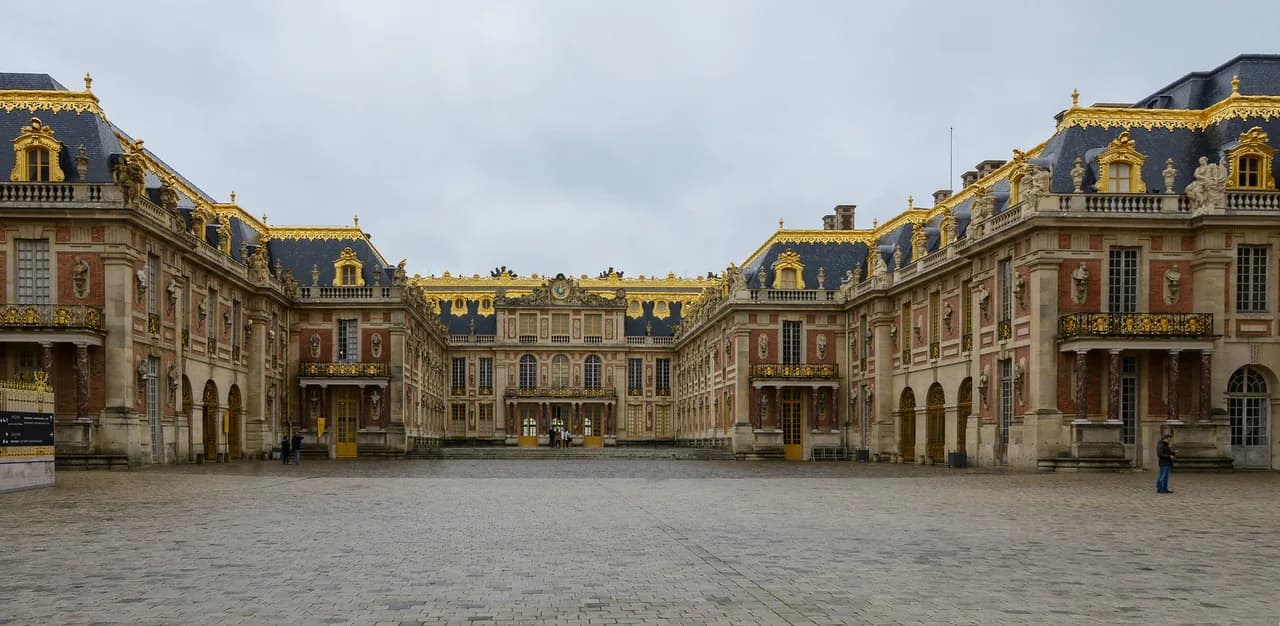
The gardens are the formal ensemble immediately west of the Palace, entered from the Cour des Princes at the top left of the Cour d'Honneur. This is where the Orangery, Latona's Fountain and the sculpted groves sit, and this is the part of the estate that carries an admission charge in season. If you only want a long walk under trees, the free park gives you that without a ticket.
The Palace itself is a separate booking from the outdoor estate, and its ticket prices are worth checking on the official site before you commit to a combined day. If you are still deciding whether the palace interior earns its place in a short break, our honest answer on whether Versailles is worth visiting sets out the trade-offs.
What Is Free and When Garden Entry Is Charged
The rule to remember is narrow and specific: from 1 April to 1 November, access to the gardens is charged from Tuesday to Sunday, on the days of the Fountain Shows and Musical Gardens. On those days you buy either a Passport ticket covering the whole estate or a Fountains Show or Musical Gardens ticket, at the garden entrances or preferably online. Outside that period, garden access is not charged on the same basis.
The park, by contrast, stays free for anyone on foot or on a bike all year, and the source lists free entry as its headline rate for pedestrians and cyclists. That makes the park the sensible choice on a tight budget or on a day when you would rather not queue. Buy garden tickets online rather than at the gate on a show day, because the ticket offices at the South Parterre, Neptune Gate and Little Venice Gate sell only those tickets.
Opening Hours Through the Year
The gardens open every day from 8am to 8.30pm in high season, running from 1 April to 1 November, and from 8am to 6pm in low season, from 2 November to 31 March. On Fountains Night Show evenings the gardens close earlier, at 5.30pm. Treat those as the standard frame and expect occasional exceptional early closures at 5.30pm with last entry at 5pm.
The park itself is listed as open daily from 07:00 to 20:30 between 1 April and 31 October, with the caveat that exceptional weather such as snow or strong winds can close it. Those hours are a seasonal figure, not a year-round promise, so plan a winter walk around the shorter garden day rather than the summer park timetable.
Arriving late in the low season is the commonest wasted afternoon here: a 6pm garden closing leaves little time once you have crossed the Cour d'Honneur and walked as far as the Grand Canal. Aim to be through the Princes' courtyard by early afternoon if you want the western end of the gardens. One check of the official page the morning you travel covers any exceptional closure.
The Gardens on Foot: Orangery, Latona, Apollo and the Mirror Pool
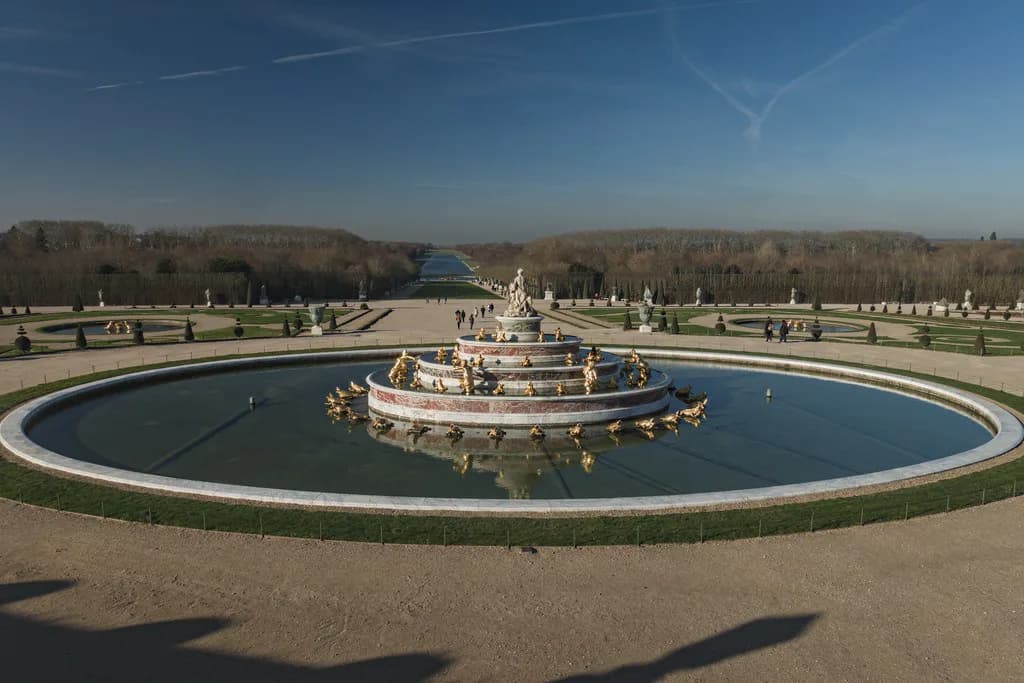
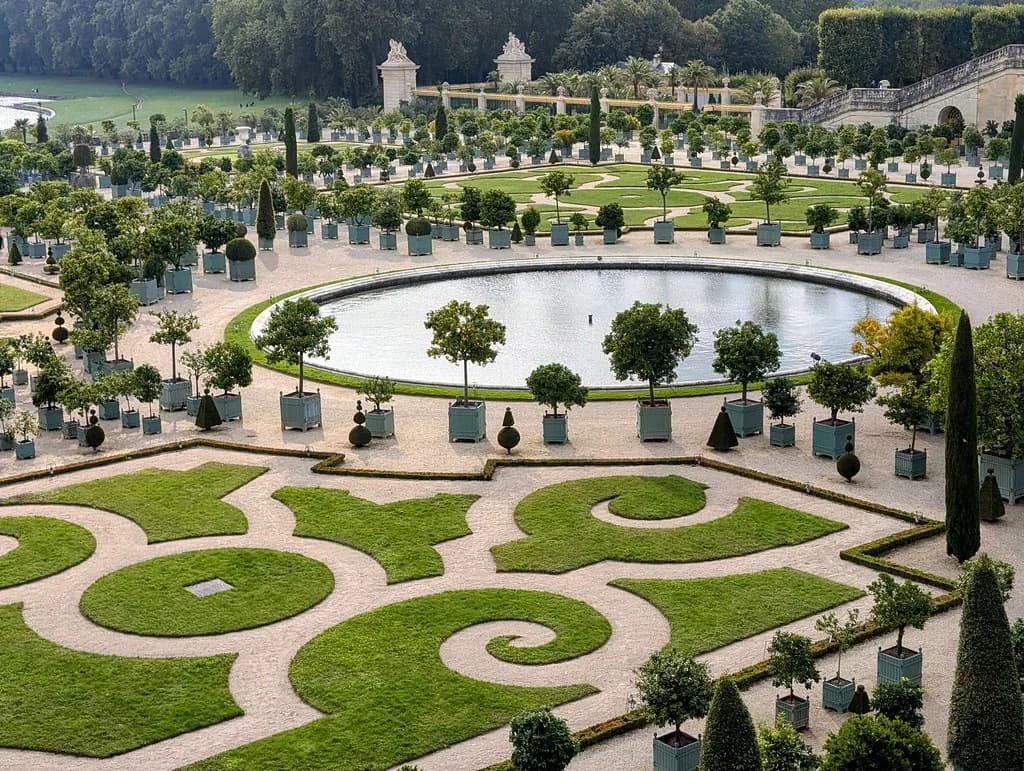
Start at the Cour des Princes and step out onto the terrace above the Orangery, built below the Palace by Jules Hardouin-Mansart and planted from May to October with 1,200 boxes of orange, lemon, pomegranate and oleander trees. It is the finest single view in the gardens and costs you no walking at all. Continue west and the Latona's Fountain, carved by the Marsy brothers in 1670 with its pool and parterre restored in 2015, marks the head of the great axis.
Follow the axis downhill past the tapis vert and you reach Apollo's Fountain, where a gilded lead Apollo drives his chariot across the pool, made by Jean-Baptiste Tuby in 1671 after a drawing by Charles Le Brun. Beyond it lies the Grand Canal, and to the side the Mirror Pool, commissioned around 1702 and set over three levels between two sculpted dragons. Allow 45 minutes for this one straight line at an easy pace.
The Neptune Fountain, built between 1679 and 1681 and given its sculpture in 1740, throws 99 jets and is the largest pool in the gardens. It sits beside the Water Theatre Grove, which is reached only from the Neptune side and where the water shows are suspended. The groves reward wandering, but keep an eye on the time: distances inside the garden are deceptive.
Groves Worth Seeking Out
The Colonnade Grove, begun in 1685 under Hardouin-Mansart, rings François Girardon's Abduction of Proserpina with 32 marble columns, and it is the most architectural of the wooded rooms. The Ballroom, made by Le Nôtre between 1680 and 1683, once had a marble island used for dancing, and the cascades over gritstone and shells still give it a theatrical feel.
For water effects, head to the Grove of the Three Fountains, laid out by Le Nôtre in 1677 and restored in 2005, where the jets form a fleur-de-lys, a watery vault and a column of 140 jets across three levels. The Enceladus Grove, cast in lead by Gaspard Marsy between 1675 and 1677, shows the giant buried under rocks with a single jet bursting from his mouth.
The Queen's Grove was made for Marie-Antoinette in 1776 on the site of the old maze and reopened to the public on 14 June 2021 after a two-year restoration. It is planted with North American species such as the Virginia tulip tree, and it feels quieter than the axial gardens because it was designed as a private walk. The King's Garden, enclosed in 1817 in an English style, lost much of its planting in the 1999 storm.
The Park Beyond the Gardens: Grand Canal and Picnics
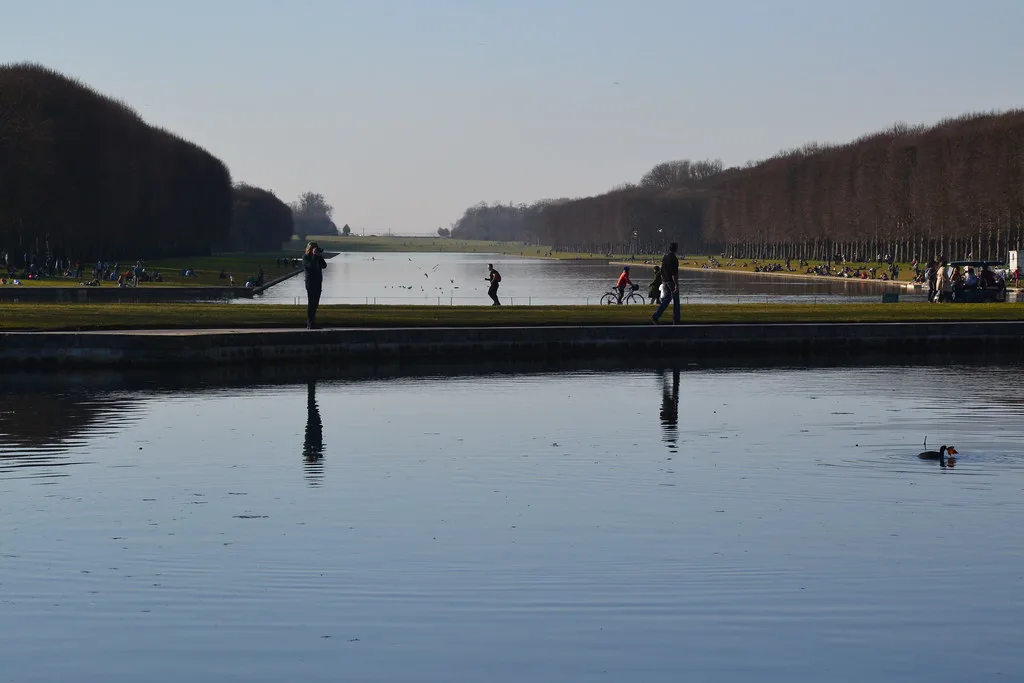
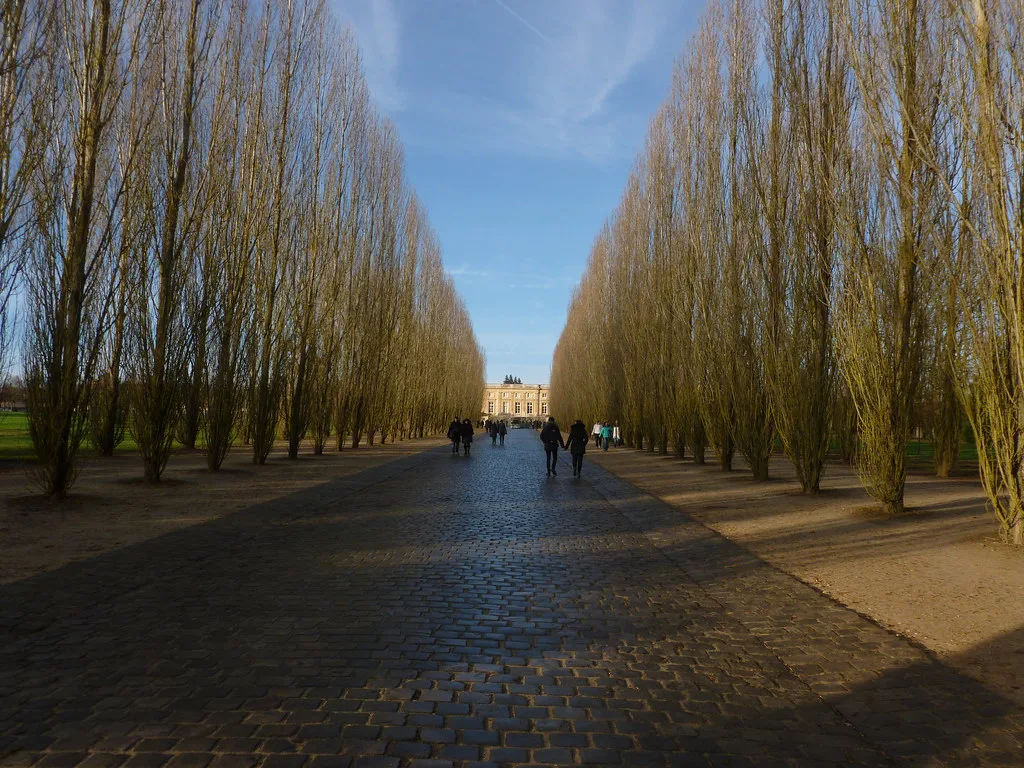
Past Apollo's Fountain the scale changes completely. The Grand Canal runs west toward the Trianon palaces, its banks shaded and flat, and the park around it is free to enter and well suited to a picnic. Cycling the canal banks is the most efficient way to see the outer estate without covering 13 km on foot.
There are free toilets with disabled access near the Little Venice entrance and a drinking fountain at the Grand Canal, plus a picnic area by the Halle des Marmousets beyond the Opera House. Bring food from the town if you want to keep costs down, because the estate restaurants are convenience stops rather than bargains. The park gates at the Dragon Gate run from 7am to 7.30pm from April to October, with last admission at 7pm.
Getting Around: Mini-Train and Electric Vehicles
The little train leaves the Palace, calls at the Grand Canal, then the Grand Trianon and the Petit Trianon before returning, and you can get off at each stop and board a later train. A return ticket is €9 full price and €7 reduced, with a single back to the Palace at €5, payable by card to the driver. It runs every day except Mondays, with departures starting at 11:10am and the last train between 5:10pm and 6:10pm depending on the month.
Electric vehicles with audioguides are the other option, hired from the South Terrace of the Palace or at the Grand Canal near Little Venice. They cost €42 per vehicle per hour plus €10.50 for each additional 15 minutes, with 40% off for disabled visitors and 30% off for subscribers. Hire closes entirely in January, and outside the April to October window the day ends earlier, so check the month's hours before relying on one.
The carts suit couples or families who want to reach the Trianons without spending their legs on the approach avenue, and the audioguide adds context the signboards do not. They make little sense if you have come mainly for the gardens, where the walking distances are short and the groves are best entered on foot.
Walking and Cycling the Park Loop
The full circuit of the park measures about 12.9 km with 82 m of elevation gain and takes roughly two and a half to three hours at a walking pace. That is one route's measurement rather than a rule for every path, but it is a fair planning figure for a loop that takes in the Grand Canal and the wooded blocks around it. The terrain is flat apart from gentle rises, so the distance is the challenge rather than the climbing.
Cyclists cover the same ground far faster and can reach the Grand Trianon and Petit Trianon without using the train. Walkers who want a shorter version should cut the loop at the Grand Canal rather than attempting the full circuit after a palace visit. Whichever you choose, start early enough that you are not walking back through the gates after dusk in winter.
Refreshment Stops Inside the Estate
La Girandole, in the middle of the garden, serves breakfast, lunch and snacks on two terraces from Tuesday to Sunday, 10am to 6pm in high season and 10am to 5pm in low season, and closes on Mondays. Le Dauphin opens every day from 8:30am to 7:30pm from April to October, with an earlier close on Fountains Night Show evenings, and from 8:30am to 5:30pm from November to March. Both are handy rather than destination meals.
At the Grand Canal, La Flottille is a brasserie in a c.1900 setting with set menus and à la carte dining, open daily 9am to 7pm in high season and 9am to 5pm in low season, closing early on night-show evenings. Its takeaway counter sells sandwiches, salads, ice creams and crêpes on the same hours. La Petite Venise, in the park, does Italian cooking daily from 11:45am to 6pm, or 5pm from November to March, with lunch until 3.30pm in high season.
None of these is a reason to skip the town, where the choice is wider and the prices generally kinder. If eating well matters to your weekend, our pick of the best restaurants in Versailles is the better place to book an evening table.
Security, Bags and What Gets Checked
Visitors carrying bags larger than 55x35x20 cm are not admitted to the estate, and every bag and vehicle is checked at the gates. Leave suitcases and large backpacks at your accommodation or a left-luggage point in town rather than testing the limit at the Dragon Gate. The check is quick if you travel light.
The same rule applies at the Little Venice and Menagerie gates, which separate the gardens from the park, so downsizing your bag before you arrive saves a walk back. Cycle helmets and cameras go through the checks without fuss, and the drivers of the mini-train accept card payments directly. Expect airport-style queues at peak arrival times in summer and build ten minutes into your plan.
Half-Day and Full-Day Plans
For a half-day, enter through the Cour des Princes, walk the Orangery, Latona's Fountain, Apollo's Fountain and the Mirror Pool, take in two or three groves such as the Colonnade and the Ballroom, and finish at the Grand Canal for the view back up the axis. That is roughly two to two and a half hours at an unhurried pace and needs no transport. Add lunch at La Girandole on any day but Monday.
A full day means pairing the gardens with the park: take the mini-train to the Grand Trianon and Petit Trianon, walk back along the canal, and picnic on the bank if the weather holds. Alternatively hire an electric vehicle for an hour to see the outer estate with commentary, then spend the afternoon in the groves. Trying to add every grove and both Trianons to a single afternoon is the plan that fails.
If you have a whole weekend rather than a day, our suggested Versailles itinerary fits the estate around the town, and the best time to visit covers how the seasons change the gardens and the crowds. Read both before you fix dates.
If you have enjoyed the green spaces here and want the same exercise in another French city, our guide to the parks in Lyon follows the same logic of free versus ticketed ground.
Fitting the Town Around the Park
Versailles is a real town, not just a gate to the Palace, and the walk between the two is part of the day. The Quartier Notre-Dame, with its market and grid of streets, sits a short walk from the château and makes a natural counterweight to a morning in the gardens. Our guide to the old town picks out where to wander when you have had enough of gravel.
Combining a market morning with an afternoon in the park works well because the two sit at different ends of the day: markets wind down before lunch, while the gardens are at their best in the softer light. If you want the town's museums as well, our museums in Versailles guide explains what is open and when.
The most common planning error is turning up on a fountain-show day without a garden ticket and finding the free gate closed to you. The second is underestimating the scale: the park loop alone is nearly 13 km, and the walk from the Palace to the Grand Trianon is longer than most visitors expect. Build in one rest stop and a clear plan for getting back.
Plan Your Versailles Visit
Decide first whether you are visiting the gardens or the park, because the ticketing and the timings follow from that single choice. The park is free on foot and on a bike, the gardens are charged from Tuesday to Sunday between 1 April and 1 November, and the mini-train shortens the distances for a few euros. Build the day around those facts rather than around a wish list of every grove.
Then set your hours against the season: a high-season garden day runs to 8.30pm, while a low-season afternoon ends at 6pm and the light goes earlier still. Book garden tickets online on show days, carry a small bag, and leave space for the town on the way back. That is enough planning for a weekend.
Explore more Versailles guides
Frequently Asked Questions
Do you have to pay to get into the gardens at Versailles?
Yes, on most days between spring and autumn. From 1 April to 1 November, access to the gardens is charged from Tuesday to Sunday, on the days of the Fountain Shows and Musical Gardens, and you buy either a Passport ticket for the whole estate or a Fountains Show or Musical Gardens ticket. The wider park stays free for pedestrians and cyclists, which is why the two parts of the estate are worth separating in your planning.
Is the park at Versailles free?
Yes for anyone on foot or on a bicycle. The park covers around 800 hectares and entry is free for pedestrians and cyclists, which makes it the budget option when you mainly want the Grand Canal, the avenues and the wooded blocks. Vehicles pay at the Queen's Gate and Saint-Antoine Gate, so arriving by car changes the calculation.
When are the gardens at Versailles free to enter?
Outside the charged season that runs from 1 April to 1 November, access to the gardens is not charged on the same basis, so a winter visit costs nothing to enter the outdoor gardens. In the charged season the free window is Monday, when the garden ticket offices do not sell Fountains Show or Musical Gardens tickets. Check the official gardens page before you travel, since exceptional closures do happen.
How long does it take to walk around the park at Versailles?
A full loop of the park comes to roughly 12.9 km with about 82 m of ascent and takes two and a half to three hours at a steady walking pace. That is one measured route rather than a guarantee for every path, and it excludes any time spent in the gardens, the Palace or the Trianons. If you want a shorter day, cut the circuit at the Grand Canal.
How do you get from the Palace to the Grand Canal and the Trianons?
Walk west through the gardens past Latona's Fountain and Apollo's Fountain to reach the Grand Canal, or take the little train, which leaves the Palace and calls at the Grand Canal, the Grand Trianon and the Petit Trianon before returning. The train runs every day except Mondays and you can get off at each stop and board a later one. Electric vehicles with audioguides are hired from the South Terrace of the Palace or at the Grand Canal near Little Venice.
Are there places to eat inside the park at Versailles?
Yes, and their closing days matter. La Girandole in the middle of the garden opens Tuesday to Sunday and closes on Mondays; Le Dauphin, La Flottille and its takeaway counter, and La Petite Venise all operate daily with shorter hours from November to March. La Flottille closes early on evenings when the Fountains Night Show takes place. For a better-value evening meal, head back into the town.
Sources
Notes for French city breaks
Optional updates to our guides.
You might also like
Continue reading
More guides you'll find useful