
Chapelle Impériale, Ajaccio: What to See and How to Visit

The Chapelle Impériale is a compact 19th-century chapel on rue Fesch in central Ajaccio, forming the right wing of the Palais Fesch and holding the crypt of the Bonaparte family. It is a short stop rather than a half-day: half an hour covers the nave, the dome and the octagonal crypt below.
The building is classified as a monument historique, so what you see is a protected ensemble rather than a reconstructed display. Its interest lies in the setting — marble-clad walls, a coffered cupola and a crypt cut into the masonry — more than in any museum-style exhibition.
Where the Chapel Sits in Ajaccio
The address is 50 rue Fesch in Ajaccio, Corse-du-Sud, in the old town a few minutes' walk from the market quarter and the old port. Rue Fesch is the long pedestrian spine of the historic centre, so the chapel is easy to slot into a morning of wandering rather than a separate excursion.
Muvistrada city buses lines 1, 2, 3, 4 and 7 serve the area, with the nearest stop at St Roch. If you are coming from the port, the walk up through the old streets is short and puts you at the chapel's door without a bus at all.
The Building Outside
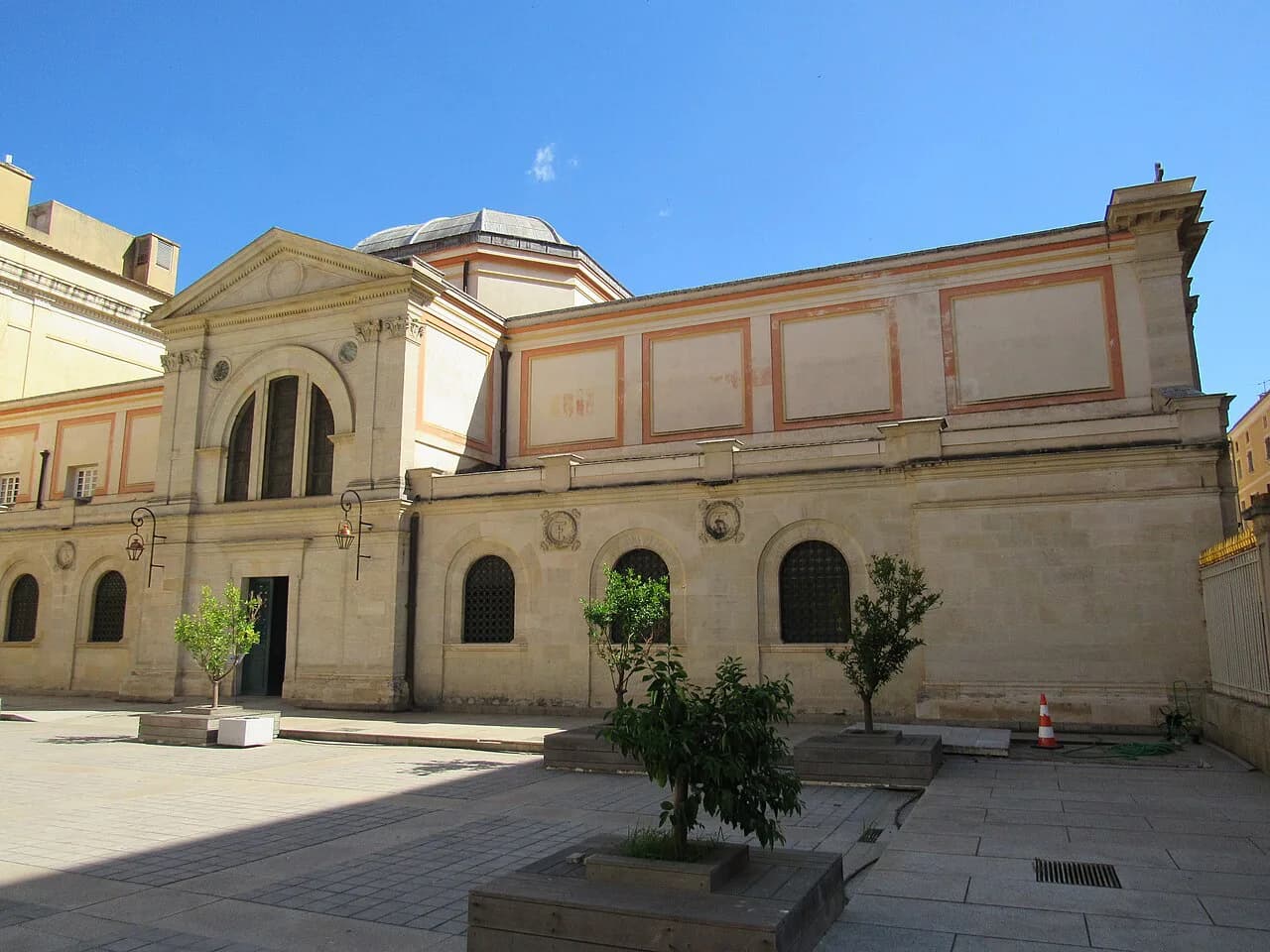
The chapel is built in San Fiorentino stone, a pale local granite that gives the exterior its sober, slightly austere look. The main façade opens through a large arcade into an entrance porch, and the doorway itself is a bronze door — a deliberate imperial gesture for a building funded by Bonaparte money.
Read the exterior as one half of a pair: the chapel forms the right wing of the Palais Fesch, and the two buildings share a wall line and a history. Looking at the join between them is the quickest way to understand why the chapel feels tucked into the street rather than standing free.
Inside: Nave, Dome and Grisailles
The plan is a Latin cross, with a nave flanked by side aisles and crossed by a transept whose four great arches carry a dome lit from its apex. Side aisles are closed off with wrought-iron grilles, which keep the sightlines clean while letting you look straight down the church.
Walls are finished in stucco imitating marble, and the choir, pendentives and coffered cupola are decorated with grisailles — painted in tones of grey that read as sculpture from a distance. Six stained-glass windows light the side aisles, throwing colour onto the black-and-white marble floor.
The Octagonal Crypt
Beneath the transept, the crypt is octagonal and clad in white marble, with sarcophages hollowed out of the thickness of the walls and sealed with black marble slabs. The effect is restrained rather than gloomy, and the whole space is small enough to take in at a glance.
Light reaches the crypt through an openwork bronze rosace set into the chapel floor at the centre of the transept, so stand on that spot upstairs before you go down. It is the single detail most visitors miss, and it explains the pale light below.

Who Is Buried Here
The crypt holds members of the Bonaparte family, including the father and mother of Napoleon and Cardinal Fesch himself. It is that family connection, rather than any royal scale, that gives the chapel its weight.
Cardinal Fesch died in exile in Rome in 1839 and left money in his will for a mortuary chapel for himself and his relatives. His universal legatee Joseph Bonaparte did not carry out that clause, which is why the chapel you see is a later imperial project rather than Fesch's own design.
How the Chapel Came to Be Built
Napoleon III ordered the transfer of the remains of the cardinal and of Madame Mère in 1851, and two court architects were appointed. Paccard drew the plans and Caseneuve directed the works, which ran from 1857 to 1859.
The chapel was blessed on 9 September 1860, which is why the build dates and the dedication date do not match. Keep the two apart: 1857 to 1859 is construction, 1860 is the blessing.
It was classified as a monument historique on 22 July 1924 and is owned by the State, with the culture ministry as the assigned user. That status explains the careful condition of the stucco and marble inside.
Opening Pattern and Entry
The chapel opens from May to October, subject to change, and the tourist office listing gives daily opening from 09:15 to 18:00. Treat those hours as the seasonal pattern rather than a year-round guarantee, and check the Ajaccio tourisme page before you travel outside that window.
Visits are self-guided, and the listing describes the chapel as visible without a guided visit, so individual travellers do not need to book. The listing has a rates section alongside opening times, so expect any charge to be set on site; check at the desk rather than relying on the website.
How Long to Allow
Thirty minutes is realistic: a few minutes on the façade, ten inside the nave and dome, and the rest in the crypt. The chapel is small, and there is no exhibition circuit to slow you down.
The honest trade-off is scale. This is a single decorated room with a crypt, not a museum, so it rewards visitors already interested in the Bonaparte story and disappoints anyone expecting a half-day out. Build it into a walk through the old town rather than making it the reason for the trip.
What to See Nearby
The Palais Fesch is the obvious partner visit, since the chapel is its right wing and the Musée Fesch inside holds a fine collection of paintings. Do the chapel first while it is quiet, then give the museum the rest of the morning.
Two other Bonaparte-linked sights sit within walking distance of rue Fesch: the Maison Bonaparte, the family's ancestral house, and the cathedral where Napoleon was baptised. Both are short visits that fit the same morning.
If you want sea air afterwards, the Citadelle d'Ajaccio and the Îles Sanguinaires lie along the coast beyond the old town. The streets around rue Fesch themselves are worth an unhurried hour, with the market quarter close by.
Plan Your Visit
Treat the Chapelle Impériale as a thirty-minute stop that anchors a Bonaparte morning: chapel, Palais Fesch and its museum, then the Maison Bonaparte. The seasonal opening pattern makes it a spring-to-autumn visit, and the crypt is the part worth arranging your morning around.
Check the Ajaccio tourisme listing for the daily hours on the day you go, then plan the rest of the old town around it.
Explore more Ajaccio guides
Frequently Asked Questions
Where is the Chapelle Impériale in Ajaccio?
It is at 50 rue Fesch in central Ajaccio, Corse-du-Sud, forming the right wing of the Palais Fesch. The nearest Muvistrada bus stop is St Roch, served by lines 1, 2, 3, 4 and 7, and the old port is a short walk away.
Who is buried in the Chapelle Impériale crypt?
The octagonal crypt holds members of the Bonaparte family, including Napoleon's father and mother, along with Cardinal Fesch. The sarcophages are cut into the thickness of the crypt walls and closed with black marble slabs.
When is the Chapelle Impériale open?
The chapel is open from May to October. The Ajaccio tourisme listing shows daily hours of 09:15 to 18:00; check that listing outside the May-to-October window.
Is the Chapelle Impériale free to visit?
The Ajaccio tourisme listing describes the chapel as visible without a guided visit, so individual travellers can turn up without booking. It also lists payment methods for the site, so ask at the entrance what applies on the day.
How long does a visit to the Chapelle Impériale take?
Allow about thirty minutes for the façade, the nave and dome, and the crypt. It is a small monument, so it works best combined with the Palais Fesch next door rather than as a half-day outing.
What is the relationship between the Chapelle Impériale and the Palais Fesch?
The chapel forms the right wing of the Palais Fesch, and the two share a wall line on rue Fesch. The Palais houses the Musée Fesch, which makes an obvious follow-on visit after the chapel and crypt.