
Palais Fesch, Ajaccio: Visiting the Musée Fesch
The Palais Fesch is worth an hour or two in Ajaccio because it holds the largest collection of Italian painting in France outside the Louvre, alongside a Napoleonic section devoted to the Bonaparte family. The museum occupies a gated palace on rue Fesch, a short walk from the old town and the railway station. Plan the visit around a single quirk: the route runs from the top floor downwards.
Allow at least 90 minutes for the painting galleries and the ground-floor Napoleonic rooms, and add time if the Imperial Chapel is open during your stay. The chapel keeps a separate summer season from the museum itself, so it is not automatically part of a winter visit.
What the Palais Fesch is and why it is worth an hour or two
Cardinal Joseph Fesch, Napoleon's maternal uncle, left his native Ajaccio a bequest of a thousand paintings from a collection that ran to more than 17,000 works. The palace built to house them was designed in 1806 but construction only began in 1827, and Fesch died in Rome in 1839 without seeing it finished. What survives today is a panorama of Italian art from the 14th to the 18th century, plus Flemish, Dutch, German, French and Spanish works and a substantial Napoleonic section.
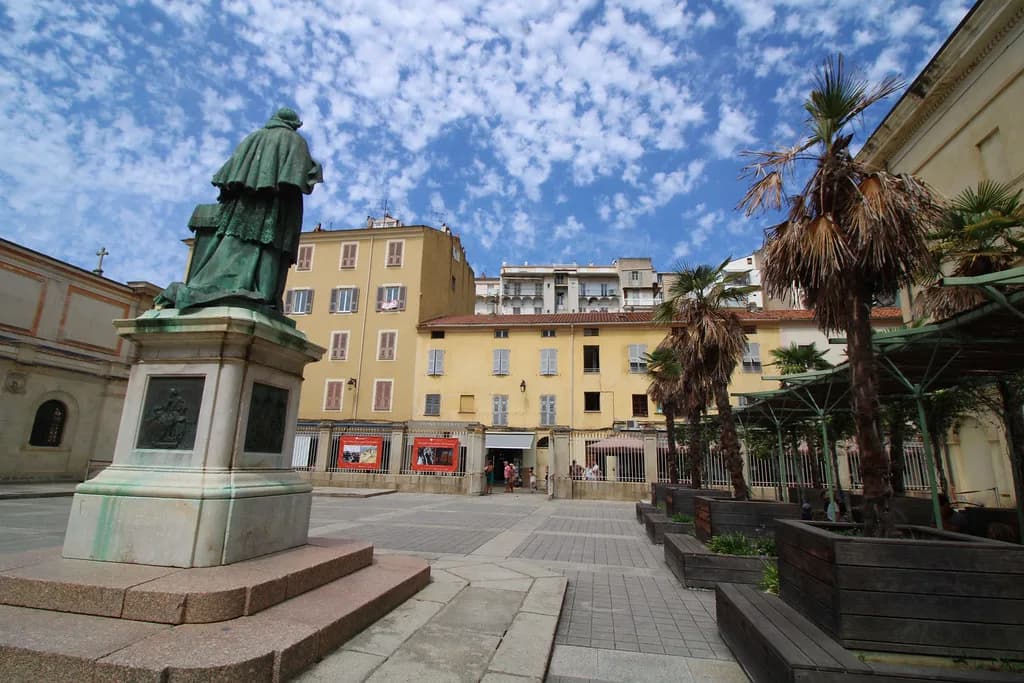
The building is arranged around a square courtyard, and a statue of the cardinal by the Second Empire sculptor Vital Dubray faces you as you enter. The courtyard layout makes the museum easy to read: wings enclose the centre, and the visit moves through stacked floors rather than a long single circuit.
Where it sits in Ajaccio and how to walk there from the station
The address is 50-52 rue Fesch, 20000 Ajaccio. From the railway station it is a 10-minute walk: follow Boulevard Sampiero towards the town centre, then take rue Jérôme Péri. From Ajaccio Napoléon Bonaparte airport the journey takes about 15 minutes, and Rive Sud Porticcio is roughly 20 minutes away.
Bus line 8 serves the museum, and a maritime shuttle is another option across the bay. If you are building a wider weekend, our guide to Ajaccio Attractions sets this museum alongside the city's other principal sights.
Opening hours and ticket prices
Opening hours change with the season. From 1 November to 30 April the museum opens daily from 9.00 to 17.00; from 1 May to 31 October it opens daily from 9.15 to 18.00. It closes annually from 1 to 16 January inclusive, and shuts on Christmas Day and New Year's Day.
A full-price ticket costs 9€ and a reduced ticket 6€, with the same 6€ rate for groups. A loyalty card is available at 30€ as a one-off payment. Buy at the ticket desk on arrival unless you are bringing a group, in which case bookings go through accueil.musee@ville-ajaccio.fr.
The visit in order: start on the third floor and work down
The permanent route is arranged chronologically, and it starts at the top: begin on the third floor and work down to sea level. That sequence takes you from the Italian Primitives through to the Corsican painters of the twentieth century, with works by Botticelli, Titian, Veronese and Baron Gérard punctuating the way.
Working downwards means the paintings grow later as you descend, and the building's own logic does the storytelling for you. If you only have an hour, ride or walk straight to the top and take the first two floors at a steady pace rather than starting at ground level and running out of time upstairs. The lift and stairs both serve all levels.
The Italian painting galleries: Primitives to the 18th century
The second floor holds the Florentine and Renaissance rooms, the gallery of Primitives, the still-life gallery, Venetian and late-16th-century paintings, the Bolognese rooms and two Caravaggio rooms, plus the Hall of the Apostles and the Great Gallery. This is the densest part of the collection and the reason many visitors come.
The first floor adds Italian paintings hung in the Cardinal Fesch Gallery, the Sunset and Sunrise cabinets, 17th-century Roman paintings and 18th-century Italian rooms. The short version: the Big Names cluster high up, and the upper floors reward slow looking more than the lower ones.
The Napoleonic rooms on the ground floor
The ground floor of the Napoleonic courtyard holds a sculpture gallery, busts of the imperial family, and the Fesch, Survilliers and Napoleon III rooms. The collection includes portraits of the imperial family, Napoleonic memorabilia and the costume of a colonel of the chasseurs of the Imperial Guard, on loan from the President of the Republic.
These rooms were created partly to absorb material from the restricted Salon napoléonien in Ajaccio town hall, and they suit anyone more interested in the Bonapartes than in Old Masters. Read them on the way down rather than first, so the paintings above get your freshest attention.
Corsican painting at sea level
The bottom of the route is the sea-level floor, given over to Corsican painting: the Ollandini room, an academic painting room and the Corsican Painting Department gallery. Finishing here closes the chronological arc that begins with the Primitives upstairs.
If you are weighing this museum against the rest of the city, note that its Corsican holdings are modest in scale compared with the Italian galleries. The Italian collection is the argument for paying the entrance fee.
The Imperial Chapel and its summer-only opening
The Imperial Chapel is the south wing of the same complex, along rue Fesch, and it is not covered by the museum's year-round timetable: it opens only in the summer season, from 1 May to 31 October, daily from 9.15 to 18.00. Off-season access is possible for groups by prior arrangement.
Built between 1857 and 1860 in Saint-Florent stone, it is a neo-Renaissance funeral chapel on a Latin cross plan, with grisaille decoration inside and stained glass combining Cardinal Fesch's initials with imperial symbols. The interior work is by Jérôme Maglioli, and the vault marbles were engraved by Champollion-Figeac. Treat it as a separate ten-minute stop; our page on the Chapelle Impériale, Ajaccio covers it in full.
Security rules and what you cannot bring in
Under the Vigipirate plan, suitcases, backpacks and large items of luggage are not allowed inside the museum. Only handbags, satchels and small backpacks are accepted, and staff may ask you to open bags and jackets at the checkpoint.
This matters most for travellers arriving straight from the station or the ferry with a weekend bag. Drop luggage at your accommodation first, or you risk being turned away at the door after walking over.
Accessibility and family practicalities
Admission is free for disabled visitors and one accompanying person on presentation of proof, such as a disability card or equivalent documentation. All areas and services are accessible to people with reduced mobility, with adapted toilets and lifts, and the museum lends wheelchairs and children's strollers free of charge from the checkroom against identity proof.
For families, the stroller loan removes the need to carry one around the galleries, and the building's lifts mean the top-down route does not depend on stairs. Ask at the checkroom on arrival rather than at the ticket desk.
How much time to allow and when to go
Budget around two hours: roughly 75 minutes for the Italian galleries on the upper floors, half an hour for the Napoleonic rooms and 15 minutes at sea level. If the chapel is open, add ten minutes for the visit and a few more to walk round from the museum entrance.
Summer gives you the longest opening day and the chapel, but also the busiest streets of the old town around rue Fesch. Winter gives you a shorter day and no chapel, which suits a focused painting visit rather than a combined one. Verify the day's timings on the museum's own practical-information page before you set out, especially around the January closure.
Nearby: Maison Bonaparte and the old town
The old town around the museum is compact, and the Citadelle d'Ajaccio is in the same quarter, making a natural extension to an afternoon. The lanes between rue Fesch and the waterfront are the pleasant way back towards the port.
Maison Bonaparte, Ajaccio is the other essential Napoleonic address in the city, and it pairs logically with the museum's ground-floor rooms for anyone following the family story.
For a quieter religious stop, the Cathédrale Notre-Dame-de-l'Assomption is a short walk away in the old town. Beyond the city, the Îles Sanguinaires, Ajaccio are the classic half-day run when the weather holds, but they sit outside a museum day.
Plan Your Visit
Set aside two hours, start on the third floor and work down, and check the chapel season before you count on seeing it. Arrive without a suitcase, because the bag rules are enforced at the door.
The museum works best as a morning stop followed by the old town and the Bonaparte sites on foot, since everything sits within a short walk of rue Fesch. Confirm the day's hours and ticket price on the museum's own page before you travel.
Explore more Ajaccio guides
Frequently Asked Questions
Is the Musée Fesch worth visiting in Ajaccio?
Yes, if Italian painting interests you. It holds the largest collection of Italian painting in France outside the Louvre, spanning the 14th to the 18th century, and adds a Napoleonic section covering the Bonaparte family. Visitors with no interest in either can spend their time elsewhere in the old town.
How long does it take to visit the Palais Fesch?
Allow around two hours. The chronological route starts on the third floor and descends to sea level, so the Italian galleries take the most time, the ground-floor Napoleonic rooms about half an hour, and the Corsican painting floor at the bottom around 15 minutes.
How much does the Musée Fesch cost?
The museum publishes a full-price ticket, a reduced rate and a group rate, plus a one-off loyalty card; the current figures are listed on its practical-information page. Buy at the ticket desk on arrival, or book in advance by email if you are bringing a group.
When is the Musée Fesch open?
Hours differ by season: the museum opens daily from 9.00 to 17.00 from 1 November to 30 April, and daily from 9.15 to 18.00 from 1 May to 31 October. It closes annually from 1 to 16 January and on Christmas Day and New Year's Day.
Is the Imperial Chapel at the Palais Fesch open all year?
No. The Imperial Chapel opens only in the summer season, from 1 May to 31 October, daily from 9.15 to 18.00, even though the museum itself runs year-round. Groups can arrange off-season access by prior reservation.
How do you get to the Palais Fesch from Ajaccio station?
Walk for about 10 minutes: follow Boulevard Sampiero towards the centre, then take rue Jérôme Péri to rue Fesch. Bus line 8 also serves the museum, and a maritime shuttle crosses the bay.
Can I bring a suitcase into the Musée Fesch?
No. Under the Vigipirate plan, suitcases, backpacks and large luggage are refused, and only handbags, satchels and small backpacks are accepted. Staff may ask you to open bags and jackets at the checkpoint, so leave luggage at your accommodation first.
What should I see first inside the Palais Fesch?
Head to the third floor. The route is arranged chronologically from the top down, beginning with the Italian Primitives and ending with Corsican painting at sea level, so starting upstairs keeps the art in sequence and saves the Napoleonic rooms for the descent.