
Notre-Dame de la Garde: Marseille's Hilltop Basilica
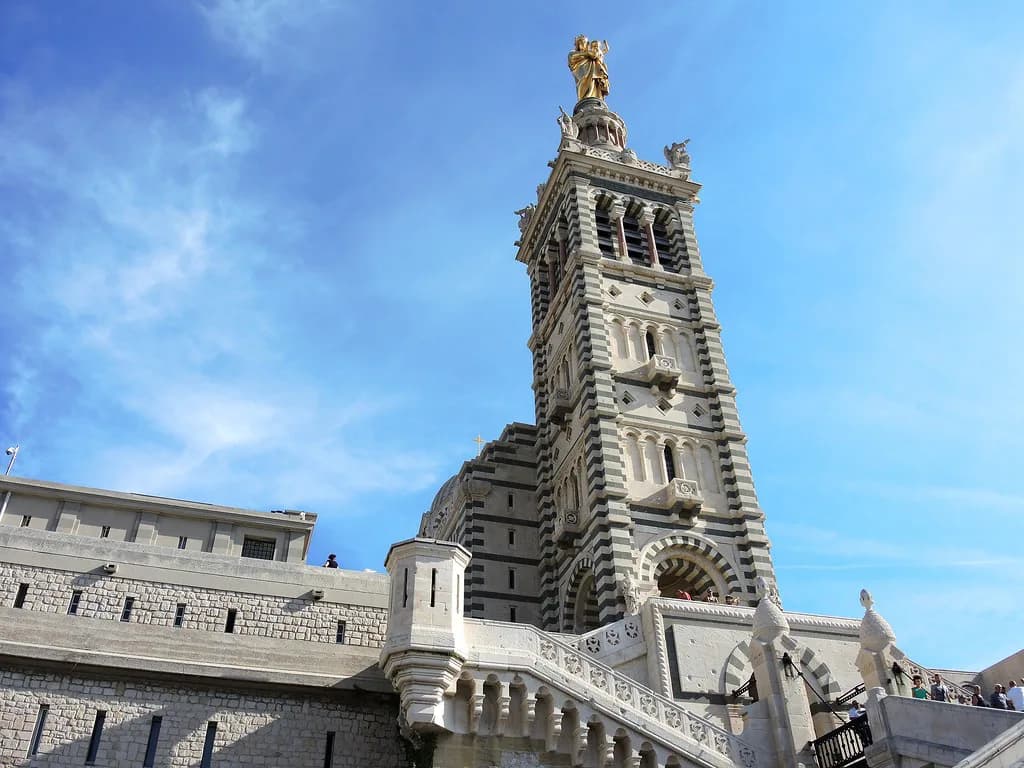
Notre-Dame de la Garde is Marseille's most visited monument, a Romano-Byzantine basilica raised between 1853 and 1864 on the city's highest natural point and topped by an 11.2-metre gilded Virgin and Child. Locals call her La Bonne Mère, the Good Mother, and sailors and their families have left thank-offerings on this hill since a chapel was first built here in 1214.
Entry to the basilica and its terraces is free, so the visit costs you only the climb or a bus fare. Allow at least an hour on the summit for the mosaics, the ex-voto collection and the panorama, and longer if you plan to walk up from the Old Port.
What Notre-Dame de la Garde is and why it matters
The basilica stands 154 metres above sea level, perched on the limestone peak that is Marseille's highest natural point, and draws close to two million visitors and pilgrims a year. A chapel has crowned the summit since 1214, and King François I fortified it in 1524; those ramparts still wrap the base of the church you see today.
Architect Henri-Jacques Espérandieu built the present church in an exuberant Romano-Byzantine style, banding the facade in white Calissanne limestone and green stone from Italy. The gilded statue of the Virgin and Child by Eugène-Louis Lequesne was raised on the bell tower in 1870 and is visible from almost every street in the city and far out to sea.
The hill is also Marseille's emblem, a place of maritime devotion before it was ever a sightseeing stop. The basilica sits on the city's highest point, and the view from the parvis over the city and the sea is what makes it the first thing many visitors climb to.
Where it sits above the Vieux-Port
The basilica sits directly above the Vieux-Port, on the hill of La Garde that rises behind the harbour's south side. From the terrace the whole harbour layout is legible: the quays, the boats and the city's rooftops falling away towards the water.
The hilltop is exposed in a way the streets below are not. The summit terrace is genuinely windy, so secure hats, scarves and camera straps, and bring a layer even on a warm day; in spring the mistral can scrub the air clear enough to pick out the Calanques on the horizon.
If you want to understand how the hill fits the rest of the city before you go, the wider set of Marseille Attractions: 6 Visitor Guides covers the harbour, the museums and the quarters in walking distance of the port.
How to get up: on foot, by bus 60 or by tourist train
There are three ways to the top, and the choice is really about effort against cost. On foot, the climb from the Old Port through the Roucas Blanc streets takes 15 to 20 minutes and is steep but free, with the harbour dropping away behind you the whole way.
The number 60 city bus runs from the Vieux-Port at cours Jean Ballard straight to the basilica gates, taking a standard RTM ticket rather than a special fare. The little tourist train from the Quai des Belges is the third option, grinding up from the harbour for a narrated ride and a higher price than the bus.
The bus and train both save your legs for the mosaics and the terrace, but they also put you in a group rather than letting you arrive on your own schedule. Walking up is the better choice in cool, clear weather; take the bus on a hot afternoon or when time is short. The Quai des Belges is where much of the harbour life concentrates, and it is worth a look before or after the climb.
Tickets, access and the interior lift
Admission to the basilica and its terraces is free, in keeping with its role as a working place of worship and pilgrimage; a small donation is invited if you light a candle inside. That makes it one of the cheapest major sights in the city, and one of the few where the cost of the day is transport rather than entry.
For visitors with limited mobility, an interior lift connects the fort level to the church, so the sanctuary itself is reachable without the final flight of steps. The climb through the fort is the part that is difficult, not the church door.
Guided options exist if you want the hill's eight centuries of story decoded: a shared walking tour that takes in the summit, or a private guide for a couple of hours. Prices for both are published by operators rather than fixed by the basilica, so compare before booking.
Opening hours and Mass at the basilica
The basilica opens daily, broadly from early morning until late afternoon in winter and later in high summer, with Mass celebrated each morning and a larger service on Sunday. The exact pattern shifts through the year, so confirm current hours and Mass times on the official basilica site before you climb.
Because this is an active place of worship rather than a monument on a timetable, services can restrict access to parts of the church while they are under way. Plan the visit around the liturgy rather than the other way round, and keep silence if a Mass is in progress.
Inside: the crypt below and the upper church
The building splits into two very different spaces, and the contrast between them is the point. The crypt, cut straight into the rock, is deliberately bare, low and dark, given over to quiet prayer rather than ornament.
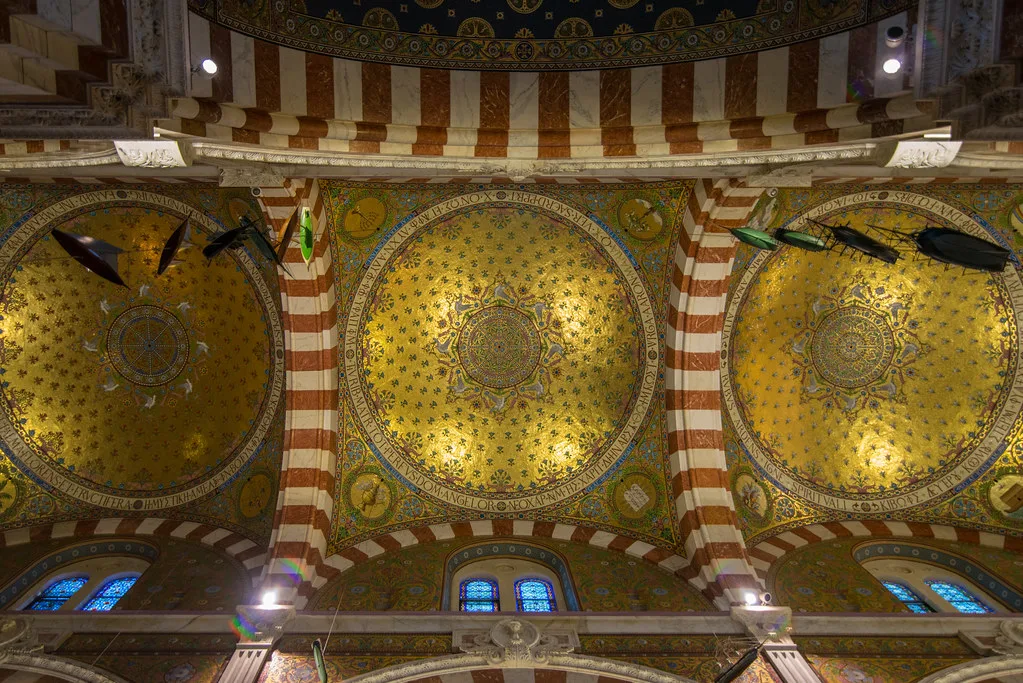
Above it, the upper church celebrates the Virgin with a burst of decoration: gold-ground mosaics, bands of coloured marble, bronze doors and altars set with lapis-lazuli. The mosaics were cleaned and the stonework repaired in a major restoration completed in 2008, so the colour you see is close to the original intent.
Walk in expecting a working church and adjust accordingly: shoulders and knees covered, voices low, no flash photography indoors and never during services. That etiquette matters more here than at a museum, because people come to pray as well as to look.
The ex-votos: model ships and storm paintings
The ex-voto collection is the reason to slow down inside rather than treat the basilica as a viewpoint with a roof. Hundreds of model ships hang from the ceiling, alongside oil paintings of vessels caught in storms, marble plaques reading simply merci, and life-belts and medals from survivors of wrecks and wars.
Taken together they form an archive of the city's relationship with the sea, left by fishing families and sailors who credited the Virgin with bringing them home. Treat the offerings as the sacred keepsakes they are: look closely, but do not touch or lean on them.
The maritime thread continues offshore, where the island fortress of Château d'If sits out in the bay and is visible from the terrace on a clear day. It makes a natural second harbour excursion rather than something to fold into the same morning.
The terrace view: Vieux-Port, Frioul, MuCEM and Le Panier
The panoramic terrace opens a 360-degree sweep over the Old Port, the Frioul islands and Château d'If, with the latticed MuCEM at the harbour mouth and the tiled roofs of Le Panier below. On a clear day the white cliffs of the Calanques show up on the horizon to the south.
Use the view to plan the rest of your day rather than just photograph it. Once you can see how compact the harbour is, the walk down to the MuCEM and the waterfront becomes obviously short, and you can judge whether Le Panier fits before or after lunch.
Le Panier repays a slow wander on the way down, with its steep lanes and small squares between the hill and the port. It is the kind of quarter where the pleasure is in the walking rather than a single sight, and it sits directly on the route back to the water.
How long to allow and when to go
Give the site at least an hour for the mosaics, the ex-voto collection and the panorama, and add the climb or the wait for the bus on top of that. A comfortable half-day takes in the basilica, the walk down through Le Panier and the harbour front.
Two windows work best: the first hour after opening, before the coach groups arrive, and the last hour before sunset, when low Mediterranean light turns the gilded Madonna and the limestone terrace amber. May through September brings the clearest skies and warmest evenings, while winter mornings are crisp and near-empty but bitter on the exposed summit when the wind gets up.
Carry water in summer, because facilities at the top are limited, and wear shoes that cope with the steep climb and the uneven terraces. If you would rather arrive composed, take the bus up and walk down, which gives you the view without the sweat.
Practical etiquette and conditions on the summit
This is a pilgrimage site before it is an attraction, so dress and behaviour should match: covered shoulders and knees inside, quiet during Mass and private prayer, and no flash photography indoors. Leaving a candle is a quiet tradition rather than a transaction, handled at the designated stands.
The other practical point is the weather on the hill, which is windier and cooler than the streets you left. The summit is exposed on every side, so a layer and a secure grip on your belongings make the terrace comfortable rather than a quick retreat.
What is nearby: the port, the cathedral and the museums
At the foot of the hill, the Vieux-Port Marseille is the natural place to land, with the fish quays, ferry pontoons and the broad Quai des Belges forming the city's front room. From there the MuCEM and the waterfront museums are a short walk round the harbour mouth.
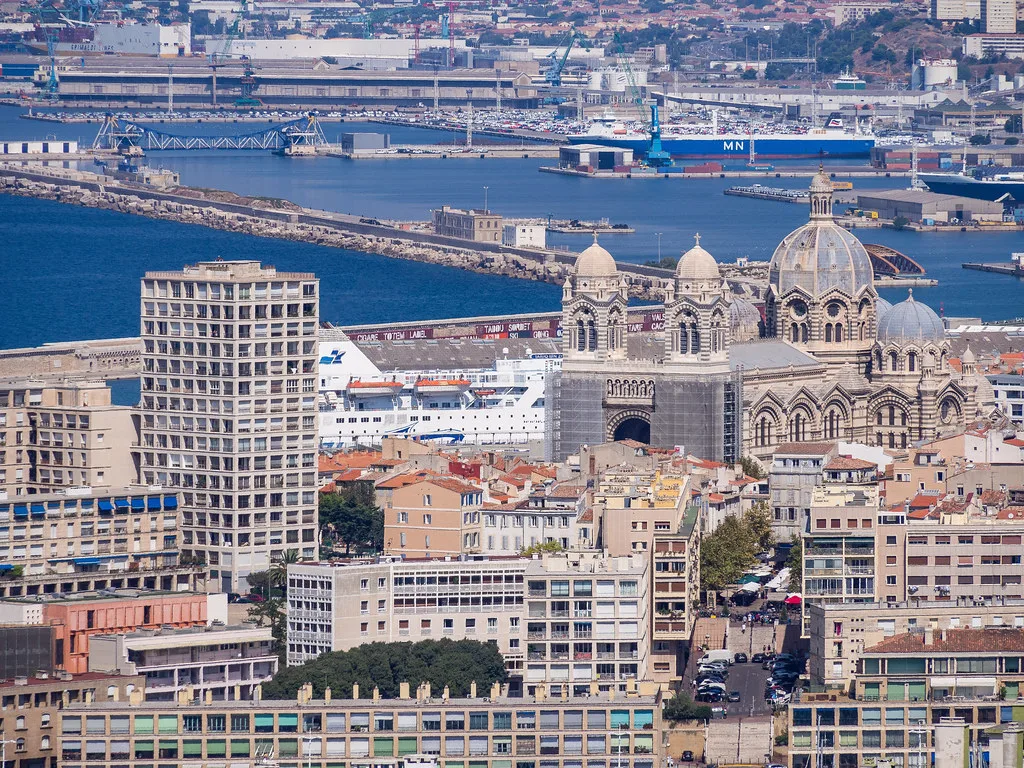
Marseille Cathedral (Cathédrale de la Major) sits on the waterfront between the Old Port and the MuCEM, a vast striped building that most visitors pass without stopping. Its scale and its position make it a sensible addition to the same walk rather than a separate trip.
Inland, the Palais Longchamp is a different kind of Marseille set piece, a monumental water tower and park at the end of the boulevard that bears its name. It suits a half-day of its own rather than an hour squeezed onto the harbour circuit.
Key facts at a glance
Construction of the present basilica ran from 1853 to 1864 under Henri-Jacques Espérandieu, over a fort built by François I in 1524. The 11.2-metre gilded Virgin and Child by Eugène-Louis Lequesne was hoisted onto the bell tower in 1870, and a restoration completed in 2008 cleaned the mosaics and re-gilded the statue.
The hill also carries war memory: during the liberation of Marseille in August 1944, French troops fought across the summit, and shell and bullet scars on the facade and bronze doors are left unrepaired as a deliberate witness. Look for them on the way in, before the interior claims your attention.
The 15 August feast of the Assumption is the basilica's patronal day, when the city climbs the hill in procession and the boats of the port below are blessed. If your weekend falls around it, expect the summit to be busy and the atmosphere to be quite unlike an ordinary morning.
Plan Your Visit
Notre-Dame de la Garde works best as a half-day rather than a quick photo stop: walk up or take bus 60, give the crypt, the mosaics and the ex-votos a proper hour, then walk down through Le Panier to the harbour. Go early or late for the light and the thinner crowds, and dress for a working church on an exposed hill.
The rest of Marseille slots in around it easily, from the Vieux-Port to the museums at the harbour mouth. Build the hill into a day on foot rather than a separate excursion.
Frequently Asked Questions
Is entry to Notre-Dame de la Garde free?
Yes. Entry to the basilica and its terraces is free. A small donation is invited if you light a candle inside. Guided tours are sold separately.
Quel bus pour monter à Notre-Dame de la Garde ?
The number 60 city bus runs from the Vieux-Port at cours Jean Ballard directly to the basilica gates on a standard RTM ticket. A tourist train from the Quai des Belges is the alternative, and the walk up from the Old Port takes 15 to 20 minutes.
How long does it take to walk up to Notre-Dame de la Garde?
The climb from the Old Port through the Roucas Blanc streets takes 15 to 20 minutes and is steep in places. Once at the top, an interior lift connects the fort level to the church for visitors who find the steps difficult.
Quelle est la date de construction de Notre-Dame de la Garde ?
The present basilica was built between 1853 and 1864 to designs by Henri-Jacques Espérandieu, over a fort built by François I in 1524. The gilded Virgin and Child on the bell tower was raised in 1870.
À quelle heure est la messe à Notre-Dame de la Garde à Marseille ?
Mass is celebrated each morning, with a larger service on Sunday, and the basilica's daily opening hours lengthen in high summer. Times shift through the year, so check the official basilica site before you climb.
Qui est l'enfant dans les bras de Notre-Dame de la Garde ?
The gilded figure on the bell tower is the Virgin and Child, an 11.2-metre statue by Eugène-Louis Lequesne raised in 1870. Locals know the Virgin as La Bonne Mère, the protector of sailors and their families.
How long should I spend at Notre-Dame de la Garde?
Allow at least an hour on the summit for the crypt, the upper church, the ex-voto collection and the terrace view. Add the climb or the bus wait on top of that, and consider walking down through Le Panier to the harbour.
When is the best time to visit Notre-Dame de la Garde?
The first hour after opening and the last hour before sunset combine the best light with the thinnest crowds. May to September brings the clearest skies, while winter mornings are quietest but colder and windier on the exposed summit.