
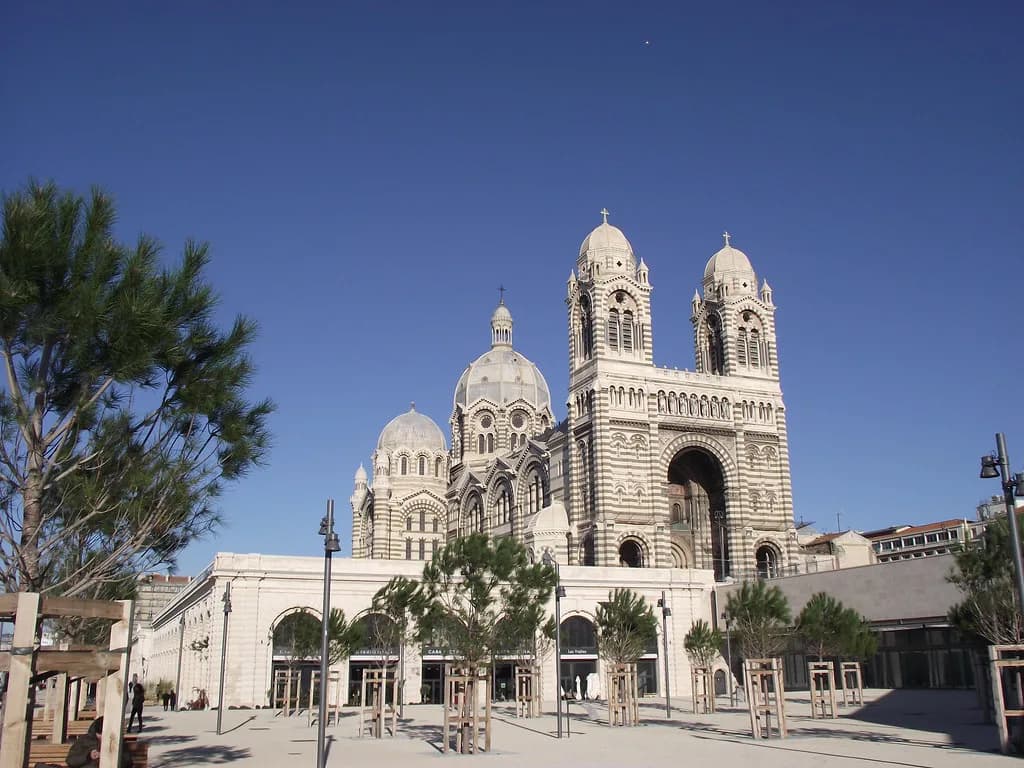
Marseille Cathedral (Cathédrale de la Major)
The Cathédrale de la Major is Marseille's cathedral, a Romano-Byzantine building that sits on the esplanade Jean-Paul II between the Vieux-Port and the port de la Joliette. Treat it as a 45- to 60-minute stop folded into a walk between Le Panier and the waterfront rather than a destination in its own right.
If you searched for "Marseille cathedral" and expected the hilltop basilica with the golden Virgin, you want Notre-Dame de la Garde, a separate landmark on a different site. This page covers the Major; the Marseille Attractions: 6 Visitor Guides hub sets out how the city's sights fit together.
What the Cathédrale de la Major is and why it's worth the detour
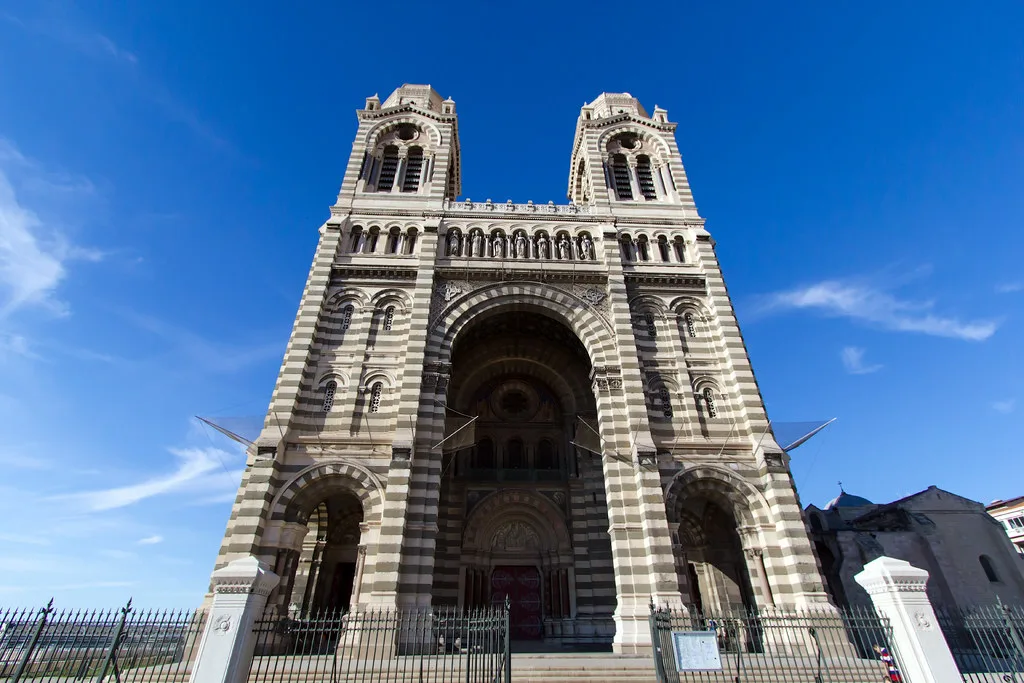
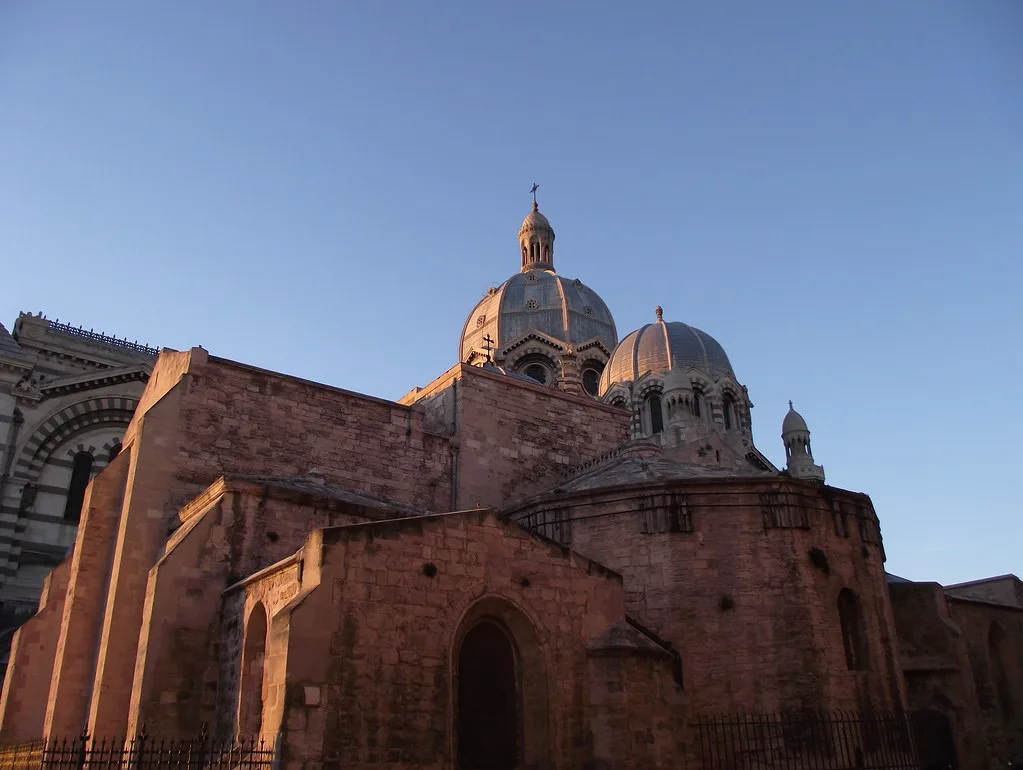
The Major is the seat of the archdiocese of Marseille, and its silhouette is unmistakable: large domes, bands of alternating pale and green stone across the facade, and a scale that dwarfs the surrounding streets. It sits on the quayside edge of the city, so the exterior is visible from much of the waterfront between the Vieux-Port and the Joliette docks.
Come for the outside first. The striped masonry and the dome cluster are the reason to detour, and you can read them in a few minutes from the esplanade without going through the doors. The interior is large and calm, but the shell, not the furnishings, leaves the impression.
Where it is: the esplanade Jean-Paul II between the Vieux-Port and the Joliette
The cathedral fronts the esplanade Jean-Paul II in the Joliette quarter, on the landward side of the docks, between the Vieux-Port to the south-west and the working port spreading north. That hinge position is what makes the Major so easy to slot into a walk, because you pass it moving between the old harbour and the newer city.
Approach from the Quai du Port and the domes stay ahead of you for the last stretch; approach from Le Panier and you drop down past the cathedral to the water. Both routes are short and keep the building as a waypoint rather than a separate errand.
How to get there and how long to allow
Métro line 1 serves the Vieux-Port, and from there the cathedral is a roughly 15-minute flat walk along the quays; the same line runs up to the Gare Saint-Charles for mainline trains. Walking is the practical choice because the route brings you past the waterfront rather than behind it.
Set aside 45 to 60 minutes: enough for the exterior from the esplanade, a slow turn inside, and a few minutes on the steps looking back towards the Vieux-Port. If you are tight on time, ten minutes outside still justifies the detour, but do not build a whole excursion around it.
What to see outside: the Romano-Byzantine domes and the striped stonework
Work your way around the building rather than stopping at the front. The alternating stone courses read most clearly in low, raking light, and the domes are best seen from the esplanade side where the building has room to breathe. From the quay edge you also get the contrast between the cathedral's pale stone and the port behind it.
The esplanade itself is the natural place to pause, with the Vieux-Port and Le Panier rising behind the building to the south. For the harbour's own sights and the morning fish market at the Quai des Belges, the things to do in Marseille guide is the place to start.
Inside the cathedral: what a short visit covers
Inside, the scale is what strikes you: a wide nave under the domes and a crossing that opens out rather than pressing down. Walk the length of the nave, look up, and leave a few minutes to sit in the quiet. Twenty minutes is a reasonable interior visit.
Do not expect a museum. There is no collection to work through and the visit is architectural. If you prefer sightseeing built around collections, the Marseille History Museum is a short walk away and opens Tuesday to Sunday, 9:30 a.m. to 6:00 p.m., closing on 1 January, 1 May, 1 November, 25 and 26 December.
Practical points: entry and opening times
Visiting the Major should be planned as a walk-in stop rather than a timed slot, and you should confirm the day's opening hours with the cathedral or the Marseille tourist office before setting off from the Vieux-Port. Opening times for religious buildings move around services and public holidays, and a Sunday morning is best avoided if you want to look around rather than attend Mass.
The building's setting on the esplanade Jean-Paul II is described among the city's landmarks in this Marseille overview, which places the cathedral between the Vieux-Port and the Joliette docks. Read it before you go so you know which side of the waterfront you are aiming for.
Nearby: the MuCEM, Fort Saint-Jean and Le Panier
The strongest pairing is with the MuCEM and Fort Saint-Jean, a short walk south along the quay, where the exterior spaces and the Mediterranean garden are free and a pedestrian bridge links fort and museum; the MuCEM closes on Tuesdays. Check the museum's own site for gallery and exhibition rates, since they change with the programme.
Le Panier, Marseille's old town, is a five-minute climb from the cathedral steps, and its lanes, street art and the Vieille Charité make a natural loop back towards the Vieux-Port. Make the Major the last stop on a walk that starts at the old port, climbs through Le Panier and comes down to the water; it fills an afternoon comfortably.
Common mistakes on a short Marseille break: mixing up the Major with Notre-Dame de la Garde
The usual mix-up is planning time for "Marseille cathedral" and arriving at Notre-Dame de la Garde, or the reverse. They are different buildings on different sites: the Major is on the waterfront between the Vieux-Port and Joliette, while the basilica stands on the hill above the city.
Notre-Dame de la Garde, Marseille has its own guide, and the two work best on separate halves of a day: the Major on a waterfront walk, the basilica for the view back over the city. Trying to do both in one hour means seeing neither properly. If you enjoy comparing cathedral architecture across a trip, the Ajaccio Cathedral guide covers another Provençal example worth reading before you travel.
Getting your bearings: the walk between the Vieux-Port, the Major and the Joliette
A useful loop starts at the Vieux-Port, crosses to the Quai du Port, follows the water to the cathedral and returns through Le Panier. The circuit is roughly 3 kilometres and takes two to three hours at a relaxed pace with stops, and the vieux port Marseille guide covers the harbour's own sights if you want to extend the start.
If you are building a longer Marseille itinerary, the Château d'If is reached by boat from the Vieux-Port and takes a separate half-day, so do not bolt it onto the cathedral walk. On a two-day break, keep the Major for the day you are already on the waterfront.
Plan Your Visit
Treat the Cathédrale de la Major as a 45-minute stop on a waterfront walk between the Vieux-Port and Le Panier, and confirm the day's opening hours with the cathedral or the tourist office before you go. The exterior is the reason to walk over; the interior is a calm bonus, not a museum.
With one clear afternoon in Marseille, pair the Major with the MuCEM and Fort Saint-Jean, and leave Notre-Dame de la Garde for a separate visit with a view. That split keeps both landmarks in proportion.
Explore more Marseille guides
Frequently Asked Questions
Where is Marseille Cathedral?
The Cathédrale de la Major stands on the esplanade Jean-Paul II in the Joliette quarter, between the Vieux-Port and the port de la Joliette. It is a flat walk of about 15 minutes along the quays from the Vieux-Port métro stop on line 1.
Is Marseille Cathedral the same as Notre-Dame de la Garde?
No. The Major is the cathedral on the waterfront; Notre-Dame de la Garde is a separate basilica on the hill above the city. They are different buildings on different sites and are worth separate visits.
How long does it take to visit the Cathédrale de la Major?
Allow 45 to 60 minutes for the exterior and a short interior visit. If you are short of time, ten minutes on the esplanade to see the domes and striped stonework is enough.
What else is near the Cathédrale de la Major?
The MuCEM and Fort Saint-Jean are a short walk south along the quay, and Le Panier old town is a five-minute climb from the cathedral steps. All three fit into an afternoon loop with the Vieux-Port.
What style is Marseille Cathedral built in?
The Cathédrale de la Major is Romano-Byzantine in style, with large domes and bands of alternating pale and green stone across the facade. Seen from the esplanade, the exterior is the highlight.