
MuCEM Marseille: what to see at the Museum of European and Mediterranean Civilisations
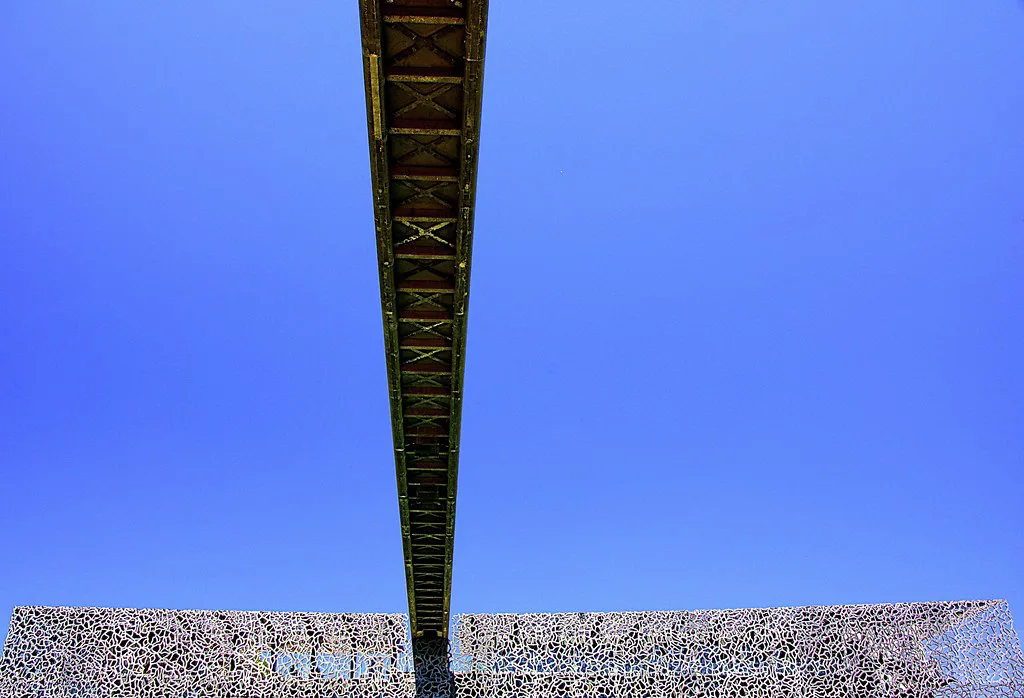
The MuCEM is Marseille's museum of European and Mediterranean civilisations, and it is worth visiting for the building and the setting as much as the displays. It occupies the J4, a converted port mole beside the Cathédrale de La Major, plus the 12th-century Fort Saint Jean next door, and the two are linked by a 115-metre footbridge over the water. Allow two to three hours if you want the collections and the fort, and check the day of the week before you set out, because the museum closes on Tuesdays.
MuCEM in a sentence: what it is and where it sits
The museum opened on 7 June 2013 as part of Marseille Provence's year as European Capital of Culture, and it is devoted to the cultures of the Mediterranean basin. Its setting is the reason to go even if you skip the galleries: the J4 building stands on the old harbour mole between Fort Saint Jean and the Cathédrale de La Major, with the sea on three sides. It suits travellers who want one substantial museum with a view rather than a full day indoors.
The three sites: J4, Fort Saint Jean and Belle de Mai
The MuCEM is not a single building. It is split between the J4 on the waterfront, Fort Saint Jean beside it and the Centre de conservation et de ressources at Belle de Mai, a store and research centre away from the harbour. Together the three cover around 40,000 square metres, so treat Belle de Mai as a separate errand rather than part of a harbour walk. For a weekend visit, the J4 and the fort are the practical pair.
The J4 holds 15,500 square metres of exhibition space, an auditorium, a bookshop and a panoramic restaurant. The fort side contributes the outdoor space, and the Centre de conservation et de ressources at Belle de Mai is where the collection is stored. Few weekenders will make the trip out there, and that is a reasonable trade-off given how much is already on the waterfront.
How to get there and how the parts connect
Everything hangs off the water between the Vieux-Port and La Joliette. The 115-metre footbridge runs from the J4 to Fort Saint Jean, and a second 70-metre bridge connects the fort to the Église Saint-Laurent and the edge of Le Panier. That layout matters: you can enter at the J4, cross to the fort, and walk out into Le Panier without retracing a step.
Coming from the Vieux-Port, the walk along the quays to the J4 is short and flat, and buses and the métro serve the Joliette area nearby. Plan your route so the museum is the middle of the day rather than the end, since the fort gardens are the pleasantest part and you want daylight for them.
What's inside the J4 building
The J4's two exhibition levels total 3,600 square metres. The first level is given over to the Mediterranean world, its diversity and its complexity, and the second floor holds 2,000 square metres of temporary exhibitions. That split means the permanent displays reward a slower hour and the temporary shows can be taken or left depending on what is on.
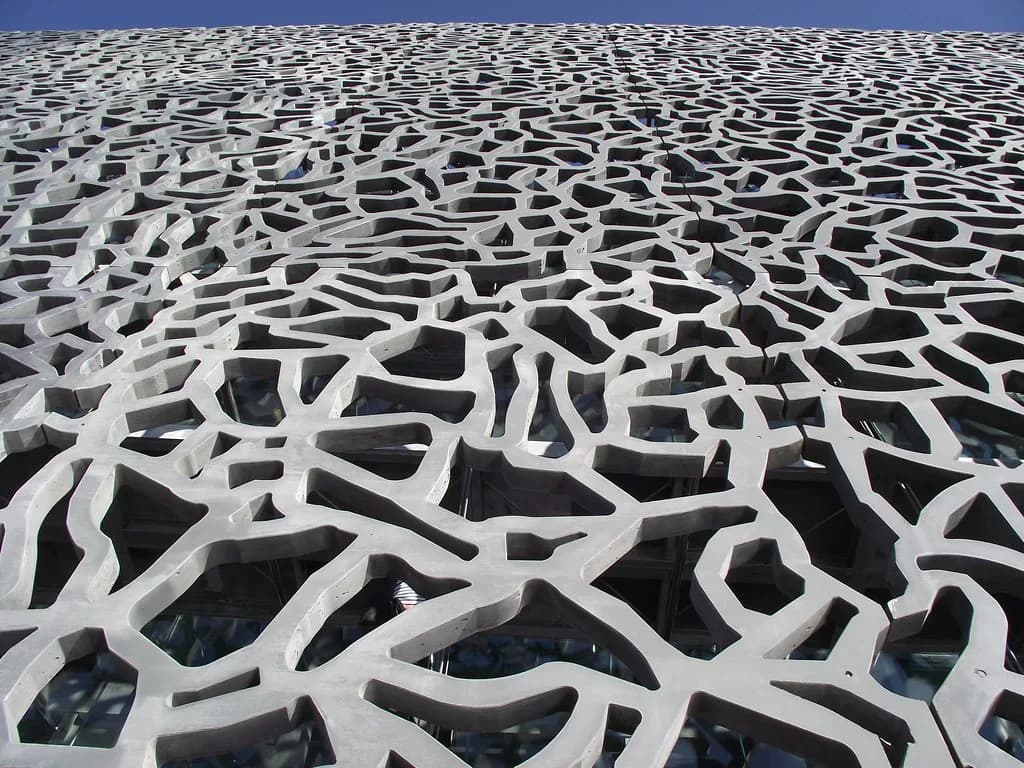
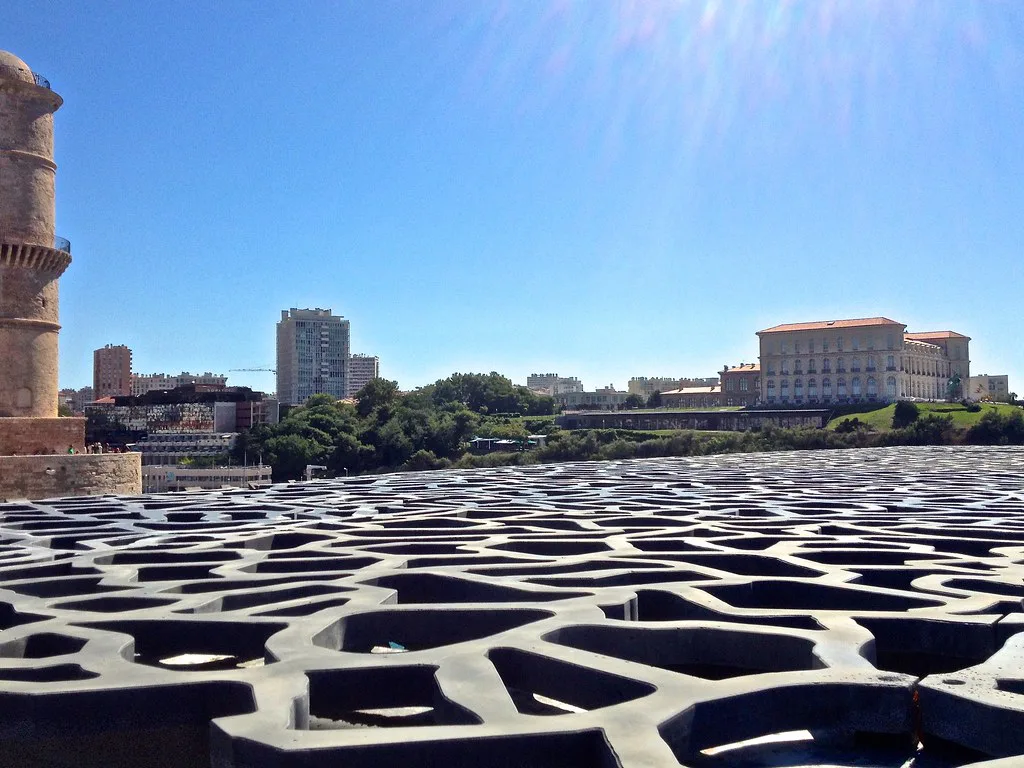
The building itself is the draw for many visitors: a concrete lattice wrapped around the exhibition box, with terraces looking back over the city. Check what is showing before you commit, since the temporary programme changes and the museum publishes its exhibition calendar online.
Fort Saint Jean: gardens, views and La Major
Fort Saint Jean dates from the 12th century and has been fully renovated, and it works as a free-flowing counterpoint to the galleries. The landscaped garden, the walk along the ramparts and the outlook over the Cathédrale de La Major are the reasons to cross the bridge, and there is a café and a shop on site. Give the fort at least 45 minutes even if you rush the museum.
The view takes in the whole city front from the fort, which makes it one of the better free outlooks in Marseille. Pair it with the Cathédrale de La Major next door, a striped neo-Byzantine building visible from the ramparts, rather than saving it for another day.
The Belle de Mai conservation centre
The third site, the Centre de conservation et de ressources at Belle de Mai, takes you behind the scenes of how the collection is stored and conserved. It is a working facility rather than a display space, and it sits well away from the harbour in a former industrial quarter. Skip it unless you have a specific interest and a spare half-day.
Opening hours by season and the Tuesday closure
The MuCEM is open every day except Tuesday. Opening times shift through the year: 11am to 6pm from 5 November to 30 April, 11am to 7pm from 2 May to 6 July, 10am to 8pm from 7 July to 2 September, and 11am to 7pm from 3 September to 4 November. A Saturday or Sunday visit is the safest bet for a weekend trip, since Monday is open and Tuesday is not.
That seasonal pattern has a practical consequence: a winter weekend gives you a shorter window than a summer one, so start earlier in the day between November and April. Confirm hours against the museum's own agenda before you travel, as the bands above are the tourist office's published timetable rather than a guarantee for your dates.
Tickets: full and reduced prices
Standard admission is 9.50 euros, with a reduced rate of 5 euros. Buying at the billetterie avoids the worst of the queue, and you can also book a skip-the-line pass in advance. Budget for the full price unless you know you qualify for the reduction, and check the booking page for current terms.
How long to allow, and how to split the visit
A realistic split is an hour and a half in the J4 for the permanent collections and a temporary show, 45 minutes in Fort Saint Jean for the gardens and ramparts, and 20 minutes for the bridge crossings. That lands you at roughly two and a half hours without rushing. Add time if a major temporary exhibition is running, since the upper floor alone holds 2,000 square metres.
The route that avoids doubling back is J4 first, then the 115-metre bridge to the fort, then the 70-metre bridge out towards Église Saint-Laurent and Le Panier. Walking downhill into Le Panier at the end puts you in the old quarter for lunch or a wander. Do the reverse if you want the museum quietest, since tour groups tend to arrive mid-morning.
Nearby: La Major, Le Panier, the Vieux-Port and La Vieille Charité
The MuCEM sits in a cluster of sights you can cover on foot in a single afternoon. The Cathédrale de La Major is immediately west, Le Panier climbs behind Fort Saint Jean, and the Vieux-Port is a 15-minute walk around the quays. La Vieille Charité, the 17th-century almshouse turned cultural centre in Le Panier, is a further 10 minutes uphill.
If you want one more boat-based sight, the Château d'If sits out in the bay and is reached by ferry from the Vieux-Port rather than from the MuCEM. Notre-Dame de la Garde is the other obvious half-day, sitting on the hill south of the old harbour. Both are separate outings, not add-ons to a MuCEM morning.
Honest trade-offs: museum-led or harbour-led weekend
The MuCEM earns its slot if you want one big museum with a strong sense of place and you are happy to spend half a day on it. It is less compelling if your weekend is built around the calanques, the port and the food, because the museum pulls you indoors. A harbour-led day of the Vieux-Port, Le Panier and La Major covers the same ground with more walking and less reading.
Pick the MuCEM when the weather turns, when a temporary show interests you, or when you want the fort's viewpoint as much as the galleries. Leave it out if you only have one full day and would rather see the city from the water and the hills. Either way, the walk between J4, the fort and Le Panier is worth doing on its own.
Plan Your Visit
Build your MuCEM visit around a non-Tuesday, arrive in the morning in winter or late morning in summer, and route yourself J4, bridge, fort, then out through Le Panier. That order keeps the walking short and puts you in the old quarter when you are ready to eat. Check the museum's calendar for what is on and confirm the day's hours before you go.
Explore more Marseille guides
Frequently Asked Questions
Is the MuCEM worth visiting in Marseille?
Yes, if you want one substantial museum with a setting you cannot get elsewhere in the city. The J4 building sits on a harbour mole with the sea around it, and the footbridge to Fort Saint Jean gives you gardens and ramparts as part of the same outing. If your weekend is built around the port, the calanques and food, it is a reasonable skip.
How long does a MuCEM visit take?
Allow about two and a half hours for the J4 collections, Fort Saint Jean and the bridge crossings. Add time if a large temporary exhibition is running, since the upper floor alone holds 2,000 square metres of display space.
When is the MuCEM closed?
The museum is closed on Tuesdays. Opening times vary through the year, with shorter days in winter and longer summer hours, so a weekend visit should be planned around the published seasonal timetable for your dates.
How much does the MuCEM cost?
There is a standard adult rate and a reduced rate for those who qualify, and tickets can be bought at the billetterie or booked in advance to avoid the queue. Check the current prices on the museum's ticketing page before you travel, as rates change.
How do you walk between the J4, Fort Saint Jean and Le Panier?
Start at the J4, cross the 115-metre footbridge to Fort Saint Jean, then take the 70-metre bridge out towards Église Saint-Laurent and the edge of Le Panier. That route avoids doubling back and ends in the old quarter.
What else is near the MuCEM?
The Cathédrale de La Major is immediately next door, Le Panier climbs behind the fort, and the Vieux-Port is a 15-minute walk around the quays. La Vieille Charité is a further 10 minutes uphill in Le Panier.
What is the third MuCEM site at Belle de Mai?
The Centre de conservation et de ressources at Belle de Mai is a storage and research facility rather than a display space, and it sits away from the harbour in a former industrial quarter. Most weekend visitors can skip it without missing anything from the main visit.