
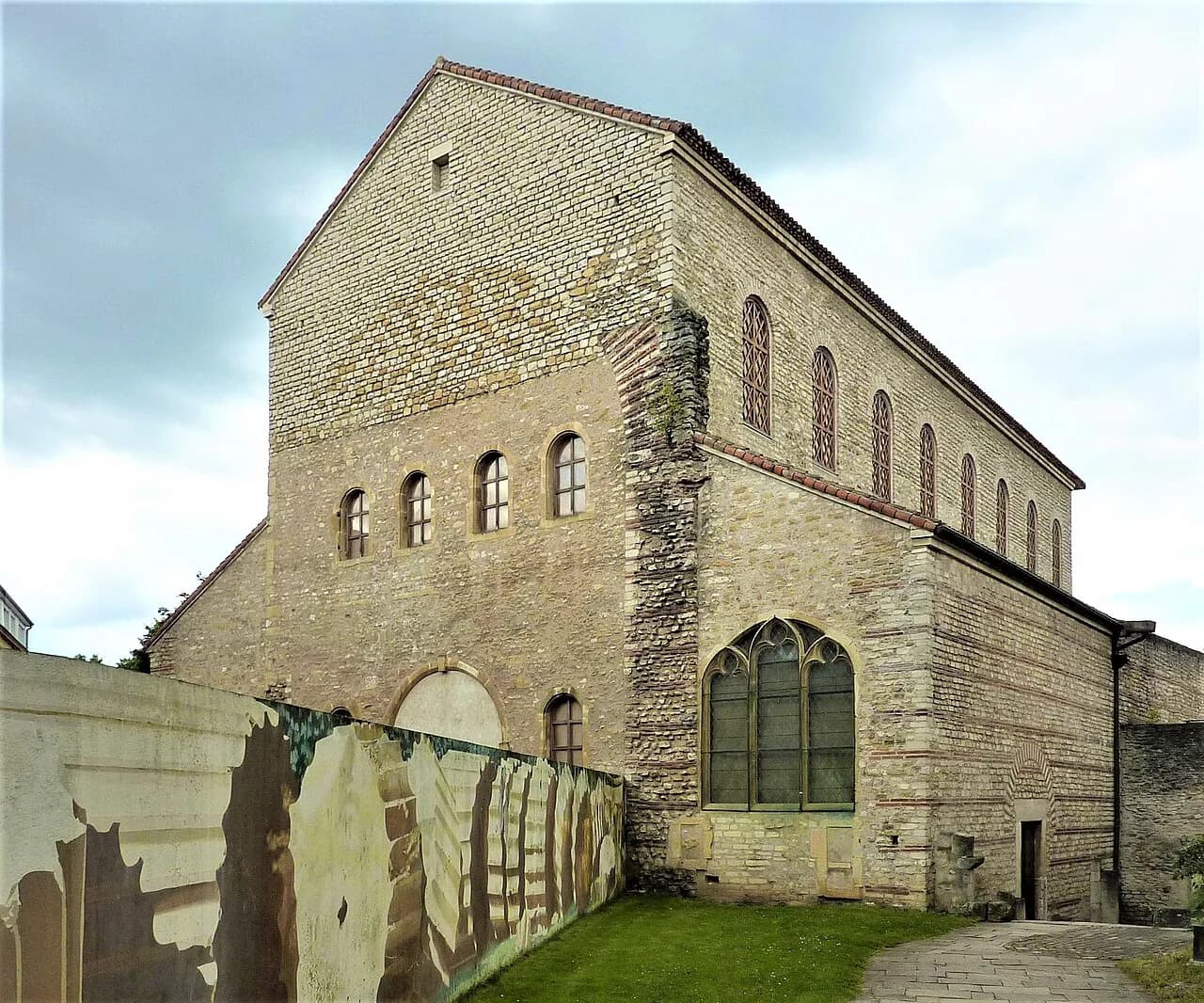
Saint-Pierre-aux-Nonnains: A Roman Building in Metz

Saint-Pierre-aux-Nonnains is the rare case of a Roman building in Metz that has survived almost intact and been put to a new use in every century since. It stands at 1 rue de la Citadelle, inside the Arsenal ensemble, a short walk from the Centre Pompidou-Metz. You come for the fabric of the building itself, not for furnishings or a museum display.
The visit is short and cheap in time: the nave alone takes about half an hour, and a guided tour adds the history that the bare walls do not tell you. Plan it as one stop in a half-day around the Arsenal, and pair it with the Merovingian pieces from the site now held at the Musée de la Cour d'Or.
What Saint-Pierre-aux-Nonnains is
The building was put up between the end of the fourth century and the start of the fifth, when Metz was a Roman city, and it is counted among the oldest church buildings in Europe. Its first life was probably secular: the city describes it as possibly the palestra of a large, probably unfinished bath complex, or a civil basilica where people gathered. That origin is the key to reading the space, because the plan you walk through was not designed for Christian worship.
The Huns devastated the complex in 451, and the hall was later abandoned before becoming a Benedictine abbey around 620. It has been listed as a Monument Historique and shows Roman walls with Gothic adjustments on top. Treat the building carefully: it is a former church, now a heritage venue rather than a parish in use. If you enjoy reading a building's layers this way, the Roman and medieval fabric of the near-by city gives the same pleasure: see things to do in Nancy for its medieval and Art Nouveau streetscapes.
Where it is and how to get there
The address is 1 rue de la Citadelle, 57000 Metz, in the Arsenal quarter on the edge of the historic centre. From place de la République or the cathedral area, the walk takes roughly fifteen to twenty minutes at an easy pace. From Metz-Ville station, allow around twenty-five to thirty minutes on foot, or take the city bus towards the centre and finish on foot.
The building sits within the Arsenal ensemble, so you approach it through a military-era setting rather than a churchyard. Look for the plain outer walls rather than a tower or spire: there is no landmark steeple to guide you in. If you are working through the wider city sights first, the Metz attractions guide sets out the other stops in the same quarter.
Opening hours and guided visits
The city publishes opening from Tuesday to Sunday, 14:00 to 18:00, until 22 September, so the building is closed on Mondays and the published hours are seasonal rather than year-round. Guided visits of Saint-Pierre-aux-Nonnains and the Chapelle des Templiers can be arranged by appointment, subject to space: Saturdays at 14:00, 15:00, 16:00 and 17:00, and Sundays at 11:00, 12:00, 14:00 and 15:00. Reserve by email at fchantoiseau@citemusicale-metz.fr.
The city page gives no admission price, so the guided slots are the practical alternative to a self-guided look, and they cover both this building and the Chapelle des Templiers in one booking. Check the current hours and slot pattern before you travel, since the page ties them to a season.
What you see outside
The exterior is deliberately austere: high, simple walls with none of the buttresses, portals or tracery you expect on a French church. The original main entrance, a round-arched opening, is still visible on the side of the building, now walled up. That blocked arch is the best single clue to the hall's Roman past, so walk the outside before you go in.
The dimensions explain why the building has been reused so often: it is a big, robust shell that could hold grain, troops or an audience. Its position inside the citadel explains the later military role as much as its architecture does. Read the walls as a record of adaptation rather than as decoration.
Inside: a 34-metre Roman hall
The nave measures 34 metres long, 18 metres wide and 20 metres high, and the volume is the main event. Inside, the successive phases of the building remain legible, from Roman hall to Benedictine church to store. Give yourself time to stand at one end and read the whole space before moving to the details.
The far end of the story is practical rather than spiritual: after the taking of Metz in 1552, Maréchal de Vieilleville built the citadel and the church was absorbed into it as a military warehouse. Spiritual use had already ended in 1556. Knowing that helps you spot the changes made for storage rather than worship.
The Ottonian work
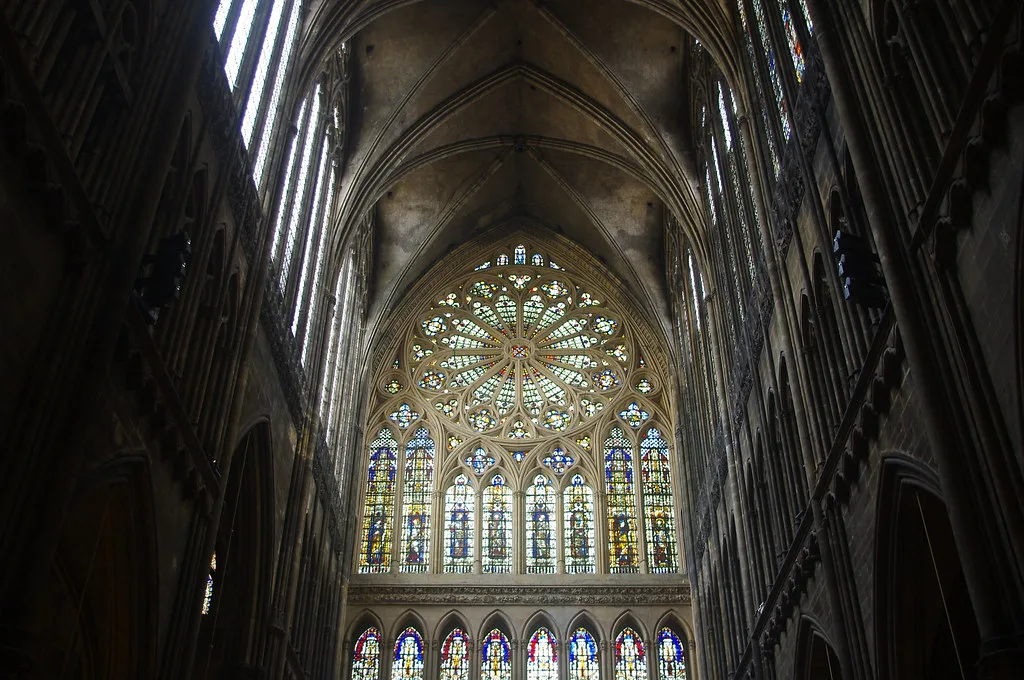
In the tenth century, donations from the Emperor Otto paid for major changes: the nave was divided into three vessels and a narthex, or fore-nave, was created. In one of the side aisles you can still see an Ottonian arrangement, a deep round-arched niche that held relics or a sarcophagus, with traces of paint on its arch. Look low and to the side for it, because it does not announce itself.
This is the part of the visit that rewards a guide, since polychromy traces and a blocked niche are easy to walk past. The Ottonian layer also explains why the interior reads as three spaces rather than one hall. If the niche is your priority, mention it when you book so the guide builds it into the tour.
The Gothic rib vault
The building was reworked again in the fifteenth century, when a Gothic vault on crossed ribs was added over the older fabric. The effect is a Roman box capped by a medieval ceiling, and the join between the two is the clearest single illustration of the building's long life. Look up as soon as you enter, then down at the walls, to see how the two periods meet.
Because the vault came so late, the interior does not have the gloom of an authentic Roman hall, and it does not have the furnishings of a Gothic church either. That mixture is what you are here to see. It also means the space works well for concerts, which is how it is used today.
The Merovingian pieces at the Musée de la Cour d'Or
A remarkable Merovingian sculpture of Christ in majesty and a carved stone chancel barrier from this period are held at the Musées de la Cour d'Or, not in the building itself. If you want to see the site's finest early medieval art, you have to make a second stop in the city. The building alone shows the architecture; the museum shows the sculpture.
Build the two into one day rather than treating the Cour d'Or as an optional extra, because the chancel and the Christ figure make sense of the abbey phase you have just walked through. Museum hours and ticket prices are published by the museum rather than by the venue page. Check them before you set your route.
How long to allow and when to go
Allow about thirty minutes for the building and its exterior on your own, or an hour if you take a guided slot that covers the Chapelle des Templiers too. Afternoon opening means it fits neatly after a morning elsewhere in the centre.
The trade-off is real: this is a bare, austere interior with few furnishings, and it suits people interested in the building itself rather than in display. If you want stained glass and carved altars, the cathedral is the better use of an hour. If you want to see how a Roman hall was bent into a church, this is the stop. See our guide to Metz cathedral.
Nearby sights
The Chapelle des Templiers is the natural companion, since it appears in the same guided-visit booking and stands in the same quarter. The Arsenal ensemble itself is worth a slow circuit on the way in or out. These three together fill a comfortable half-day without any transport.
The Centre Pompidou-Metz is a short walk away and makes an obvious pairing for a modern-and-Roman afternoon. The covered market is useful if you want lunch before the 14:00 opening. For a fuller shortlist of city stops, see the Metz attractions guide.
Concerts and events in the building
Saint-Pierre-aux-Nonnains is used as a concert venue, and the city page lists performances there, including programmes built around Bach trio sonatas. The page does not make clear which year those listings belong to, so do not treat any date on it as upcoming. Check the venue's current programme before you plan an evening around a concert.
A concert is a different way to see the space, and it exploits the height and the bare stone. If you are in Metz for a weekend, though, the afternoon opening is the reliable option. Keep the concert as a bonus rather than the reason for the trip.
Is It Worth Your Time?
Saint-Pierre-aux-Nonnains earns an hour of a Metz weekend if you care how buildings are made and remade. It delivers fifteen centuries in one room, from a probable Roman palestra to a Benedictine abbey to a military store, with an Ottonian niche and a Gothic vault still in place. Skip it if you want colour and gold.
Book a guided slot by email if you can, or simply turn up in the afternoon window and walk the outside first. Pair it with the Chapelle des Templiers on site and the Merovingian pieces at the Cour d'Or. Then check current hours before you travel.
Explore more Metz guides
Frequently Asked Questions
Is Saint-Pierre-aux-Nonnains the oldest church in France?
The building dates from the late fourth to early fifth century and is described as one of the oldest churches in Europe. That is a broader claim than a national title, and the surviving fabric has been altered repeatedly since antiquity, so it is better understood as one of the oldest surviving church buildings rather than as a single record holder.
How old is Saint-Pierre-aux-Nonnains?
It was built between the end of the fourth century and the start of the fifth, probably as part of a Roman bath complex or as a civil basilica. It became a Benedictine abbey around 620, was reworked in the tenth and fifteenth centuries, and lost its spiritual use in 1556 when it was absorbed into the citadel.
When is Saint-Pierre-aux-Nonnains open?
The city lists opening from Tuesday to Sunday, 14:00 to 18:00, until 22 September, so Monday is closed and the hours are seasonal. Check the current schedule on the city page before you travel, because the published window is tied to a date rather than the whole year.
Can you visit Saint-Pierre-aux-Nonnains without a guide?
Yes, the afternoon opening lets you look around on your own. Guided visits of the building and the Chapelle des Templiers can be arranged by appointment, subject to space, with Saturday slots at 14:00, 15:00, 16:00 and 17:00 and Sunday slots at 11:00, 12:00, 14:00 and 15:00. Reserve by email at fchantoiseau@citemusicale-metz.fr.
Where are the chancel and Merovingian sculpture from Saint-Pierre-aux-Nonnains?
The Merovingian Christ in majesty and the carved stone chancel barrier are held at the Musées de la Cour d'Or in Metz, not in the building. Visit the museum in the same trip to see them, since they belong to the abbey phase the bare interior cannot show.
How long does a visit take?
Allow about thirty minutes for the interior and a walk around the outside, or around an hour if you join a guided visit that also covers the Chapelle des Templiers. The nave is large but unfurnished, so there is little to slow you down once you have read the walls.
What is nearby?
The Chapelle des Templiers shares the guided-visit booking and the Arsenal quarter, and the Centre Pompidou-Metz is a short walk away. The Musée de la Cour d'Or holds the site's Merovingian sculpture, so it makes a logical second stop rather than a detour.