
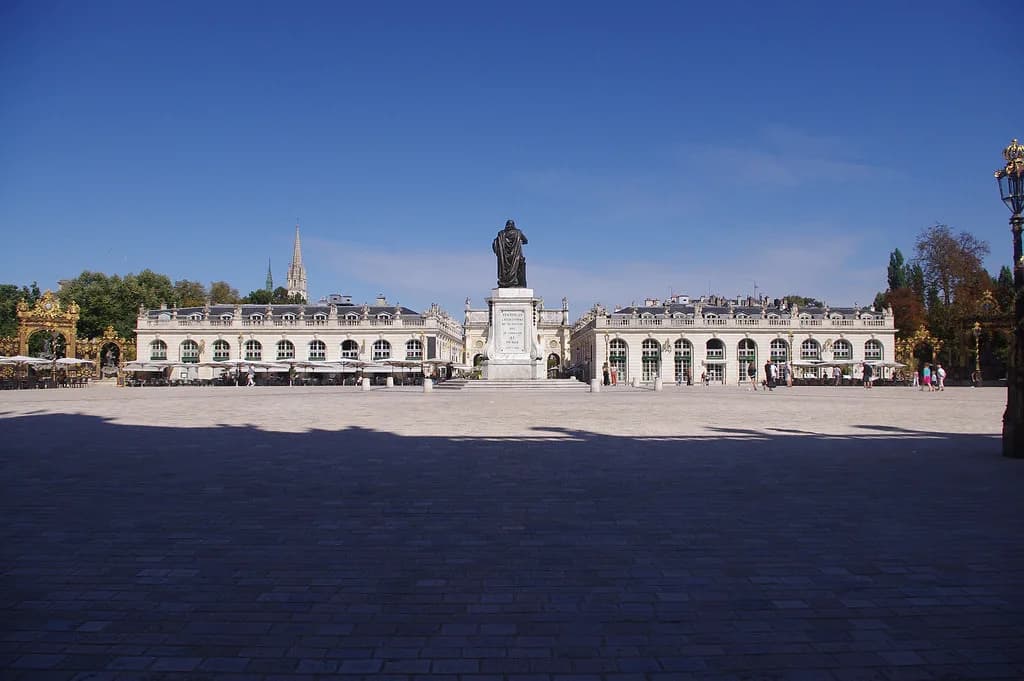
Place Stanislas: Nancy's UNESCO Square and How to Visit It
Place Stanislas is the classical heart of Nancy: a pedestrianised 18th-century square, listed by UNESCO, and free to walk through at any hour. It works as the hinge of a short break, sitting between the medieval Ville Vieille and the formal ensemble that runs on to Place de la Carrière. Give it 30 minutes for the square alone, or half a day once you add the museum on its edge.
An 18th-century royal square at the centre of Nancy
The square was laid out by Emmanuel Héré for Stanislas Leszczynski, the former King of Poland who became Duke of Lorraine, and it is held up as a model of French classicism among European royal squares. Fine gilded wrought-iron gates by Jean Lamour frame the space, and two Rococo fountains designed by Barthélémy Guibal sit at its northern corners. A statue of Stanislas has stood in the centre since 1831.
The whole square is pedestrianised, paved in light stone and ringed by low gates rather than traffic, which is why it feels calmer than its scale suggests. It is part of the UNESCO listing that covers Nancy's three 18th-century squares, so the paving, railings and fountains are the protected fabric rather than decoration. Look up as much as forward: the gilding and the wrought iron are the details worth the detour.
Where it sits between the Ville Vieille and Place de la Carrière
Place Stanislas occupies the middle of Nancy's centre, a stone's throw from the old town and linked by the Héré arch to Place de la Carrière, the former equestrian and tournament square that now marks the entrance to the historic core. On the old-town side, the Grande Rue runs from near Place Vaudémont down to the Porte de la Craffe, and the square sits just off that axis. Treat it as a crossroads rather than a destination you tick off, and the rest of central Nancy falls into place around it.
How to get there and how to move around
Nancy is about an hour and a half from Paris on the TGV from the Gare de l'Est, with around ten daily connections, and the centre is compact enough to cover on foot from the station area. Note that the Lorraine TGV station sits outside the city and is linked by shuttle, so check which station your ticket uses before you book. Within the centre there is a tram and a dozen bus lines, but for the square itself you will be walking.
If you are structuring a weekend, the Nancy Attractions: 6 Visitor Guides collection shows how the square connects to the rest of the city's sights. It is a useful comparison if you are weighing a short break here against a weekend in Metz, where the classical centre plays a similar anchor role.
What to look at on the square itself
Start with the statue of Stanislas in the middle, then work round the edges: the Hôtel de Ville, the Opera House and the Musée des Beaux-Arts pavilion all face the square in matching classical stone, and the Héré arch closes the view towards Place de la Carrière. The gilded gates and the Guibal fountains are the two features most visitors photograph, and they repay a slow circuit rather than a snapshot. In summer, the square has hosted a 30-minute sound-and-light show; the tourist office confirms whether it runs during your stay.
Place Stanislas is also the natural starting point for a wider wander through the city, and the wider things to do in Nancy list is a sensible way to plan the rest of the day around it.
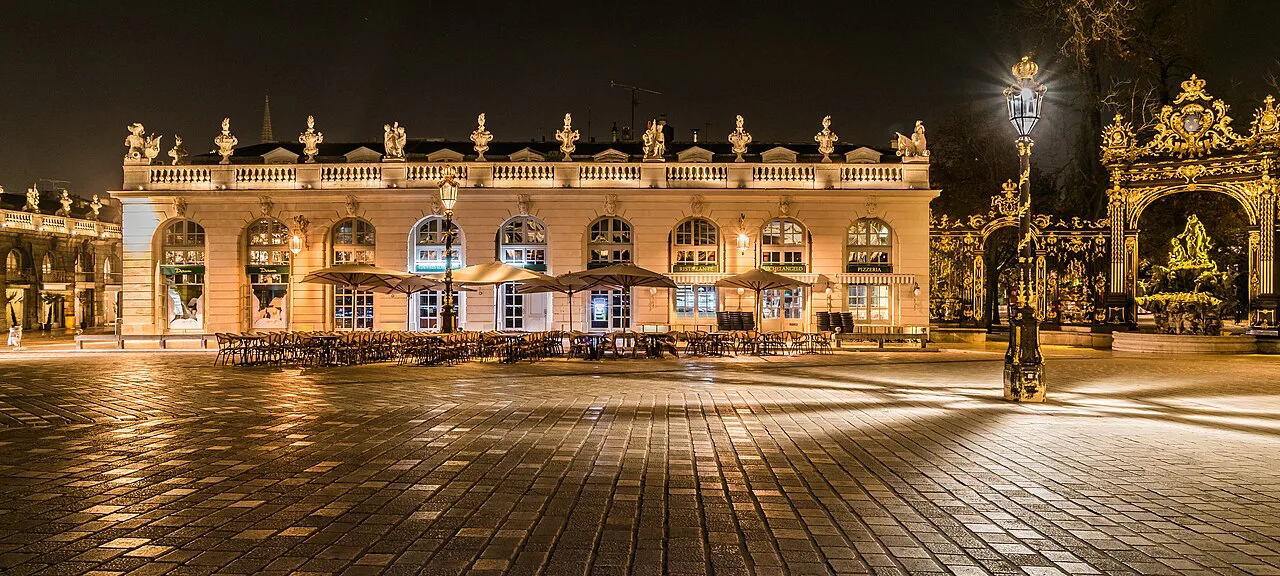

The Musée des Beaux-Arts on the square's edge
The Musée des Beaux-Arts occupies an 18th-century pavilion on Place Stanislas and covers European art from the 16th century to the present, with names including Rubens, Delacroix and Modigliani across roughly 9,000 square metres of collection. For most Art Nouveau-minded visitors the real draw is downstairs: the Daum crystal collection, rows of vases and glassware from the Nancy firm, shown in a dark, high-ceilinged basement space. Look out for the stone ramparts down there, the last remnant of the walls that once circled the city.
The musée des beaux-arts is the main indoor reason to linger on the square, and it is the sensible move when the weather turns. Check the museum's own site or the tourist office for current opening hours, closing days and ticket prices before you go.
Best time to see it
The square is at its best in the morning, when the light rakes across the ochre stone and the gilding, and again at the blue hour, when the gates and fountains are lit and the space empties out. In summer, a café on the square is a good place to sit while the light changes; in winter the same stone reads grey and the gilding does more of the work. Because the whole square is pedestrian, there is no traffic to spoil either end of the day.
If you can time a visit to a clear evening, the walk through to Place de la Carrière after the lights come on gives you the square and the medieval entrance to the old town in one loop.
How long to allow
Thirty minutes covers the square: a circuit of the fountains, the statue and the gates, and a look at the facades. Half a day is more realistic if you add the Musée des Beaux-Arts and a slow lunch or coffee on the square, because the museum alone can take a couple of hours once you factor in the Daum collection. If you want a full Art Nouveau day, use the square as a base: the Villa Majorelle, the Musée de l'École de Nancy and the Saurupt neighbourhood are all a short walk or tram ride away.
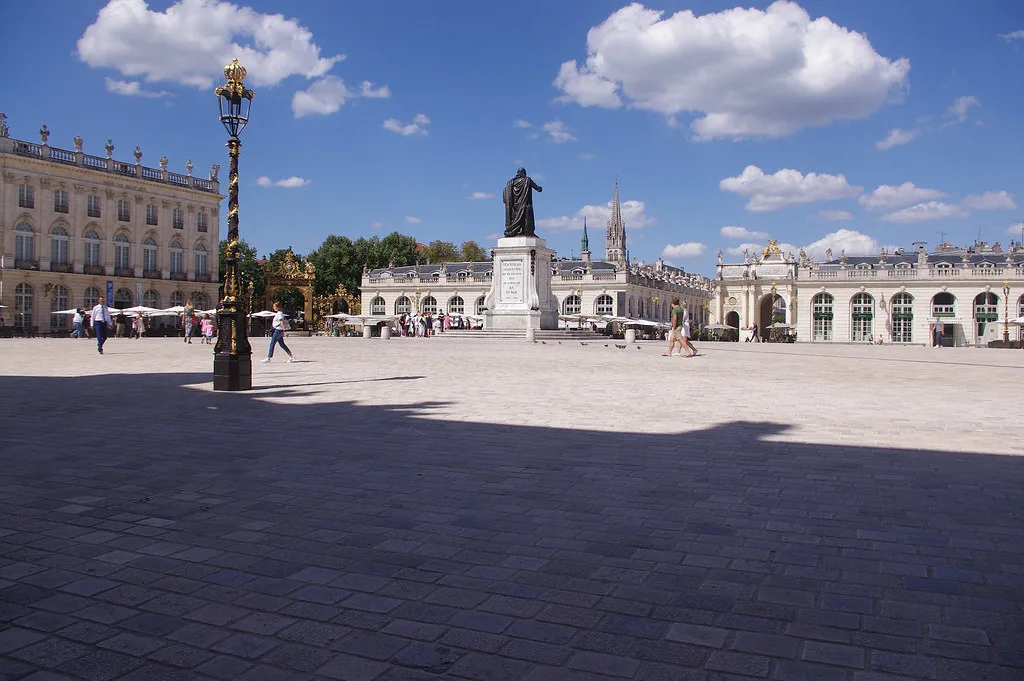
Nearby sights within a few minutes' walk
Place de la Carrière is through the Héré arch, and the Ville Vieille opens up beyond it: the Grande Rue, Place Saint-Epvre with its neo-Gothic basilica, and the Porte de la Craffe, the 14th-century gate that is the oldest surviving piece of Nancy's walls. The Ducal Palace on the Grande Rue now houses the Lorraine Museum, and the Église des Cordeliers, which serves as a necropolis for the Dukes of Lorraine, sits beside it. Allow an extra half day if you want to do the old town properly.
In the other direction, the Parc de la Pépinière is a short walk from the square: almost 21 hectares of green space with a rose garden and a small zoo, useful for stretching a city break out with children or a picnic. The covered market on Rue Saint-Dizier is also within walking distance and runs on five days a week with around 60 traders, so check which mornings before you plan a market breakfast.
Practical notes
The square itself costs nothing to walk through, and you can cross it at any hour without a ticket. The museum on its edge is ticketed: book and check prices on the museum's own site or at the tourist office rather than relying on second-hand figures. Note that many French museums close one day a week, so confirm the day before you build your plan around a visit.
Where the Square Fits Into a Nancy Weekend
Place Stanislas is the fixed point of any Nancy short break: a free, pedestrian square that anchors the old town on one side and Place de la Carrière on the other, with the Musée des Beaux-Arts as the one substantial indoor stop on its edge. Give it a morning or an evening for the square itself, and half a day if you want the Daum collection and a coffee. Build the rest of the weekend around it: the Villa Majorelle and the Musée de l'École de Nancy for Art Nouveau, and the Ville Vieille and Porte de la Craffe for the older city.
Frequently Asked Questions
Where is Place Stanislas in Nancy?
It sits in the middle of central Nancy, between the medieval Ville Vieille and Place de la Carrière, which is reached through the Héré arch. The Grande Rue and the old town, including the Porte de la Craffe, are a few minutes' walk away, and the Musée des Beaux-Arts occupies a pavilion on the square itself. Everything on the square is pedestrian, so you arrive and move around on foot.
Is Place Stanislas free to visit?
Walking through the square costs nothing and there is no ticket or barrier. The buildings around it are another matter: the Musée des Beaux-Arts is a ticketed museum, so check its own website or ask at the tourist office for current prices, opening hours and closing days before you plan a visit around it.
How long do you need at Place Stanislas?
Thirty minutes is enough for a circuit of the statue, the gilded gates and the two Rococo fountains, plus a look at the facades. Allow half a day if you add the Musée des Beaux-Arts and its Daum glass collection, which can take a couple of hours on its own, and longer still if you use the square as the base for an Art Nouveau day.
What can you see on Place Stanislas?
The statue of Stanislas Leszczynski stands at the centre, the gilded wrought-iron gates by Jean Lamour frame the entrances, and two Rococo fountains by Barthélémy Guibal sit at the northern corners. Around the edges are the Hôtel de Ville, the Opera House and the Musée des Beaux-Arts pavilion, all in matching classical stone, with the Héré arch closing the view towards Place de la Carrière.
Is Place Stanislas a UNESCO World Heritage Site?
Yes. The square forms part of the UNESCO listing that covers Nancy's three 18th-century squares, alongside Place de la Carrière and the ensemble around them. That protection covers the paving, railings and fountains as much as the buildings, which is why the gilding and wrought iron are worth a slow look rather than a quick photograph.
What is there to do near Place Stanislas?
Through the Héré arch, Place de la Carrière leads into the Ville Vieille, where the Grande Rue, the neo-Gothic Saint-Epvre basilica and the 14th-century Porte de la Craffe sit within a few minutes' walk. The Ducal Palace houses the Lorraine Museum and the Église des Cordeliers stands beside it, while the Parc de la Pépinière and the covered market on Rue Saint-Dizier lie in the other direction.
When is the best time to see Place Stanislas?
Morning brings light across the ochre stone and the gilding, while the blue hour lights the gates and fountains as the square empties. Both are worth planning around because the square is entirely pedestrian, so nothing interrupts the view. In summer the square has hosted a 30-minute sound-and-light show, and the tourist office can confirm whether it is running during your stay.