Strasbourg Markets: Flea, Christmas and What to Expect
Strasbourg's markets run from a year-round Friday and Saturday flea market to Advent's Christmas markets. Here is what each one sells and when it runs.
On this page
Strasbourg's markets come in two distinct seasons. A flea market of up to forty professional antique dealers, second-hand merchants and vintage clothing sellers runs every Friday and Saturday from 7am to 6pm, all year, with free entry. Then from late November the city fills with Christmas markets scattered across the old town and Petite France, which is the version most weekenders are searching for.
The two could hardly be more different in planning terms. The flea market rewards an early start on a Friday or Saturday and needs no ticket; the Christmas markets reward an evening visit and need a route, because the pitches are spread across a dozen squares rather than concentrated in one. Knowing which one your weekend is built around changes where you sleep, when you eat and how much walking you do.
The year-round flea market: days, hours and what's on the stalls
The Strasbourg flea market is the one market you can plan around in any month. It is open every Friday and Saturday throughout the year, except public holidays, from 7am to 6pm, and admission is free. Up to forty professional exhibitors take part, covering antiques, period furniture, jewellery and vintage objects rather than food.
Treat it as a morning plan rather than an afternoon one. The early hours are when dealers have their stock laid out and before casual browsers arrive, and finishing by lunchtime leaves the rest of the day for the cathedral and the old town. If your short break falls Monday to Thursday, this market simply is not running, and the city's sights should carry the trip instead.
Where the flea market spreads out: Place de l'Étal, Grande Boucherie and Tripiers
The market is not confined to one square. Pitches occupy Place de l'Étal, Place de la Grande Boucherie and Place des Tripiers, all in the city centre and all within easy walking distance of each other. Read those names together as one market with three clusters, not three separate events, and you can drift between them without a map.
This compact geography is the main reason the flea market fits neatly into a weekend. You can work the three squares in a loop, stop for coffee between Place de la Grande Boucherie and Place des Tripiers, and still be at the cathedral before midday. Set a time limit if you are a serious browser, because an antiques market of this size can swallow three hours without effort.
Saturday-only pitches at Place du Corbeau and how that changes your plan
Place du Corbeau appears in the market's lineup only on Saturdays. A Friday visitor sees three of the four locations; a Saturday visitor sees the full spread. If your dates are flexible and you want the complete market, book the weekend around Saturday morning rather than Friday.
That single difference is worth planning around. Friday is the quieter day and easier if you want unhurried browsing; Saturday gives you the extra pitches but also more competition for the best pieces. Pick Friday for calm and Saturday for range, and do not try to do both mornings if the rest of your weekend is full.
What to hunt for: antiques, period furniture, jewellery and vintage clothing
The stalls lean heavily towards antiques and vintage rather than crafts or food. Expect period furniture, sparkling jewellery, vintage clothing and collectable objects, with exhibitors described as experts in their fields. That makes it a good market for a specific hunt, such as a piece of old glassware or a brooch, and a poor one for edible souvenirs.
Come with a size limit in mind. Furniture is widely available but awkward to carry home on a train, so many buyers focus on jewellery, small ceramics and textiles that pack flat. If you do fall for something large, ask the dealer about shipping and the practicalities before you commit.
Entry, cost and how to pace a morning at the flea market
Entry costs nothing, so the only budget question is what you spend at the stalls. That removes the pressure of feeling you must buy to justify the trip, and makes a twenty-minute pass through one square perfectly reasonable. Bring cash as a sensible default, and confirm card acceptance with each dealer before agreeing a price.
A workable pace is ninety minutes to two hours: Place de l'Étal first, then Place de la Grande Boucherie, then Place des Tripiers, with Place du Corbeau added on Saturday. Leave the market by late morning and give the afternoon to the old town, which sits right beside it.
The Christmas markets: why Strasbourg draws crowds in December
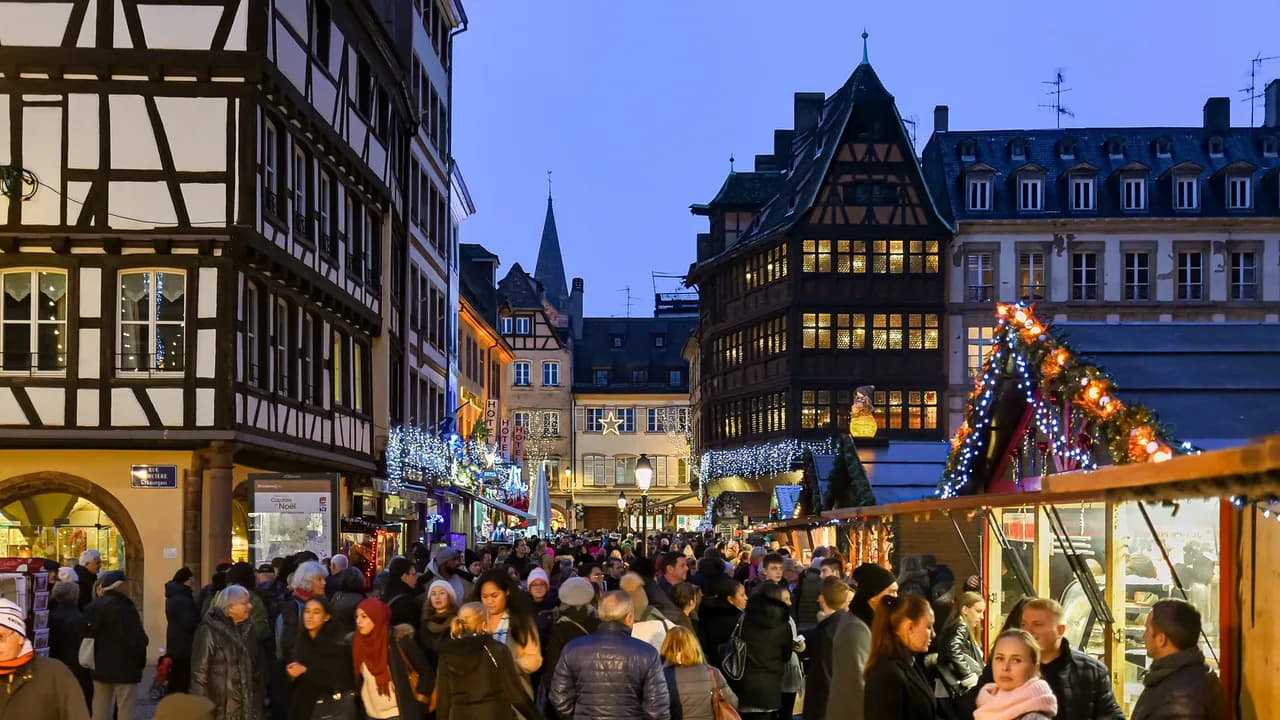
Strasbourg's Christmas markets run through Advent and into Christmas Eve, and they are the reason the city is nicknamed the capital of Christmas. In 2024 the markets ran from 27 November to 24 December, which shows the typical window rather than a date to rely on for a future year.
The markets are not one event but a series of separate pitches on named squares. That is the single most useful thing to understand: there is no single entrance, no ticket and no central hub, so your plan is a walking route between squares rather than a visit to a site. Weekday afternoons are calmer than weekends, and the light improves sharply after sunset.
For a broader view of when the city is at its best across the year, the question of the best time to visit Strasbourg is worth settling before you book, since December is the busiest stretch and prices reflect it.
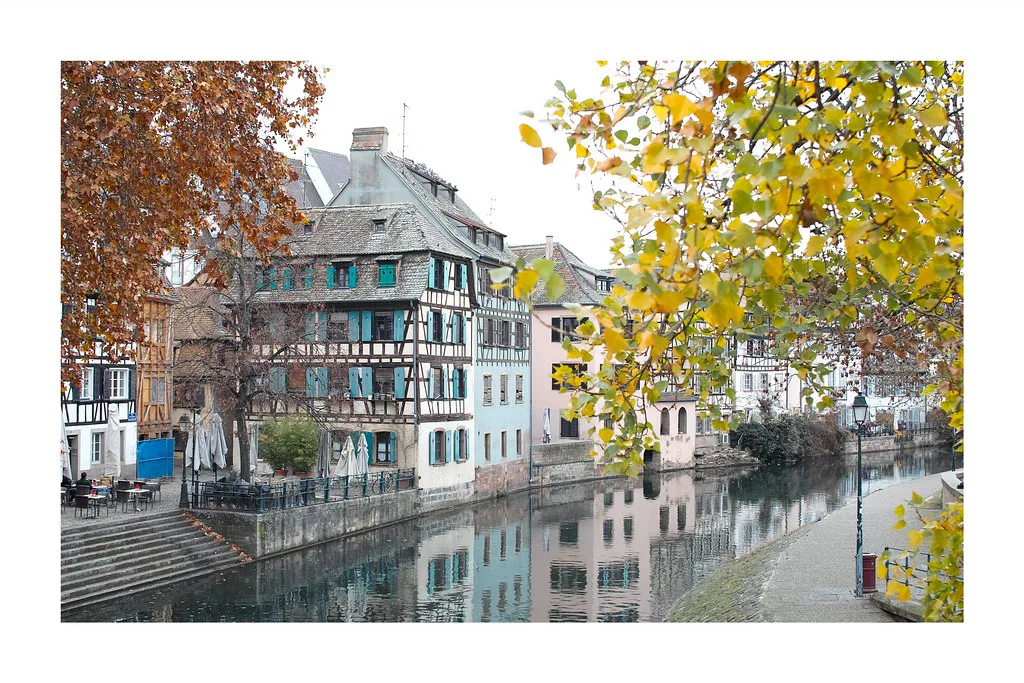
Petite France markets: Place Benjamin Zix and the Village de l'Avent on Square Louise-Weiss
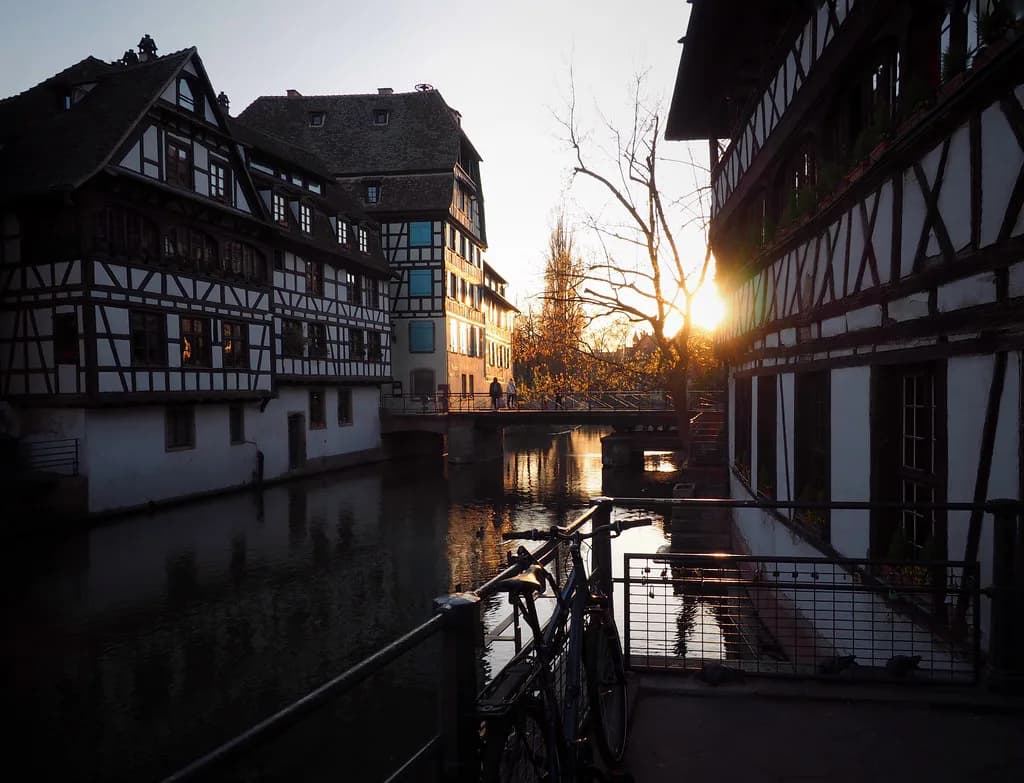
Start in Petite France, the quarter that gives the markets their prettiest setting. Place Benjamin Zix holds a small market beside the water, with hand-crafted goods alongside some mass-produced ornaments and only light food such as soup and pretzels. Nearby, the Village de l'Avent on Square Louise-Weiss gathers regional producers selling wines, jams and meats, reached through a small archway.
This is the part of the route to slow down in. The producers' market is the better stop for edible gifts, while Place Benjamin Zix suits anyone who wants a quieter square with a view of the water. Walk Rue des Moulins while you are here; it is the street most visitors photograph, and it is loveliest after dark.
Markets around the cathedral: Place de la Cathédrale and Place du Château
The two pitches flanking the Cathédrale Notre-Dame de Strasbourg are the busiest and the most spectacular. Place de la Cathédrale is the larger and more photographed, spread out enough to absorb crowds, but it fills sharply from mid-afternoon and the goods are largely mass-produced. Place du Château, on the far side, has the better food of the two.
If the cathedral tower is on your list, the queue here is the one to watch, and a market visit is a good moment to decide whether the climb is worth the wait. The tower aside, this pair of squares is the heart of the Christmas route, and reaching them at dusk gives you the best of the lighting without the worst of the crush.
Place Kléber and the great tree; Place Broglie and the Christkindelsmärik
Place Kléber holds the Grand Sapin, the great Christmas tree, and a market of handmade ornaments, jewellery and mass-produced items around it. The tree's light show runs hourly from 11:30am to 9pm and is noticeably better after dark. Place Broglie is home to the Christkindelsmärik, the oldest of the city's Christmas markets, with German-style food and some distinctive mulled wines among largely mass-produced wares.
Place Kléber works best as the end of a day, timed for one of the evening light shows. Place Broglie splits opinion: it is the historic market and worth seeing once, but the shopping is thin, so give it twenty minutes rather than an hour and put the saved time into the food stalls at Place du Château.
Place Saint-Thomas, Place du Temple Neuf and the Quai des Délices at the Palais Rohan
Place Saint-Thomas, in front of the church of the same name, is small, heavily decorated and strong on food. Walk down Rue des Orfèvres to reach Place du Temple Neuf, known as the Carré d'Or, a tiny circle of local produce such as jams and bredele. At the Palais Rohan, the Quai des Délices sets its stalls along the water with orange-lit stars and white mulled wine ladled from barrels.
The Quai des Délices is the most atmospheric of the lot and the one to save for the evening. Pair it with Place Saint-Thomas for dinner and Place du Temple Neuf for gifts, and you have a compact, high-quality loop that skips the crowds around the cathedral. If you want more indoor options for a cold day, the city's museums are a sensible complement to the market route, and the Palais Rohan itself is one of them.
Place Gutenberg and La Marche Off: the markets worth skipping if time is short
Two of the pitches are easy to cut. Place Gutenberg is a handful of stalls selling mulled wine and mass-produced ornaments, and it takes minutes rather than an hour. La Marche Off on Place Grimmeissen, focused on upcycled goods in container-built stalls, has a different, less festive feel. Both are worth skipping when a weekend is tight.
Being willing to skip two squares is what makes the rest manageable. Strasbourg's Christmas markets are spread out enough that trying to see every pitch means rushing the good ones. Choose the water at Petite France, the cathedral squares, Place Kléber after dark and the Quai des Délices, and treat the remainder as optional extras if you have a spare hour.
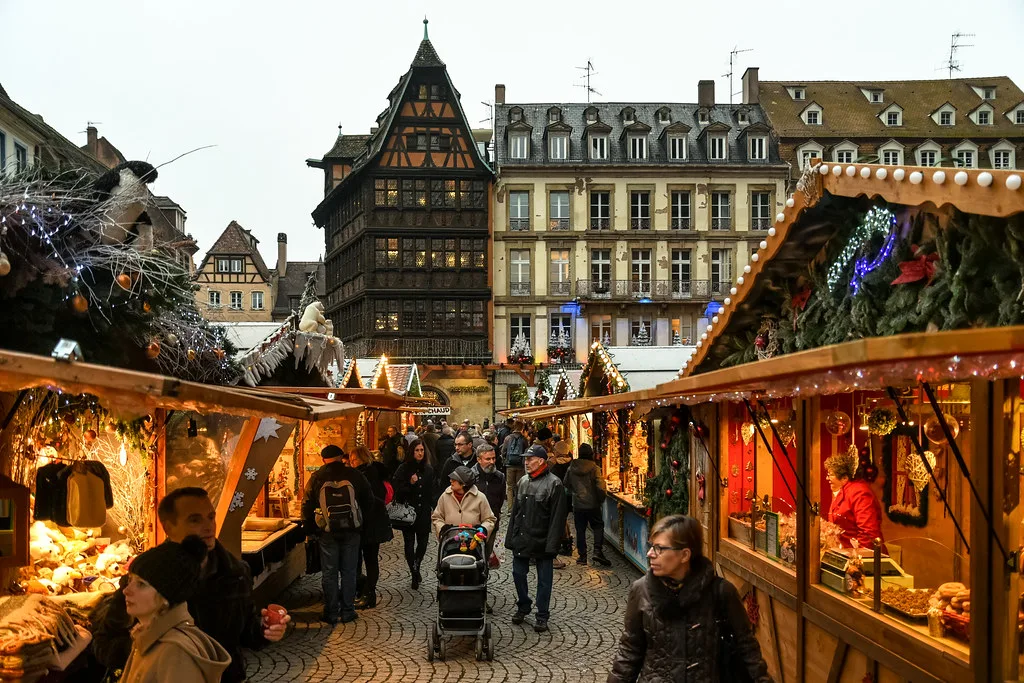
Food to try across the markets, from tarte flambée to bredele
Alsatian food is the real draw at the winter markets. Look for tarte flambée, a thin flatbread with cream, onion and bacon; choucroute garnie, sauerkraut cooked in white wine with pork and sausage; bretzels, often topped with cheese and ham; and bredele, the small butter biscuits sold in many flavours and shapes. Vin chaud is everywhere, and white mulled wine appears at the Quai des Délices.
Food quality varies sharply between pitches, so buy where the queue is local and the stall is busy rather than where the square is prettiest. Many places take cards, but carrying some euros is sensible. For a sit-down meal away from the stalls, the best restaurants in Strasbourg are worth booking ahead in December, when tables fill quickly.
How many days you need, and how to split a weekend between markets and sights
Two nights is enough for the markets plus the cathedral and one museum. Three gives you room for the flea market on a Friday or Saturday morning, a relaxed Christmas market evening and a proper look at Petite France. Base the trip on a clear itinerary, because the squares are close but the walking adds up over a full day.
A sensible split for a winter weekend is Friday evening in Petite France, Saturday morning at the flea market if your dates align, Saturday afternoon at the cathedral squares and Saturday evening at Place Kléber, with Sunday for the Quai des Délices and a museum. Do not schedule the flea market and the Christmas markets for the same morning, because that is the one combination the market calendar rules out.
Compare that with the rest of the year, when the city is quieter and cheaper and the old town is the main event. A short break in spring or autumn makes a different trip: calmer streets, easier restaurant bookings and a slower look at Strasbourg old town without the December crush.
A practical walking order from Petite France to Place Kléber
Begin in Petite France at Place Benjamin Zix and the producers' market on Square Louise-Weiss, then walk east to Place Saint-Thomas and on to Place du Temple Neuf via Rue des Orfèvres. Continue to the cathedral squares, Place de la Cathédrale and Place du Château, before turning north to Place Kléber for the tree and its light show. Finish at the Palais Rohan and the Quai des Délices if you have the energy.
The whole loop is walkable in an afternoon and evening, with short hops between squares rather than long treks. Start around 3pm in winter so you reach the cathedral at dusk and Place Kléber after dark. Wear warm, waterproof shoes, because the cobbles are uneven and the quayside at the Palais Rohan is exposed.
Common mistakes: arriving on the wrong weekday, misjudging crowds, overpaying for mass-produced goods
The most common error is turning up for the flea market on a Sunday, when it does not run, or on a public holiday, when it is closed. The second is underestimating the December crowds: the cathedral squares fill from mid-afternoon, and weekends are the worst. Arrive early, or visit those squares on a weekday, and leave the popular pitches for the quieter hours after the lunchtime peak.
The third mistake is spending on mass-produced goods at the cathedral and Place Broglie pitches when better-made things sit at Square Louise-Weiss and Place du Temple Neuf. Buy locally made items where the producers cluster, and treat the big squares as atmosphere rather than shopping. That single shift makes the souvenir budget go much further. If you want to weigh the same mass-produced-versus-local trade-off in a warmer setting, the Ajaccio Market Guide covers what its stalls sell.
Finally, do not overbuild the schedule. Strasbourg's markets are close together, and a route that looks ambitious on paper can be walked in a couple of hours. Leave gaps for a long lunch, a museum stop or a second pass at a square you liked. If you are still deciding whether the city justifies the trip, the case for Strasbourg on a short break is easy to make in winter and only slightly weaker in summer.
Plan Your Visit
Build your Strasbourg weekend around one market first and let the other fill the gaps. In December that means a Christmas market route from Petite France to Place Kléber, with the cathedral squares at dusk; any other month it means the Friday or Saturday flea market, starting early and finishing by lunch.
Whichever you choose, check the Christmas market dates for your year and the flea market's public holiday closures before booking travel, then let the rest of the weekend look after itself.
Explore more Strasbourg guides
Frequently Asked Questions
Is there a flea market in Strasbourg?
Yes. The Strasbourg flea market brings together up to forty professional antique dealers, second-hand merchants and vintage clothing sellers, and admission is free. It spreads across Place de l'Étal, Place de la Grande Boucherie and Place des Tripiers, with extra pitches at Place du Corbeau on Saturdays only.
What days is the Strasbourg flea market open?
Fridays and Saturdays, all year, from 7am to 6pm, with the exception of public holidays. A Friday visit covers three squares; a Saturday visit adds Place du Corbeau. If your weekend falls between Monday and Thursday, plan around the cathedral, Petite France and the museums instead.
Where are the Christmas markets in Strasbourg?
They are spread across named squares rather than gathered on one site. The main clusters are Petite France around Place Benjamin Zix and Square Louise-Weiss, the two pitches beside the cathedral at Place de la Cathédrale and Place du Château, Place Kléber with the great tree, Place Broglie, Place Saint-Thomas, Place du Temple Neuf and the quayside at the Palais Rohan.
What is the main Christmas market in Strasbourg?
There is no single main market with one entrance or ticket, which is why the city rewards a walking route instead. Place Broglie holds the Christkindelsmärik, the oldest of the markets, while Place Kléber draws the biggest crowds for the Grand Sapin and its hourly light show.
What food should you try at Strasbourg's markets?
Start with tarte flambée, a thin flatbread with cream, onion and bacon, then choucroute garnie, sauerkraut cooked in white wine with pork and sausage. Bretzels topped with cheese and ham are everywhere, bredele biscuits make the best edible gift, and vin chaud or white mulled wine is the standard drink in the cold.
Is Strasbourg worth a weekend?
Two nights covers the Christmas markets, the cathedral and one museum comfortably, and three nights leave room for the flea market and a slower look at Petite France. Outside December the city is calmer and the year-round flea market gives a Friday or Saturday morning a clear purpose.
Sources
Notes for French city breaks
Optional updates to our guides.
You might also like
Continue reading
More guides you'll find useful