
Dijon Cathedral: What to See at Cathédrale Saint-Bénigne
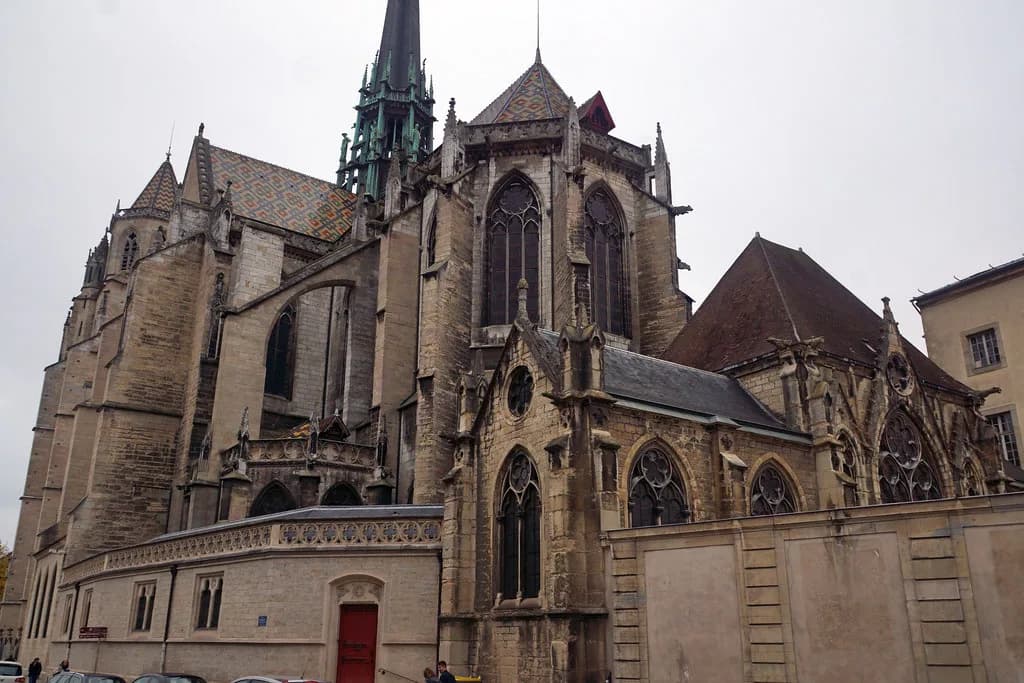
Dijon Cathedral is worth about an hour. The building gives you two clearly separate things to look at: a Burgundian Gothic church put up between 1280 and 1325 and dedicated in 1393, and beneath the choir a Romanesque crypt that survives from an earlier abbey complex. Plan it as a short, focused stop rather than the centrepiece of a day.
The name catches people out. It is the Cathédrale Saint-Bénigne, and it only became a cathedral in 1792, when it replaced the secularised church of Saint-Étienne; until then it was the abbey church of a Benedictine monastery. Knowing that explains the building's shape: an abbey church with a monastic footprint, not a purpose-built cathedral.
What Dijon Cathedral Is and Why It Earns an Hour
Two buildings in one is the simplest way to describe it. The Gothic church above ground is the part you see from the street, with a declared construction span of 1281 to 1325, while the crypt under the choir is the remnant of an early eleventh-century structure associated with Abbot William of Volpiano's rebuilding. That combination is unusual enough to justify the detour even on a tight weekend.
The trade-off is honest. This is not a cathedral on the scale of the great Gothic monuments of northern France, and the exterior has been altered over the centuries and sits slightly west of the historic core rather than on the main square. If you want one unmissable element, make it the crypt. The nave is handsome but brief.
Where It Sits in Dijon and How to Reach It
The cathedral stands west of the old centre, on the site of the former Benedictine monastery of Saint-Bénigne, which places it a few minutes on foot from the central shopping streets and the Palace of the Dukes of Burgundy. Coming from the Palais des Ducs and the Place de la Libération area, walk west through the pedestrian streets rather than looking for a tram; the approach is short and level enough for a weekend stroll. If you are building a broader itinerary around the city, the wider set of Dijon Attractions: 6 Visitor Guides is the place to line up the rest of the day.
From the station side, the natural route runs along the rue de la Liberté through the shopping heart of Dijon and past the Place Darcy area, then cuts west toward the cathedral. Allow the walk to take in one or two stops rather than treating it as pure transit; you will pass close to the Halles de Dijon and the market quarter if you swing through the centre.
The Building's Two Lives
For most of its existence this was not a cathedral at all. It served the Benedictine monastery of Saint-Bénigne, and the Gothic church was raised between 1280 and 1325 and dedicated in 1393. The change came in 1792, when it took over from the church of Saint-Étienne as the seat of the Bishop of Dijon.
That history still shapes what you walk into. Abbey churches were built for a community with its own liturgical needs, which is one reason the building reads as slightly inward-looking rather than as a civic statement. The nearby remnants of the monastic complex, including a chapter house and dormitory, reinforce the point that you are standing in a former religious precinct.
The West Front, Twin Towers and Rose Window
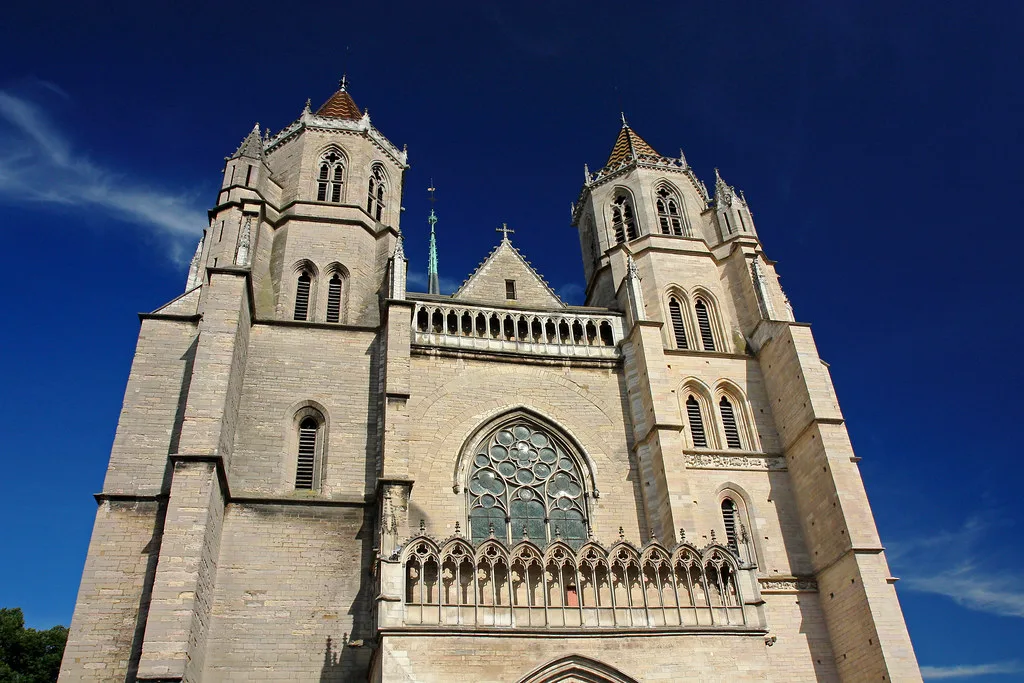
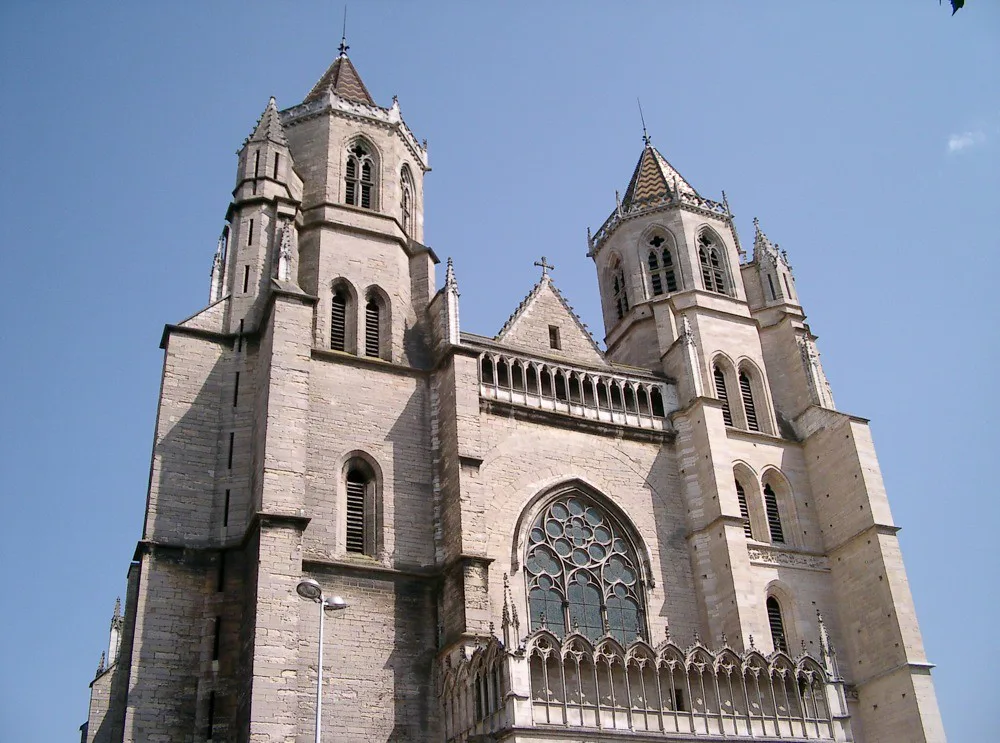
Pause outside before going in. The twin towers with their pointed roofs dominate the approach, and the central spire rises above them. Look for the carved portal sculpture and the large rose window flanked by lancet windows; the glazing is what floods the nave with light once you are inside, and seeing the outside first makes the interior make sense.
The facade is a composite rather than a single design, so do not hunt for perfect symmetry. Read it as a record of rebuilding and change. Ten minutes here plus a short circuit around the outside covers it comfortably.
Inside the Nave: Burgundian Gothic Vaulting
The interior is where the Burgundian Gothic label earns its keep. Ribbed vaults run over a broad nave, supported by flying buttresses that let in the big windows, and the effect once inside is airier than the heavy exterior suggests. Walk the length of the nave before turning to the choir.
Give the nave and aisles fifteen to twenty minutes, then head for the crypt. If you are travelling with someone who has limited stamina or patience for churches, the nave can be skimmed in five minutes and no one will feel short-changed.
The Romanesque Crypt and the Rotunda Remains
This is the part to prioritise. Under the choir survives an early eleventh-century Romanesque crypt, the last substantial remnant of a much larger complex that once included a three-storey rotunda, most of which was demolished. The crypt is traditionally associated with the tomb of Saint Benignus, the martyr venerated as the Apostle of Burgundy, and the sarcophagus there is now empty.
Because the crypt is underground and often the first thing closed when access is restricted, check before you go whether it is open on your dates through the cathedral's own pages or the Dijon tourist office rather than assuming. Budget ten to fifteen minutes down there: the columns and arches are the payoff for the whole visit.
Nearby: Saint-Philibert, the Musée des Beaux-Arts and the Ducal Palace
Two other sights make an obvious pairing. The Église Saint-Philibert, another Romanesque survivor, sits close by, and the Musée des Beaux-Arts de Dijon occupies the former palace of the Dukes of Burgundy, so you can move from Romanesque church to ducal palace in a single short loop without transport.
The Musée des Beaux-Arts is the one to give real time to if you have it, so decide in advance whether you are doing cathedral plus museum or cathedral plus a walk. The Palace of the Dukes of Burgundy, Dijon is worth a look from the courtyard whether or not you go into the galleries, and the Tour Philippe le Bon, Dijon, its viewing tower, sits on the same complex. If you enjoy comparing cathedral interiors on your travels, the guide to Antibes Cathedral offers the same kind of visit in a smaller old-town setting.
If you prefer to stay outdoors, the Place de la Libération, Dijon forms the semicircular square in front of the palace and is the natural spot to pause between the two. Farther east, the Halles de Dijon give you a covered market stop when it is trading, which makes a sensible morning pairing with the cathedral before lunch.
Practical Points: Services and the Feast of Saint Benignus
The cathedral is an active place of worship, not only a monument, and it hosts religious services alongside cultural activity through the year. The fixed date worth knowing is the feast of Saint Benignus on 1 November, the patron saint's day, which is observed with processions and prayers rather than as a ticketed event. If you are in Dijon on that date, expect the building to be in liturgical use.
Visiting hours, whether the crypt is accessible and whether any entry charge applies are not published in the material available here, so confirm them directly with the cathedral or the Dijon tourist office before you set out. That one check prevents a wasted walk across town.
Is It Worth It If You Are Short on Time?
Honest answer: yes, but briefly. If you have a single day in Dijon, the cathedral is a twenty-to-thirty-minute stop if the crypt is open and a ten-minute facade visit if it is not. It is not the reason to come to the city, but it is a genuine, distinctive building that sits naturally on the walk between the station side and the ducal palace.
If you are weighing up how to spend a short break, the wider things to do in Dijon list will help you slot the cathedral into a sensible route, and the Parcours de la Chouette gives you a marked trail through the old town to hang it on. Skip the cathedral entirely if your priority is museums and markets; see the museum separately and give it the time instead.
Plan Your Visit
Treat Dijon Cathedral as a one-hour stop built around the crypt. Come from the old town on foot, look up at the twin towers and rose window before you go in, then head straight for the Romanesque chamber under the choir. Pair it with Saint-Philibert and a courtyard look at the ducal palace and you have a compact, satisfying half-day.
Confirm opening and crypt access with the cathedral or the Dijon tourist office before you travel, and check the day of the week for the museums you want to combine with it. That done, the visit needs no booking and no elaborate planning.
Explore more Dijon guides
Frequently Asked Questions
Is Dijon Cathedral worth visiting?
Yes, as a short stop rather than a headline sight. The draw is the combination of a Burgundian Gothic church of the early fourteenth century and a Romanesque crypt beneath it, the surviving remnant of an eleventh-century rotunda complex. Allow about an hour, and make the crypt your priority.
How long does it take to visit Dijon Cathedral?
Roughly an hour covers the exterior, nave and crypt at an unhurried pace. If the crypt is closed, twenty to thirty minutes is enough for the church itself. It slots easily into a half-day that also takes in Saint-Philibert and the palace of the Dukes of Burgundy.
When was Dijon Cathedral built?
The Gothic church was built between 1280 and 1325 and dedicated in 1393, replacing an earlier Romanesque church on the same site. The crypt underneath dates from the early eleventh century. The building only became a cathedral in 1792, when it took over from the church of Saint-Étienne.
Can you visit the crypt at Dijon Cathedral?
The Romanesque crypt survives under the choir and is the single most rewarding element of a visit. Access can be restricted, so check directly with the cathedral or the Dijon tourist office on the day you plan to go.
What is the feast of Saint Benignus?
It falls on 1 November, the fixed date honouring Dijon's patron saint, and is marked with processions and prayers. Treat it as a liturgical observance rather than a ticketed visitor event, and expect the cathedral to be in religious use on that date.
What is near Dijon Cathedral?
The Église Saint-Philibert, another Romanesque building, is close by, and the Musée des Beaux-Arts de Dijon occupies the former palace of the Dukes of Burgundy a short walk east. The semicircular Place de la Libération in front of the palace makes a natural pause between them.