
Basilique Saint-Urbain in Troyes: What to See and How Long to Allow

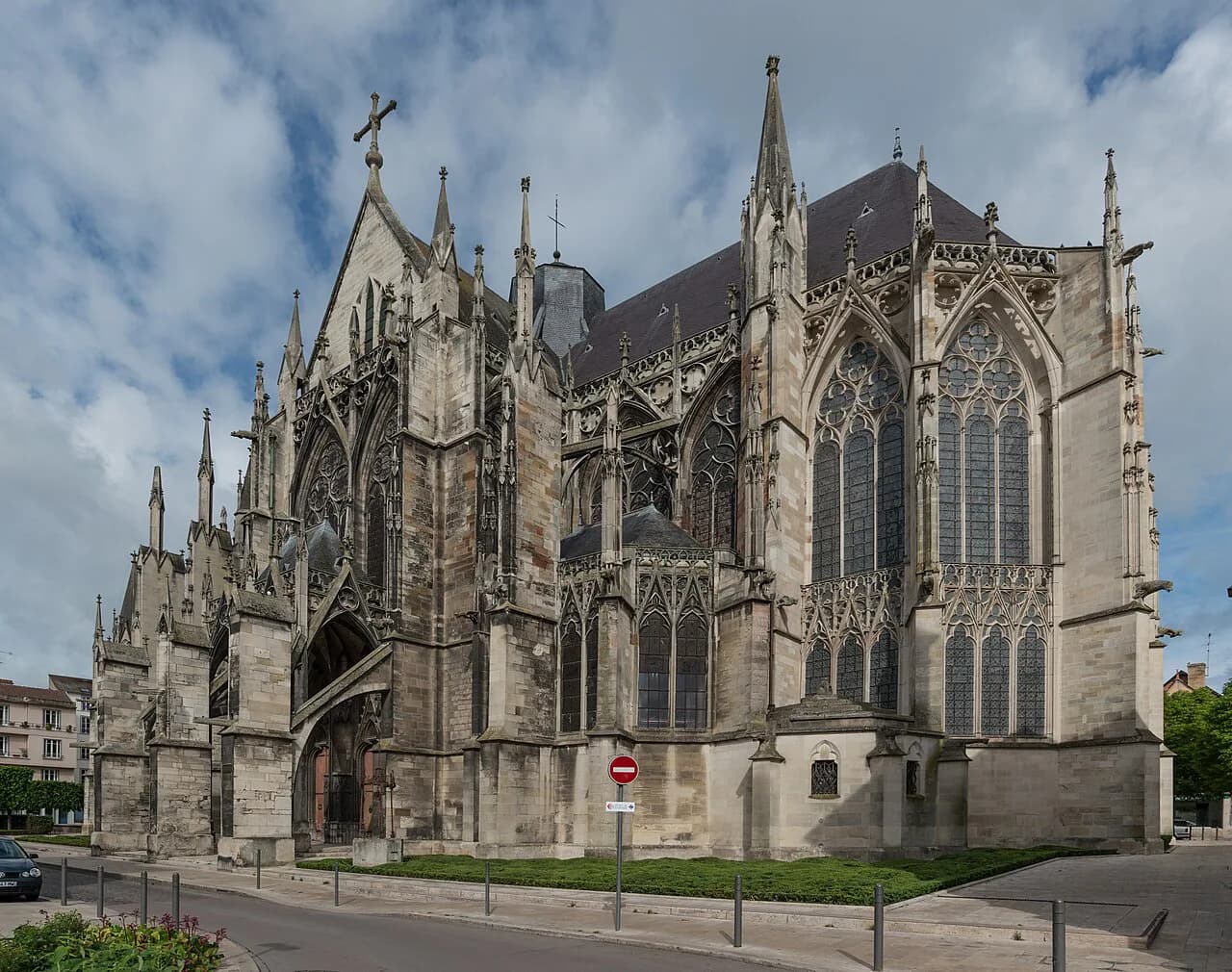
The Basilique Saint-Urbain is a late 13th-century Gothic church on Place Vernier in central Troyes, and it earns its place on a short weekend because almost everything worth seeing is packed into a small footprint. The windows in the transept and choir survive from around 1270, the west portal carries a carved Last Judgement, and a single sculpture, the Vierge aux Raisins, justifies the detour on its own. Set aside 30 to 45 minutes, and go while the light is good.
What the Basilique Saint-Urbain is and why it draws visitors
This is a collegiate church founded by a pope who never came home to see it finished, and the result is unusually coherent Gothic architecture rather than a patchwork of rebuildings. It is often called the Parthenon of Champagne for the elegance of its proportions and the lace-like stonework of its upper levels. For a weekend visitor, that means a building you can read in one sweep: portal, nave, transept, choir, all in a space small enough to hold in your head.
The interior is bright and restrained, and the effect depends heavily on daylight coming through the glass. Come on a grey afternoon and the windows read as dark panels; come on a bright morning and the transept glows. If your Troyes weekend has one sunny slot, spend it here.
Where it is: Place Vernier in central Troyes
The address is Place Vernier, 10000 Troyes, a small square in the old town rather than a grand set-piece plaza. You will not see it from a long way off, which is part of the pleasure: the church appears as you turn a corner in the lanes of the historic centre. Navigate by the street name and the square, not by a spire.
Troyes is compact, and the centre is best handled on foot. The tourist office sits at 34 quai Dampierre, a useful fixed point if you want a paper map before heading into the medieval streets. Troyes Attractions: 6 Visitor Guides is the place to plan the rest of the circuit around this stop.
How to get there on foot from the old town
Walking is the practical answer: from the cathedral quarter or the main shopping streets of the centre, Saint-Urbain is a short stroll through the pedestrian lanes, so build it into a loop rather than treating it as a separate trip. Wear shoes you can walk in, because the old centre's cobbles and narrow pavements are unforgiving.
If you are combining churches, do the Cathédrale Saint-Pierre-et-Saint-Paul and Saint-Urbain in the same walk, since the contrast between the vast cathedral and this intimate collegiate church is the point. The lanes of the old town, including the famous Ruelle des Chats, sit naturally between them and make the walk itself part of the visit. If the contrast whets your appetite for another Gothic city break, our guide to things to do in Reims covers a cathedral and Champagne cellars in the same compact centre.
The history in brief: Urban IV and the long build
The founder was Jacques Pantaléon, born in Troyes and elected pope as Urban IV in 1261. He endowed the church from 1262 on the site of his father's workshop, sent money and handed construction to the architect Jean Langlois, and it was consecrated in 1389 while still unfinished. The top of the nave was only completed in the late 19th century, following the original plan.
The building was not finished without trouble: the nuns of the nearby abbey, unhappy at a church rising on their land, disrupted the worksite. Urban IV died in 1264 before seeing his church, and his remains were transferred here in 1935, long before it was given the title of basilica in 1964. That backstory explains why the church feels grander in ambition than in size.
What to see outside: the west portal and its Last Judgement
Start with the west front, where a broad portal spans the whole western end of the building. The portal itself was finished in 1905, but the tympanum above the doors is 13th-century work and shows a Last Judgement, so look up before you go in rather than walking straight past. The mismatch between Victorian-era stonework and medieval carving is a useful reminder of how much of this church was completed in stages.
Walk around the exterior if you have time, because the upper nave and the tall windows are best appreciated from a few metres back on the square. Photography of the whole facade is easier from across Place Vernier than from the doorway.
What to see inside: the transept and choir windows
The reason to come is the glass. The transept and choir kept their original windows, dated to around 1270, and they were restored in 1992 by the Troyes workshop Le Vitrail, so what you see is medieval design with a careful modern hand behind it. The church is celebrated for these immense glazed panels as much as for its stone.
Give your eyes time to adjust after coming in from the street, then work from the crossing towards the choir rather than starting at the nearest window. The upper windows are the ones most people miss because they never look above head height.
The Vierge aux Raisins and the Troyes school of sculpture
In the chapel of the south side aisle stands the Vierge aux Raisins, a Virgin with grapes whose refinement and stillness are characteristic of the 16th-century Troyes school of sculpture. It is small, easily passed, and the finest single object in the church. Ask for it by name if you cannot find the chapel.
The wider statuary rewards a slow circuit of the side chapels rather than a beeline for the altar. Troyes has a strong tradition of churches filled with this kind of carving, and the Église Sainte-Madeleine, Troyes is the natural next stop if the sculpture is what holds your attention.
How long to allow and when to slot it into a Troyes weekend
Budget 30 to 45 minutes: long enough to read the portal, find the Vierge aux Raisins and sit with the windows, short enough to fit between two other sights. If you are short on time, cut the exterior circuit and go straight to the transept glass.
Position Saint-Urbain in the middle of a walking morning rather than at the end of the day, when light and energy are both fading. It slots neatly between the cathedral and the old-town lanes, and it works as a calm pause between the busier sights on a things to do in Troyes list.
Opening hours and access: the seasonal pattern
The published visiting pattern runs in two seasons. In the summer period, from 1 April to 31 October, the church receives visitors from 09:30 to 12:30 and 14:00 to 18:00 Monday to Saturday, and from 14:00 to 18:00 on Sunday. In the winter period, from 1 November to 31 March, the weekday and Saturday hours are 09:30 to 12:30 and 14:00 to 17:00, with Sunday afternoons from 14:00 to 17:00.
The long midday closure matters for planning: an 11:00 start gives you a comfortable window, while a 12:45 arrival leaves you waiting outside. Note that the published Sunday opening is afternoon only, so a Sunday morning visit will not work. Check the current times with Troyes La Champagne Tourisme before you travel, since these are the reference periods rather than a live schedule.
Is there an entry charge?
The church is an active place of worship and the published visitor information covers reception hours rather than ticketing. If you want to know whether a charge or a donation applies on the day you visit, ask at the tourist office on quai Dampierre or check the parish noticeboard at the entrance.
Nearby: other Troyes sights within walking distance
The cathedral is the obvious pairing: bigger, busier and quite different in mood, and close enough to visit in the same morning. Beyond that, the half-timbered lanes around the Ruelle des Chats, Troyes are a five-minute wander away and give you the city's other signature sight at no cost.
If the weather turns, the Musée d'Art Moderne de Troyes and the Maison de l'Outil et de la Pensée Ouvrière both make good indoor alternatives in the same central area. The tool museum in particular appeals to anyone who liked the craftsmanship on show at Saint-Urbain.
Practical tips for a short visit
Come in daylight, dress for a working church rather than a museum, and keep your voice down if a service is under way. Check what is happening inside before you start photographing, and skip flash entirely.
Read the portal before you enter so the interior makes sense, then go straight to the crossing for the glass and finish at the Vierge aux Raisins in the south aisle chapel. Leaving the best object until last means you will still see it even if you are hurried.
Plan Your Visit
Saint-Urbain is the best value stop in central Troyes for anyone interested in Gothic architecture or medieval glass, and it costs you less than an hour. Build it into a walking loop with the cathedral and the old-town lanes, arrive in the morning during the published opening window, and check the seasonal hours before a Sunday visit.
Frequently Asked Questions
Is the Basilique Saint-Urbain free to visit?
The published visitor information sets out reception hours rather than ticketing, so there is no confirmed entry charge listed. Ask at the tourist office on quai Dampierre in Troyes or check the noticeboard at the entrance on the day you go.
How long does it take to visit Saint-Urbain in Troyes?
Allow 30 to 45 minutes. That covers the west portal and its Last Judgement tympanum, the transept and choir windows of around 1270, and the Vierge aux Raisins in the south aisle chapel, with time to sit for a few minutes.
What are the opening hours of the Basilique Saint-Urbain?
From 1 April to 31 October it opens 09:30 to 12:30 and 14:00 to 18:00 Monday to Saturday, and 14:00 to 18:00 on Sunday. From 1 November to 31 March the weekday and Saturday hours are 09:30 to 12:30 and 14:00 to 17:00, with Sunday afternoons 14:00 to 17:00. Check current details with Troyes La Champagne Tourisme before travelling.
Why is Saint-Urbain called the Parthenon of Champagne?
The nickname refers to the elegance of its Gothic proportions and the fine, lace-like stonework of its upper levels, which stand out even in a city full of old churches.
What stained glass can you see in Saint-Urbain?
The transept and choir retain their original windows, dated to around 1270 and restored in 1992 by the Troyes workshop Le Vitrail. They are the main reason to visit and are best seen in daylight.
Is Saint-Urbain close to Troyes cathedral?
Yes. Both sit in the historic centre and are easily combined in one walking loop, along with the half-timbered lanes around the Ruelle des Chats. Allow a morning for all three.