Antibes Flea Market Guide: When to Go and What to Find
Antibes' second-hand stalls set up at Place Audiberti, Place De Gaulle and Boulevard d'Aguillon. Here's when they run and what's sold.
On this page
Antibes' second-hand market is the closest thing the town has to a flea market, and it works to a simple weekly rhythm: stalls at Place Audiberti on Thursdays and Saturdays, and at Place De Gaulle and Boulevard d'Aguillon on Saturdays. It is a browsing market rather than a ticketed event, so you build a morning around it rather than book a slot. If your short break includes a Thursday or a Saturday, this is worth an hour or two.
The market is separate from the town's famous food market, and the two sit comfortably in one half-day: the produce stalls at Place Nationale and Cours Massena wind down at 13:00, which gives you a natural deadline for the second-hand browsing. Plan the brocante first while tables are fullest, then eat and wander the old town.
What a brocante is, and what Antibes calls its flea market
In France a brocante is a second-hand and vintage market, and the Antibes event is described exactly that way: a brocante selling vintage and second-hand clothes, shoes, bags and assorted bric-a-brac. You will also hear vide-grenier for a household clear-out sale, though the Antibes market is presented as a brocante rather than a vide-grenier. The practical difference for a visitor is small: tables of used goods, mixed quality, priced to move.
Because the stalls are second-hand rather than artisanal, come for the hunt rather than for a curated craft fair. Stock rotates with the sellers, so no list of what will be there on a given day is published in advance. Treat any visit as a lucky dip and you will enjoy it more.
Where the Antibes second-hand market sets up
There are three addresses, and they do not all operate on the same days. Place Audiberti hosts stalls on Thursdays and Saturdays; Place De Gaulle and Boulevard d'Aguillon host them on Saturdays. All three sit within the town centre, close enough to combine on foot if you are there on a Saturday.
Place Audiberti is the square to aim for if your visit falls on a Thursday, since it is the only one of the three running that day. On a Saturday you can work through all three in one loop, starting at whichever is nearest your route into town. For orientation across the wider town, the things to do in Antibes guide maps out the main sights around these squares.
A Saturday is the better bet if you want the fullest picture, simply because two of the three locations operate that day. A Thursday gives you one location but a quieter browse. Plan around the days rather than an opening hour, since the listing gives the market's days and places rather than a start time.
Which days it runs
The schedule is short and fixed: Thursdays and Saturdays at Place Audiberti, Saturdays at Place De Gaulle and Boulevard d'Aguillon. Nothing in the published listing ties the market to a season, so a winter Thursday and a summer Thursday work the same way as far as the stated days go.
If your weekend is Saturday and Sunday, the market fits Saturday only, which makes it a natural first-morning activity before the rest of the break takes over. A Friday-to-Sunday trip gets you the Saturday set-up; a Thursday arrival adds the Place Audiberti day.
What's actually on the stalls
Expect vintage and second-hand clothing, shoes and bags alongside the sort of random objects that make a brocante worth walking through: antique wine glasses and plates, postcards and small souvenirs of the Côte d'Azur. The mix skews towards decorative and wearable rather than furniture or serious antiques. Bargains are the draw, and the quality across tables will vary accordingly.
Come with a rough idea of what you would actually carry home, because glassware and ceramics are heavy and awkward in a weekend bag. Postcards and textiles travel better. If you collect a particular thing, say old Provençal pottery or mid-century glass, ask sellers directly rather than waiting to spot it on a table.
How the brocante differs from the Marché Provençal
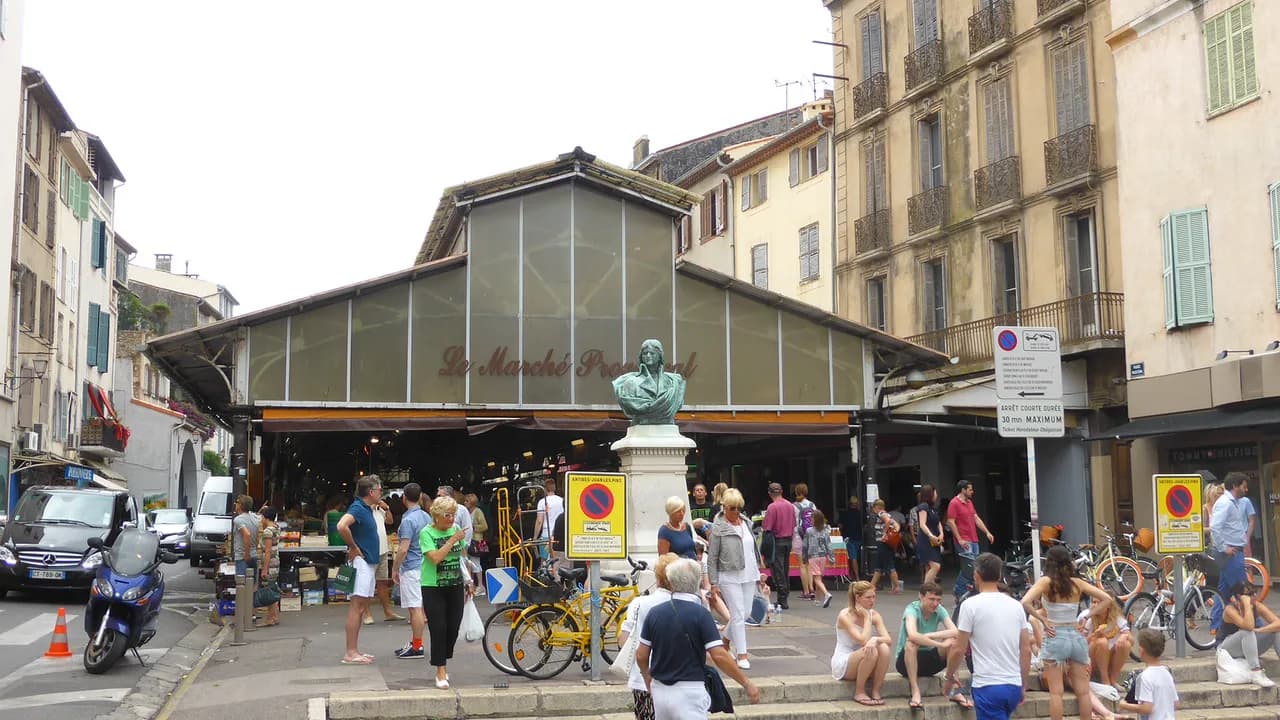
The Marché Provençal is Antibes' headline market, held at Place Nationale and Cours Massena, and it sells local produce: fruit, flowers, vegetables, meats, cheeses, spices, herbs, fish and sausages, plus Provençal olive oils and olives. It is a food market, not a flea market, and it runs daily on a morning schedule.
The trade-off is cost and purpose. The Provençal market is widely described as pricey, which is fair for top-quality local produce but makes it a poor place to hunt for a cheap souvenir. The brocante is where the bargain hunting happens, while the food market is where you buy lunch or a picnic and take in the colours.
Doing both in one morning works because they are different kinds of browsing, not competing versions of the same thing. For the full spread of weekly markets across town, including food and craft days, our guide to markets in Antibes fills in the rest of the week.
Timing a visit around the Marché Provençal's hours
The produce market opens daily from 06:00 to 13:00, staying open until 13:45 in July and August, and it closes on Monday from 1 September to 31 May. Those morning hours set the shape of your day: food shopping and samples are done before lunch. If you want the brocante and the food market together, start early and finish at the produce stalls.
Outside July and August, a Monday visit means the Provençal market is shut for the day, so shift your food shopping to another morning and keep the brocante for a Thursday or Saturday. In high summer the Monday closure does not apply and the market runs through the week. Check current dates before you set out, as hours and closures can vary by season.
If you are choosing when to come to the Riviera at all, our guide to the best time to visit Antibes weighs up the seasons and what each one does to a short break.
A half-day plan: brocante, old town, market lunch
Start at the second-hand stalls early in the morning, before the best pieces have gone. On a Saturday, work from Place De Gaulle or Boulevard d'Aguillon towards Place Audiberti; on a Thursday, head straight for Place Audiberti. An hour or so is enough for most people, more if you like digging.
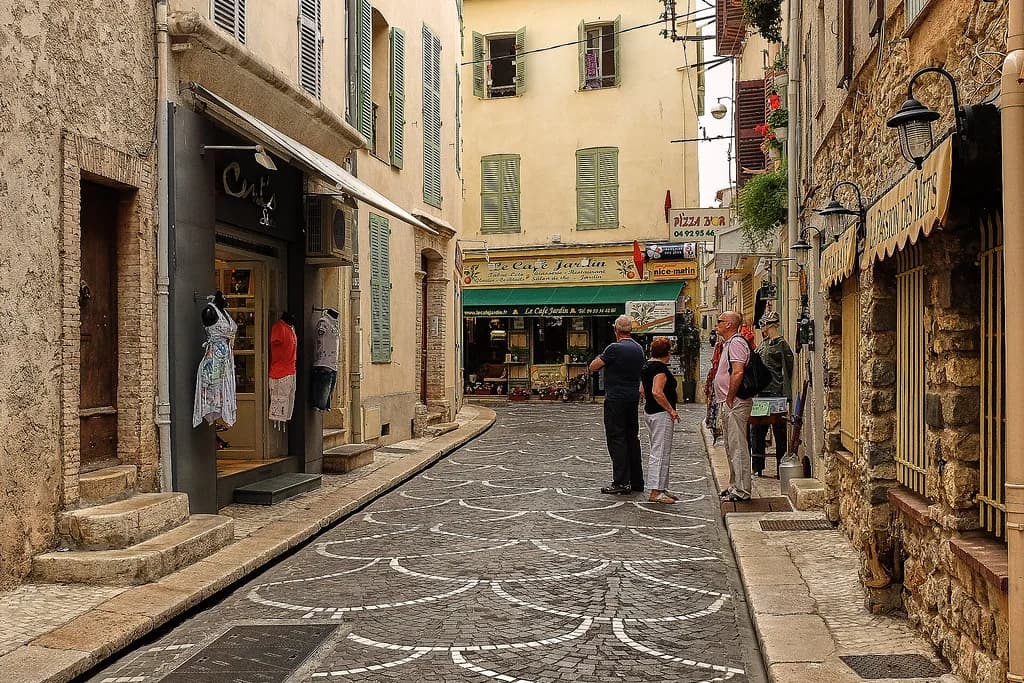
From the stalls, walk into the old town for the Marché Provençal at Place Nationale and Cours Massena, buying bread, cheese, olives or fruit for a picnic before the produce stalls close at 13:00, or 13:45 in July and August. Then spend the afternoon on the lanes and squares of the Vieil Antibes, which is where the town's texture really is.
For lunch beyond a picnic, our pick of the best restaurants in Antibes covers where to sit down in and around the old town. Book nothing tightly for the morning: the beauty of a brocante is that you leave when you have had enough.
Slotting the market into a one-day Antibes visit
If you have a single day, give the market the morning and keep the afternoon for the town's fixed sights. The Château Grimaldi, home to the Picasso museum, is the obvious anchor, and the museums in Antibes guide sets out what else is worth your time and when it opens.
For a broader plan that strings the market, the old port and the town's main sights into a workable day, follow the Antibes itinerary rather than improvising. It keeps you from over-scheduling a morning that is better left loose.
If you are still weighing up whether the town deserves a slot on your trip at all, our honest answer to is Antibes worth visiting sets out what you get and who it suits.
Practical browsing notes
Bring cash. A brocante is a string of individual sellers, and small notes are the practical currency for a few euros' worth of postcards or a pair of shoes. Arriving early gets you first pick and a calmer browse; arriving later gets you a thinner selection and sellers with time to talk.
Expect a mixture of quality and price your purchases accordingly, checking seams, chips and signatures rather than taking a stallholder's word for age or origin. Carry a tote for anything breakable, and keep a card or a note of the seller's spot in case you want to come back the same day on a Saturday.
If vintage clothing is the main draw, our shopping in Antibes guide covers the town's shops and boutiques as a complement to the market stalls. Beyond Antibes, our Marseille flea market guide shows how a bigger city market compares.
Plan Your Visit
Antibes' second-hand market is a small, unfussy affair spread over three addresses, and its value is in the browsing rather than the scale. Aim for a Thursday at Place Audiberti or a Saturday across all three sites, pair it with the daily Provençal market before 13:00, and you have a genuinely good morning without spending much.
It suits travellers who like rummaging and can be flexible about the day they are in town; it rewards little if you want a guaranteed find or a big organised flea market. For the broader picture of what else fills a short break, start with the things to do in Antibes overview.
Frequently Asked Questions
What day is the second-hand market in Antibes?
It runs on Thursdays and Saturdays at Place Audiberti, and on Saturdays at Place De Gaulle and Boulevard d'Aguillon. A Thursday visit gives you one location; a Saturday gives you all three.
Where is the flea market in Antibes?
There is no single site. Stalls set up at Place Audiberti, Place De Gaulle and Boulevard d'Aguillon, all within the town centre and walkable from one another on a Saturday.
What is sold at the Antibes second-hand market?
Vintage and second-hand clothes, shoes and bags, plus glassware, plates, postcards and assorted small souvenirs of the Côte d'Azur. Quality varies from table to table, so check items before buying.
Is the Antibes flea market different from the Marché Provençal?
Yes. The Marché Provençal at Place Nationale and Cours Massena is a daily morning food market selling produce, cheese, fish and flowers. The second-hand market sells used goods and runs only on Thursdays and Saturdays.
What are flea markets called in France?
Brocante is the usual term for a second-hand and vintage market, which is how the Antibes event is described. Vide-grenier refers to a household clear-out sale, a slightly different format.
How long does it take to see the Antibes market?
An hour or so covers most of the stalls, longer if you like digging. Pair it with the Provençal food market before 13:00 and you have a full morning.
Can I visit the market and the old town in one morning?
Yes. The stalls sit near the old town, and the lanes of the Vieil Antibes are a short walk away. Do the market first, buy picnic food before the produce stalls close, then wander.
Sources
Notes for French city breaks
Optional updates to our guides.
You might also like
Continue reading
More guides you'll find useful