Montpellier Parks: Which Gardens and Green Spaces to Visit
Montpellier's parks range from a 1593 botanical garden to the elevated Promenade du Peyrou. Here is what each green space offers and how to fit them in.
On this page
Montpellier's green spaces suit a short break because they come in two tight clusters rather than scattered across the suburbs. The Jardin des Plantes and the Promenade du Peyrou sit within a few minutes of each other on the western side of the centre, while the Esplanade Charles-de-Gaulle links the main square to the old town. That means you can fold two or three green stops into a single morning without losing the rest of your things to do in Montpellier.
This guide groups the green spaces by walking cluster, flags the market days that change a park visit from a five-minute look into a proper morning, and is honest about which ones justify an hour. If you are still deciding whether the city earns a weekend at all, start with is Montpellier worth visiting before you plan the parks.
Why Montpellier's Green Spaces Fit a Short Break
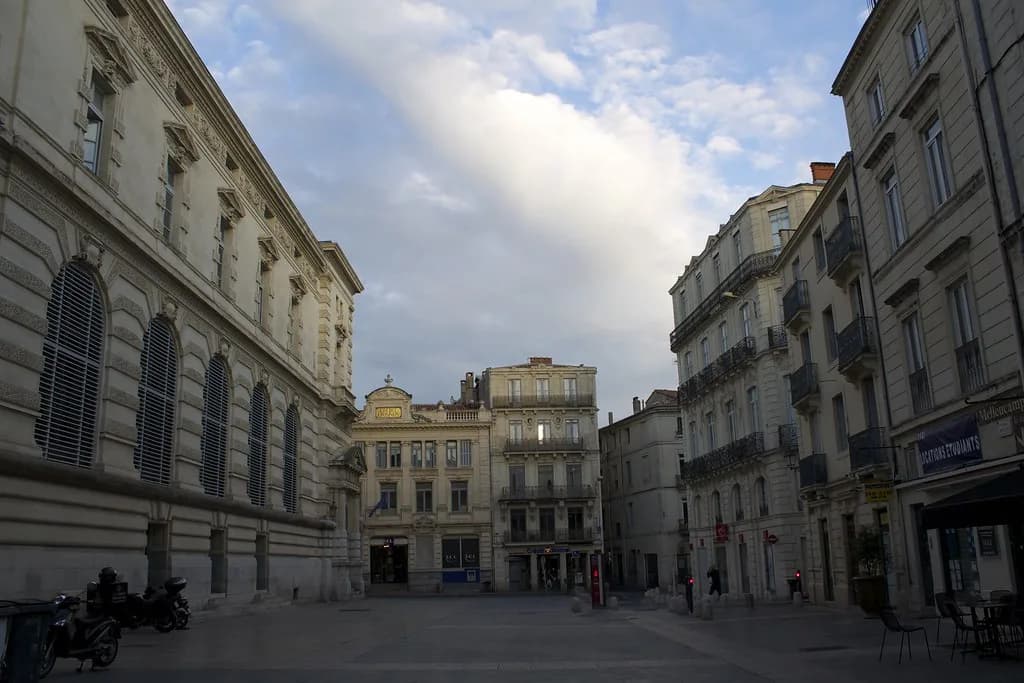
Central Montpellier is compact and largely pedestrianised, so the parks work as pauses between sights rather than as separate outings. The Écusson's narrow lanes open onto small squares, and the largest green spaces sit just beyond its western edge. Plan your day around the old town and let the parks break up the walking.
The green spaces split into three useful groups: the botanical garden and Peyrou on the west, the Esplanade near the centre, and the small squares inside the Écusson such as Place de la Canourgue. A fourth, the Jardin des Cinq Continents, sits near Montpellier Saint-Roch station and works best as a first or last stop. Two days covers the first three comfortably; add the fourth if you arrive with time before your train.
The city publishes a round-up of its parks and gardens, describing around thirty green spaces including the Jardin des Plantes, which carries a Remarkable Garden label. Treat that count as context rather than a to-do list: for a weekend, the named spaces below are the ones worth planning around.
Jardin des Plantes: A 1593 Botanical Garden
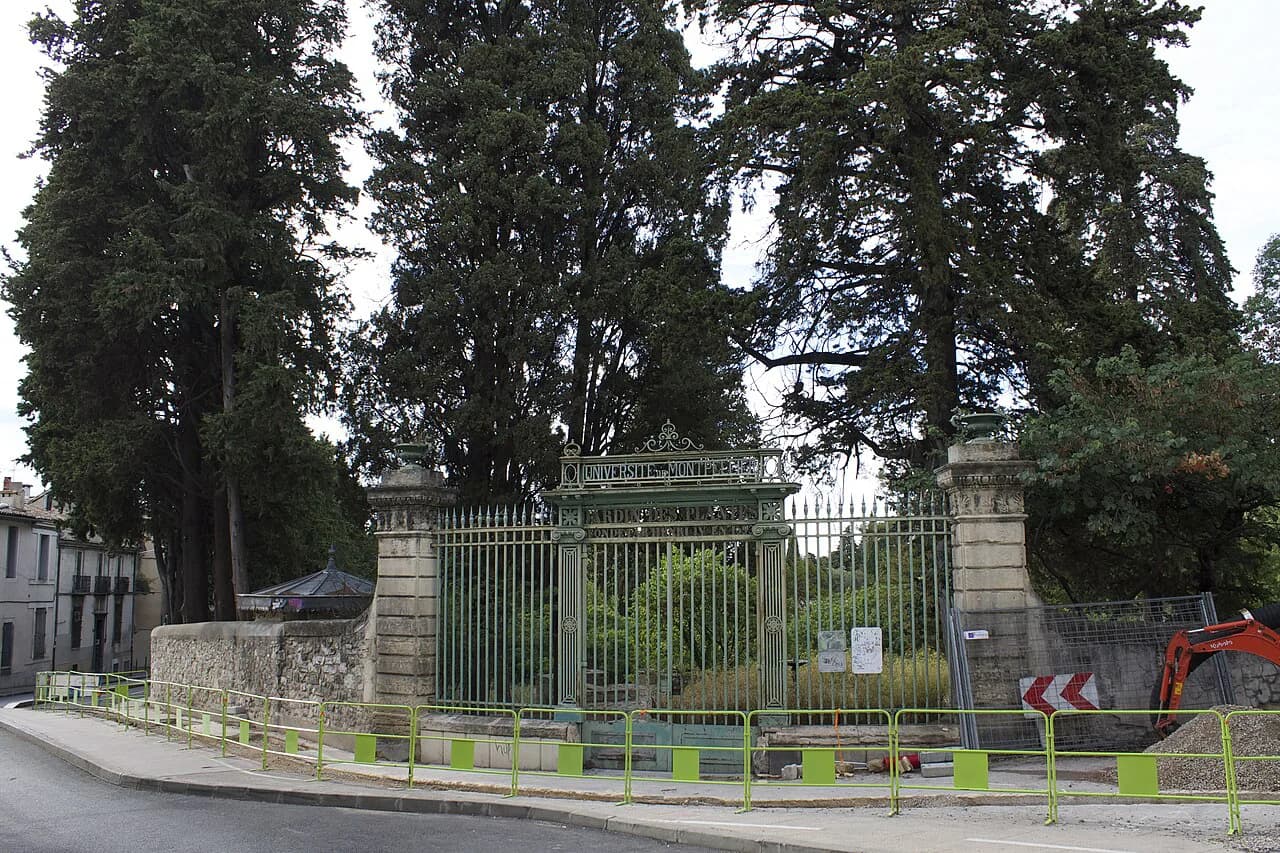
The Jardin des Plantes is the standout green space in Montpellier and one of the oldest botanical gardens in France, laid out in 1593 under Henri IV for studying medicinal plants. It spreads over nearly five hectares beside the Faculty of Medicine and holds more than 2,600 plant species, from medicinal herbs to exotic blooms. The combination of scientific history and shade makes it the one park here that justifies a slow hour.
Its position directly beside the Faculty of Medicine, one of the oldest medical schools in the Western world, means you can pair the garden with a look at the historic medical quarter on the same walk. Allow 45 minutes to an hour if you want the full circuit, less if you are only cutting through. The garden's entrance sits on Boulevard Henri IV.
The garden is a public space with no admission to arrange, which makes it the easiest green stop to slot in when plans shift. Opening times vary by season, so confirm the current gate hours with the university before you build a morning around it.
Promenade du Peyrou: The Elevated Royal Square
The Promenade du Peyrou is Montpellier's grandest open space: a raised royal square at one of the highest points in the city, with an equestrian statue of Louis XIV, an ornate 18th-century water tower known as the Château d'Eau, and the Saint-Clément Aqueduct running alongside. At its eastern entrance stands the city's Arc de Triomphe, built in 1692 in honour of Louis XIV. The elevation is what sells it, with views across the rooftops and, on a clear day, toward the surrounding countryside.
Treat Peyrou as a 20-minute stroll or a longer sit, depending on the light and the crowds. It is a peaceful place for a picnic or a break between the old town and the botanical garden, and the walk down from the square into the Écusson takes only a few minutes. Late afternoon light makes the aqueduct and the Château d'Eau the most photogenic, though the square is at its quietest early.
The square connects naturally to the old town below, so build it into a loop rather than a standalone trip. If you want to plan that half-day properly, the Montpellier old town guide covers the lanes and squares that sit at the bottom of the slope.
Les Arceaux and the Saint-Clément Aqueduct
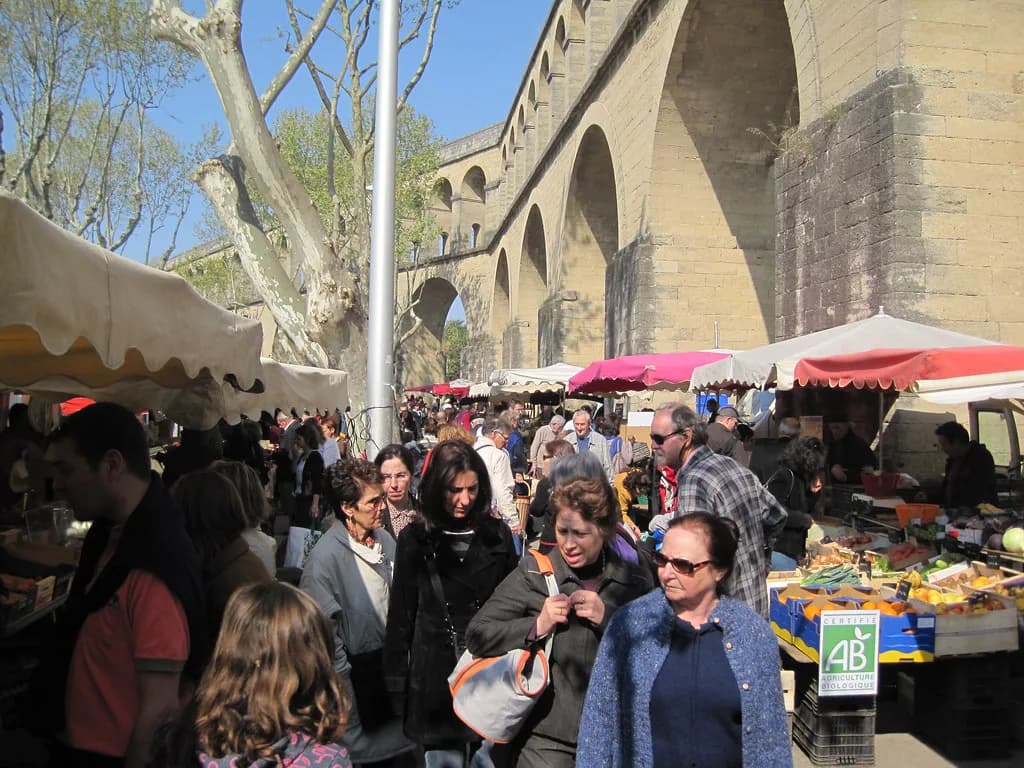
Les Arceaux is the neighbourhood just west of Peyrou where the Saint-Clément Aqueduct arches over the streets, and it hosts the Marché des Arceaux on Tuesday and Saturday mornings. The market fills the space under and around the arches with produce, bread, cheese and prepared food. Arriving on a market morning turns a quick look at the aqueduct into the best couple of hours in this part of the city.
The same market is documented as running on Tuesday and Saturday mornings from around 7:00 to 13:30, which makes a Saturday morning the strongest single slot for combining the aqueduct, the market and Peyrou in one walk. Vendors do not all take cards, so carry some cash.
Les Arceaux is also a genuine neighbourhood rather than a monument, with a small cluster of places to eat and drink that makes it a sensible base for a slow lunch after the market. For wider eating options across the city, the best restaurants in Montpellier guide is the place to look before you commit.
Sunday Flea Market on Peyrou
Les Dimanches du Peyrou is a Sunday flea market held on the Promenade du Peyrou itself, with antiques, collectibles and bric-a-brac laid out against the backdrop of the Louis XIV statue and the water tower. The market is documented as running from roughly 7:30 to 14:30, which means a Sunday morning in Montpellier has an obvious plan built in. Carry cash, because not every stallholder takes cards.
A Sunday visit also suits the wider rhythm of the city: many shops close on Sundays, so the flea market and the parks fill the day when retail is quiet. If your weekend includes a Sunday, build the morning around Peyrou and the Écusson rather than around shops.
Esplanade Charles-de-Gaulle: The Central Promenade
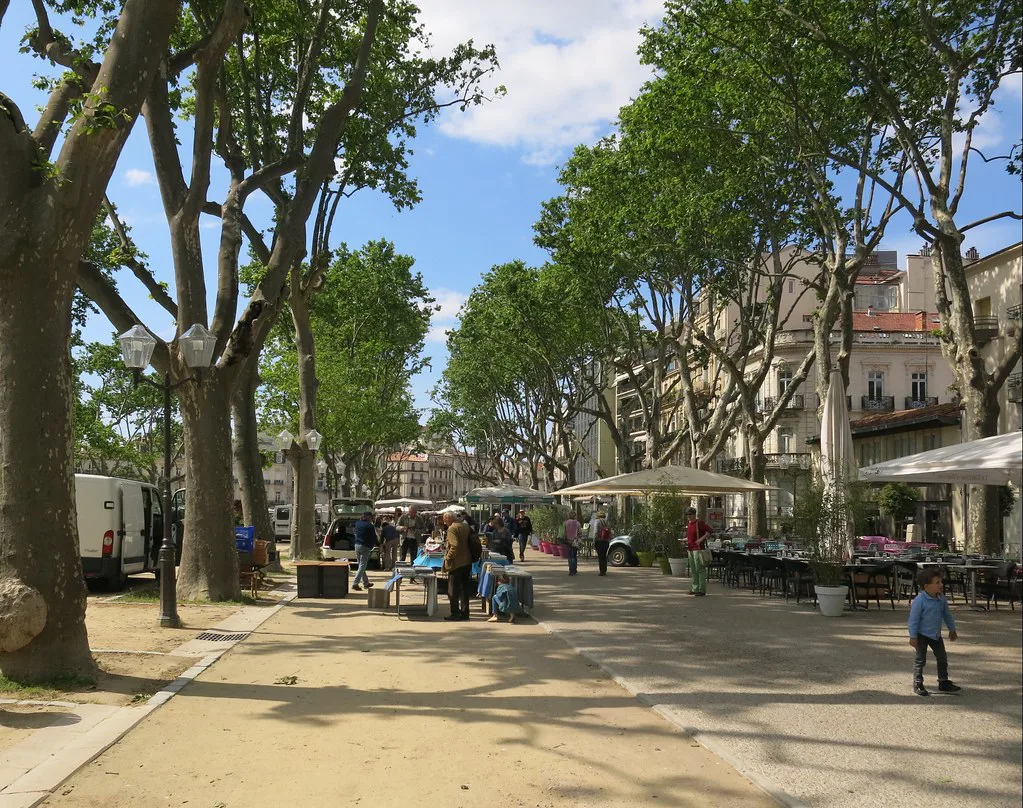
The Esplanade Charles-de-Gaulle is the tree-lined promenade running from Place de la Comédie toward the old town, with restaurants on one side and a park on the other. It is less a destination than a route, but it is the green space you will cross most often, and it is the easiest place to sit down within a minute of the main square. Use it to break up the walk between the station, Place de la Comédie and the Écusson.
Because it sits on the main axis, it belongs at the start or end of a day rather than as a planned stop. The nearby Pavillon Populaire, a photography venue on the esplanade, gives the promenade a cultural anchor if you want a reason to linger.
Place de la Canourgue: The Small Leafy Square
Place de la Canourgue is a small, elegant square in the oldest part of the Écusson, surrounded by 17th-century aristocratic mansions and leafy trees. It has the atmosphere of a garden more than a square, with cafés and restaurants on its edges and a view toward Pic Saint-Loup. It is a five-minute stop if you are passing, or a decent half-hour if you take a table.
This is the kind of green space that earns its place by being on the way to something else rather than by justifying a detour. Fold it into a wander through the old town's lanes, and treat the mansions and the view as the reason to sit down rather than the trees alone.
Jardin des Cinq Continents at MO.CO. Hôtel des Collections
The Jardin des Cinq Continents sits at MO.CO. Hôtel des Collections near Montpellier Saint-Roch station, combining contemporary design with plants representing different parts of the world. Entry to the garden is free, which makes it a low-risk stop if you arrive with an hour to spare before checking in or catching a train. It is a modern, designed space rather than a historic park, so set expectations accordingly.
Its position near the station makes it the practical choice on arrival or departure day, when a trip back into the Écusson would cost you more time than it is worth. Pair it with the nearby river walk along the Lez if you want to stretch your legs after a train.
A Short Loop: Peyrou to Jardin des Plantes to the Écusson
The most efficient green half-day runs from the Arc de Triomphe up to the Promenade du Peyrou, west to the Saint-Clément Aqueduct and Les Arceaux, then back east to the Jardin des Plantes and down into the Écusson. The whole circuit is walkable in a morning at a relaxed pace, with the botanical garden as the longest single stop. Add the Marché des Arceaux if you are there on a Tuesday or Saturday.
Walking is the right way to do this: central Montpellier is compact and much of the Écusson is pedestrian-friendly, with the main sights close enough together to link on foot. Trams are useful for reaching the station or Port Marianne, but they add little to a route this tight.
If you are building a fuller day around the loop, the Musée Fabre sits on the eastern edge of the Écusson and pairs well with a morning in the gardens. Check its opening days before you commit, since French museums commonly close one day a week.
Timing Your Visit: Market Mornings and Museum Days
The parks themselves are open public spaces, but the surrounding sights run to a schedule, and that schedule should drive your plan. The Marché des Arceaux runs on Tuesday and Saturday mornings, and Les Dimanches du Peyrou takes over the Promenade on Sundays, so those are the mornings to be on the western side of the city. Any other day, the same loop is quieter but less alive.
Elsewhere in the week, expect some friction: many shops close on Sundays, some restaurants shut between lunch and dinner, and museums often close one day a week. Build the parks into the days when indoor sights are shut, and you will lose less time to closed doors. Confirm the specific hours for any museum or restaurant you are counting on before you set out.
If your dates are flexible, the best time to visit Montpellier page covers how the seasons change the city's rhythm, which matters more for park time than for museum queues.
What to Skip on a Two-Day Trip
On two days, skip anything that requires a tram ride unless it doubles as something else you wanted to see. The Jardin des Cinq Continents is the one to drop if you are short on time and not passing the station anyway, and the small squares inside the Écusson come free with any old-town walk. Peyrou, Les Arceaux and the Jardin des Plantes are the three green spaces worth planning around.
The city's official parks and gardens round-up no longer lists the Parc Zoologique de Montpellier among the central green spaces on offer, so it should not be the anchor of a weekend plan. Plan around the central gardens instead of travelling out for the zoo.
If you are combining green space with browsing, note that shopping in Montpellier is concentrated around Place de la Comédie and the Polygone centre, both a short walk from the Esplanade. That makes a wet-weather plan easy to assemble without leaving the centre.
When the Parks Are Enough on Their Own
For a very short trip, or a repeat visit, the parks can carry a morning without any ticketed sight attached. A market breakfast at Les Arceaux, a walk along the aqueduct and a slow circuit of the Jardin des Plantes is a complete half-day, and the Peyrou flea market does the same job on a Sunday. Build the rest of the day around a long lunch rather than a museum.
The limit is weather and season: outside the warmer months, the gardens are more for walking than for sitting, and the elevated Peyrou catches the wind. That is not a reason to skip them, but it is a reason to keep a museum or a food hall as a fallback.
For readers comparing cities, park quality is one of the quieter reasons to pick Montpellier over a coastal alternative, and the is montpellier worth visiting verdict covers the wider trade-offs.
Plan Your Visit
Treat Montpellier's green spaces as a western cluster and a central strip: Peyrou, Les Arceaux and the Jardin des Plantes on one side, the Esplanade and the Écusson squares on the other. Aim for a Tuesday, Saturday or Sunday morning if you want a market to anchor the walk. If you are weighing a second stop in France, the same cluster-and-strip logic applies to the Nancy parks, where Parc de la Pépinière anchors the green spaces.
Use the Montpellier itinerary planner to slot the loop into a two-day plan, and browse montpellier attractions if you want to see how the parks sit alongside the museums, squares and markets in the city.
Explore more Montpellier guides
Frequently Asked Questions
Is the Jardin des Plantes free to visit?
It is a public botanical garden beside the Faculty of Medicine, with no admission to arrange for the garden itself. Opening hours vary by season, so check the current gate times with the university before you build a morning around it.
What is the Promenade du Peyrou known for?
It is a raised royal square at one of the highest points in the city, with an equestrian statue of Louis XIV, an 18th-century water tower and the Saint-Clément Aqueduct. The Arc de Triomphe stands at its eastern entrance, and the square gives wide views over the rooftops.
Which Montpellier market is held under the aqueduct?
The Marché des Arceaux runs in the Les Arceaux neighbourhood around the Saint-Clément Aqueduct on Tuesday and Saturday mornings. It is documented as operating from around 7:00 to 13:30, and not every vendor takes cards, so bring cash.
Where is the Sunday flea market in Montpellier?
Les Dimanches du Peyrou takes place on the Promenade du Peyrou itself, with antiques and collectibles set out beside the Louis XIV statue and the water tower. It is documented as running from roughly 7:30 to 14:30.
How long do you need at the Jardin des Plantes?
Allow 45 minutes to an hour for a full circuit of the roughly five-hectare garden, which holds more than 2,600 plant species. If you are only cutting through on the way to the Faculty of Medicine, 20 minutes is enough.
Can you visit Montpellier's parks and the old town in one day?
Yes. The Arc de Triomphe, Peyrou, Les Arceaux and the Jardin des Plantes sit within a short walk of each other on the western side of the centre, and the Écusson lanes lead back down from Peyrou. A relaxed morning covers the loop with the garden as the longest stop.
Are the parks worth visiting if it rains?
The green spaces are outdoor stops, so a wet day is better spent in a museum, a food hall or the covered Halles. Keep the Jardin des Plantes and Peyrou for a dry morning and use the Esplanade only as a route on wet days.
Sources
Notes for French city breaks
Optional updates to our guides.
You might also like


Continue reading
More guides you'll find useful